

I keep coming back to the same thought whenever AI and blockchain appear in the same conversation: we re getting better at building intelligent systems much faster than we re getting better at trusting them. That gap feels more important than the technology itself. An AI model can analyze data, react to changing conditions, and even make decisions in seconds, but the moment it starts interacting with real assets, trust becomes an infrastructure problem rather than an intelligence problem.
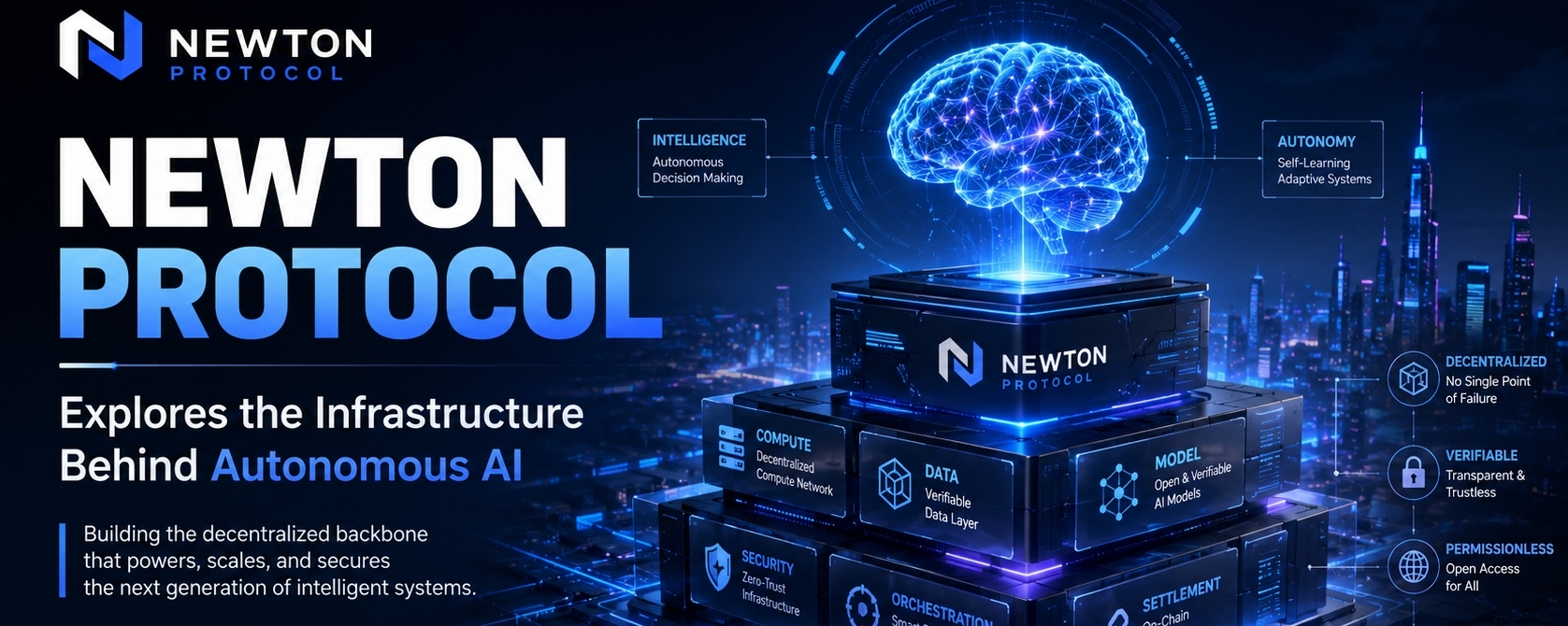
That s partly why Newton Protocol caught my attention. It doesn't frame AI as the entire story. Instead it focuses on the environment where AI systems might eventually operate. The protocol is designed as a secure rollup for AI driven strategies automated trading, and a marketplace where developers can create and distribute AI powered applications. It feels less like an attempt to predict the future of artificial intelligence and more like an attempt to prepare blockchain infrastructure for a future that may already be taking shape.
It's an interesting shift in perspective. For years blockchain infrastructure has mainly been built around human users. People sign transaction approve smart contracts and decide when to move assets. AI changes that rhythm. An autonomous system doesn't need coffee breaks or sleep. It can monitor markets continuously respond to new information instantly and execute strategies without waiting for someone to press a button. That sounds efficient but it also introduces a level of complexity that traditional blockchain applications haven't really had to deal with.
The idea of a dedicated rollup makes more sense when viewed through that lens. Rollups already help blockchains process activity more efficiently by handling transactions separately before settling them on a larger network. Newton Protocol adapts that concept for workloads generated by AI agents rather than ordinary users. The assumption is that autonomous systems may interact with decentralized applications differently creating patterns of activity that deserve infrastructure designed specifically for them instead of simply fitting into existing models.
What I find more interesting though isn't the architecture itself. It's the reasoning behind it.
People often describe AI as if making decisions is the difficult part. In reality, modern models are becoming increasingly capable of generating decisions on their own. The harder question is whether those decisions can be understood verified or challenged when necessary. A blockchain transaction tells us what happened. It doesn't always explain why it happened. That distinction becomes important when software begins acting with greater independence.
Imagine hiring a financial adviser who refuses to explain their reasoning. Even if their performance is good most people would eventually become uncomfortable. AI systems can create a similar feeling. They may produce impressive results for long periods before encountering situations that fall outside their training. When that happens, transparency matters just as much as speed or efficiency.
Newton Protocol appears to recognize this challenge by emphasizing secure execution rather than simply promoting automation. That doesn t mean every AI decision suddenly becomes easy to interpret. It does suggest that the surrounding environment should provide stronger guarantees about how those decisions are carried out once they reach the blockchain. It's a subtle difference but one that feels increasingly relevant as autonomous software becomes more common.
The marketplace for AI developers is another aspect that raises interesting questions. In theory it creates a place where developers can publish AI driven tools while users discover strategies that match their needs. The concept is appealing because it encourages experimentation without requiring every developer to build an ecosystem from scratch.
Still marketplaces have always depended on trust more than availability.
Having hundreds of AI strategies isn t automatically useful if users struggle to distinguish thoughtful engineering from unrealistic promises. The crypto ecosystem has experienced this before. Open participation encourages innovation, but it also creates an environment where reputation becomes difficult to measure. A strategy that performs well during calm markets may struggle during periods of uncertainty and historical success doesn t always translate into future resilience.
There's another tension that I don t think receives enough attention. Blockchain technology values permanence. Every transaction contributes to a history that cannot easily be changed. AI models, on the other hand are constantly evolving. Developers retrain them update datasets and refine their behavior over time. One technology is designed around stable records while the other improves through continuous adaptation. Building infrastructure that accommodates both philosophies without compromising either one is a more complicated challenge than it first appears.
Perhaps that s why projects like Newton Protocol feel significant even before their long term impact is clear. They aren t just asking how AI can be connected to blockchain. They re asking what kind of blockchain infrastructure makes sense once autonomous systems become regular participants rather than occasional experiments. Those are different questions and I think the second one is likely to matter more over time.
I don t know whether AI driven financial systems will become as common as many people expect. Technology has a habit of surprising both optimists and skeptics. But if autonomous software does become a routine part of decentralized networks, then the quality of the infrastructure surrounding it may end up determining how much confidence people are willing to place in those systems.
Newton Protocol doesn t eliminate the uncertainty surrounding that future, and it probably can t. What it does is shift the conversation away from the excitement of AI itself and toward the quieter question of how intelligent systems should behave once they re trusted with real responsibility. In a space that often celebrates the newest application I find myself wondering whether the foundations might end up being the more interesting story.
