
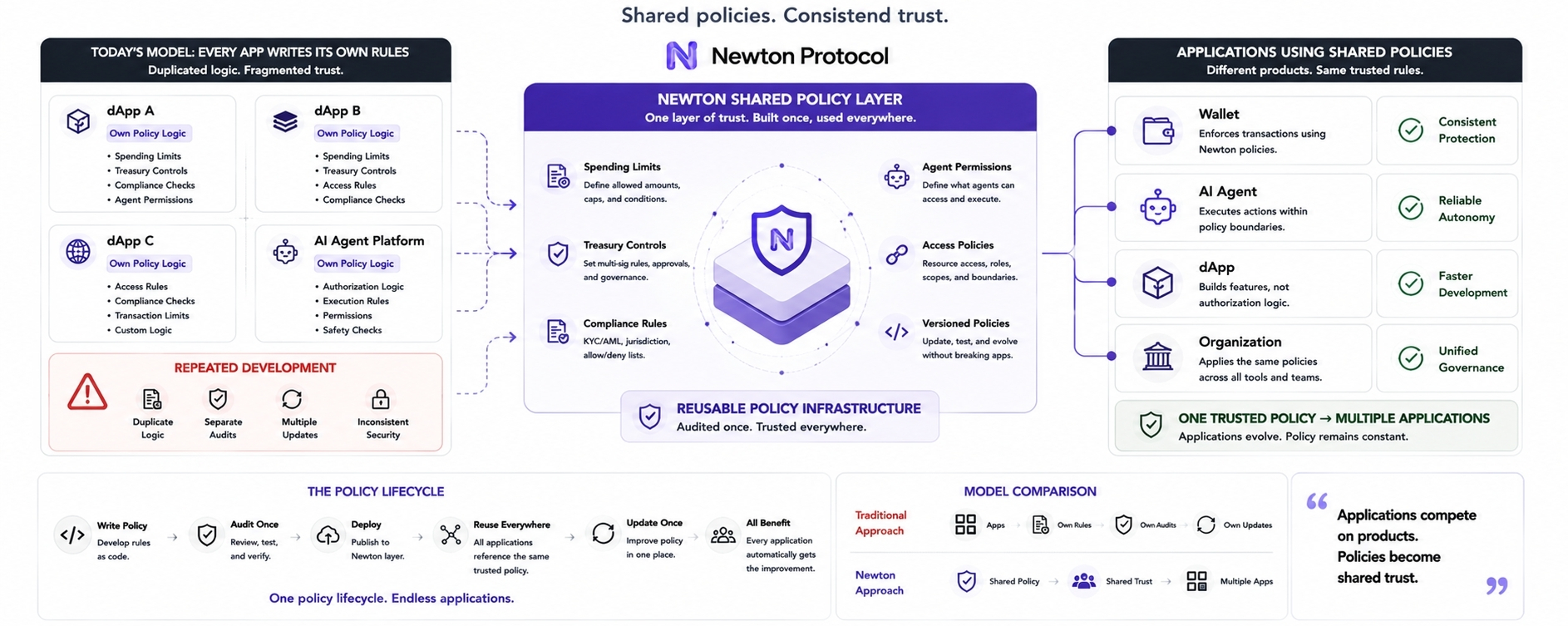

i spent some time digging through @NewtonProtocol 's documentation expecting each application to ship its own authorization logic.
One design choice kept standing out instead..
policies are designed to be reusable.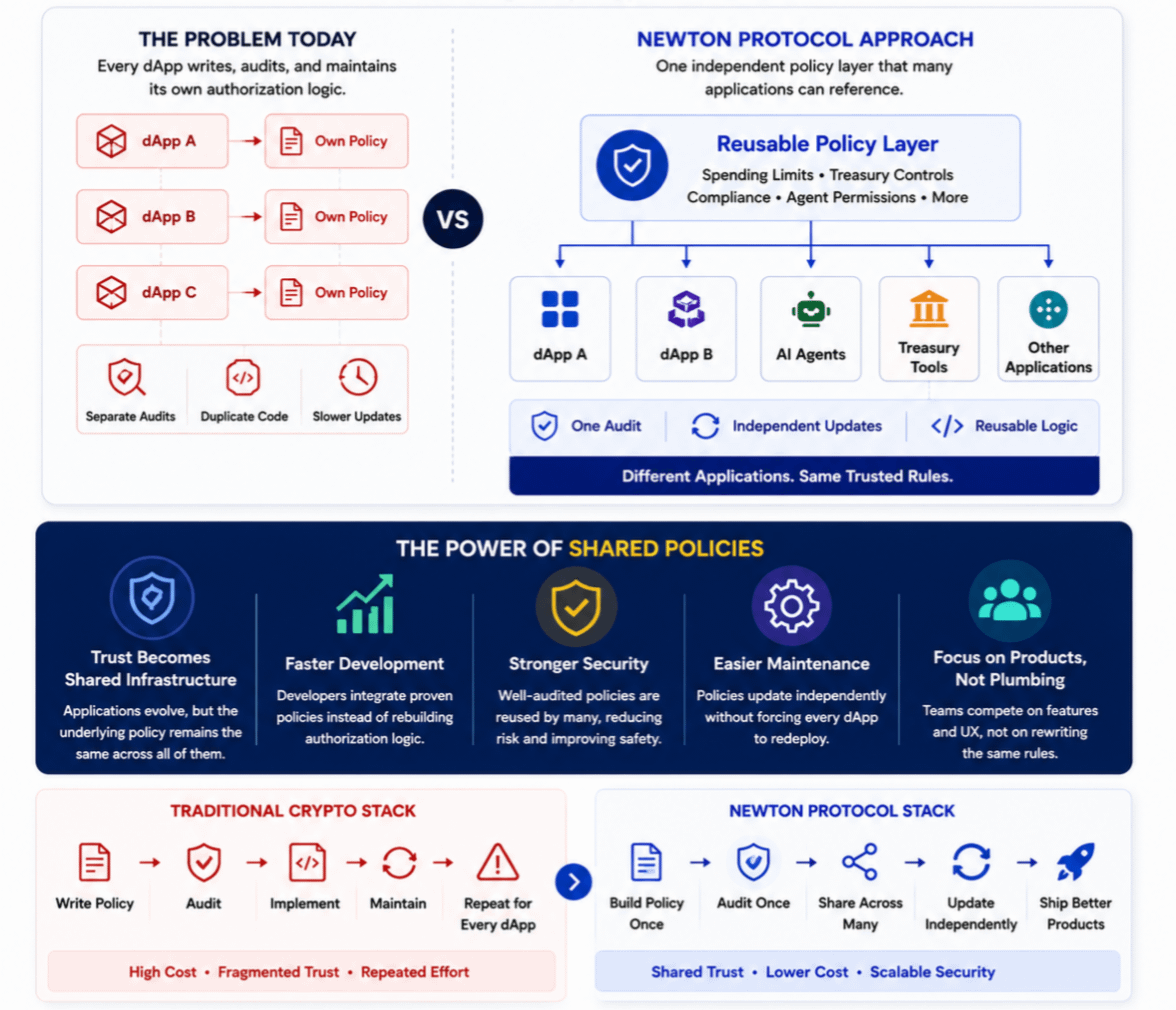
rather than treating spending limits, treasury controls, compliance checks, or agent permissions as code that every dApp rewrites, Newton introduces a policy layer that multiple applications can reference.
The protocol's goal isn't simply to make policies programmable..
it's to keep them independent from the applications they're protecting.
that changed how I looked at the architecture.
In today's crypto stack, two protocols with nearly identical security requirements often maintain completely separate implementations, audits, and update cycles.
Newton seems to be betting that trust itself can become shared infrastructure..
Applications evolve, interfaces change, and AI agents improve, but the underlying policy can remain the same across all of them.
the interesting consequence isn't just less duplicated code.
If widely adopted policies become common infrastructure, developers may end up competing on products instead of repeatedly rebuilding the same authorization logic.
i went in expecting Newton to standardize automation..
I came away thinking it might be trying to standardize trust before anything else.
#Newt $NEWT $TLM $BIRB #USADP98KMiss #BitcoinWorstFirstHalfSince2022 #BlackRockIBITHoldingsFallNearly100000BTC #AvalancheTreasuryFlagsGoingConcernRisk