

🧠 At First, I Thought This Was Just Another Security Pitch
At first, I did not pay much attention to Newton Protocol.
Another AI x crypto idea.
Another attempt to make automation sound safer than it actually is.
Crypto has seen this movie before.
But then one line kept bothering me:
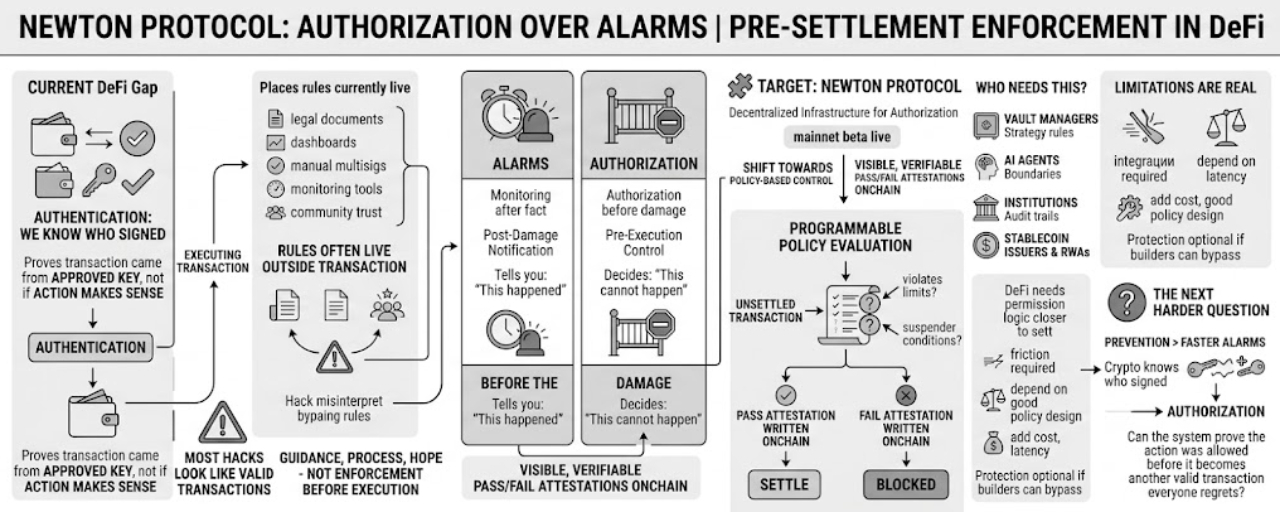
Most DeFi disasters do not look illegal to the chain.
They look valid.
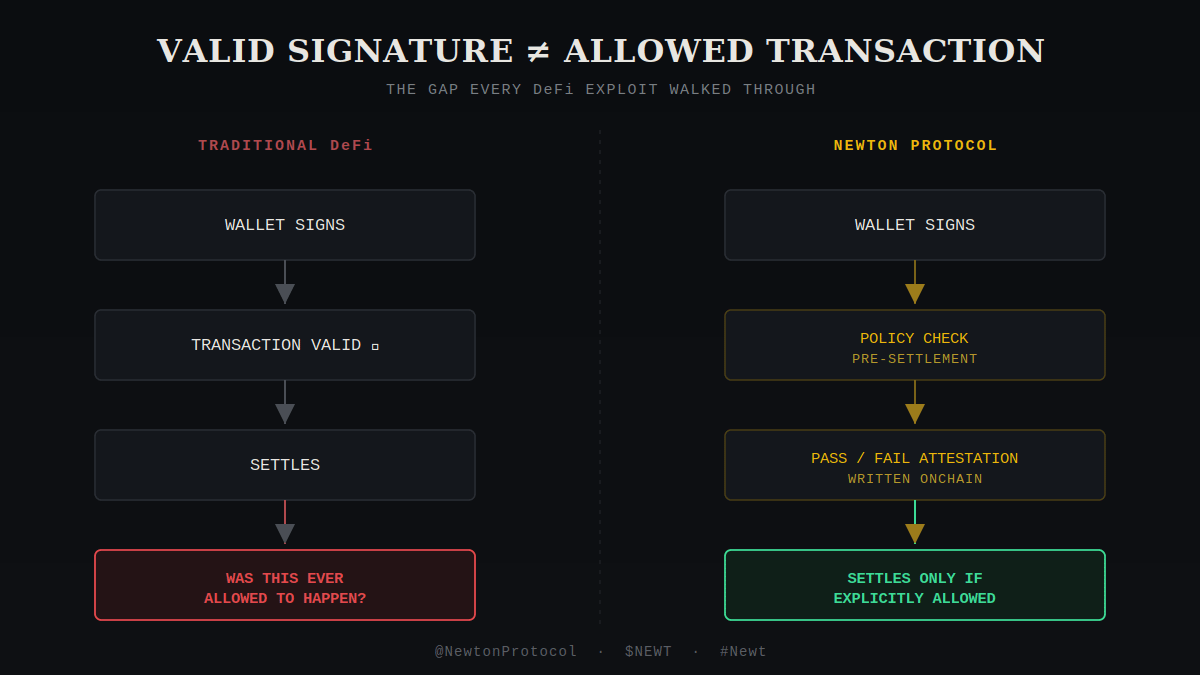
A wallet signs.
A contract executes.
A transaction settles.
Only later does everyone realize the system allowed something it should never have allowed.
🔐 Crypto Solved Identity — Not Permission
This is the uncomfortable gap.
Crypto is very good at authentication.
A signature proves who controlled the wallet.
It proves the transaction came from an approved key.
But it does not prove the transaction made sense.
It does not prove the vault rules were followed.
It does not prove the AI agent stayed inside its limits.
It does not prove the trade respected risk policy, compliance boundaries, or user intent.
That is authorization.
And authorization is still incomplete in DeFi.
🏦 The Rules Often Live Outside the Transaction
In real DeFi usage, rules are everywhere.
They sit in dashboards.
They sit in frontends.
They sit inside vault descriptions, legal documents, multisigs, manual reviews, monitoring tools, and community trust.
These systems help.
But they are not the same as enforcement before execution.
A frontend can warn users.
A dashboard can detect risk.
A multisig can slow decisions.
A legal document can define responsibility.
But if the actual transaction can still settle, then the rule is not fully real.
It is guidance.
It is process.
It is hope with better formatting.
🚨 Alarms Tell You What Happened — Authorization Decides What Can Happen
This is where the tension becomes clear.
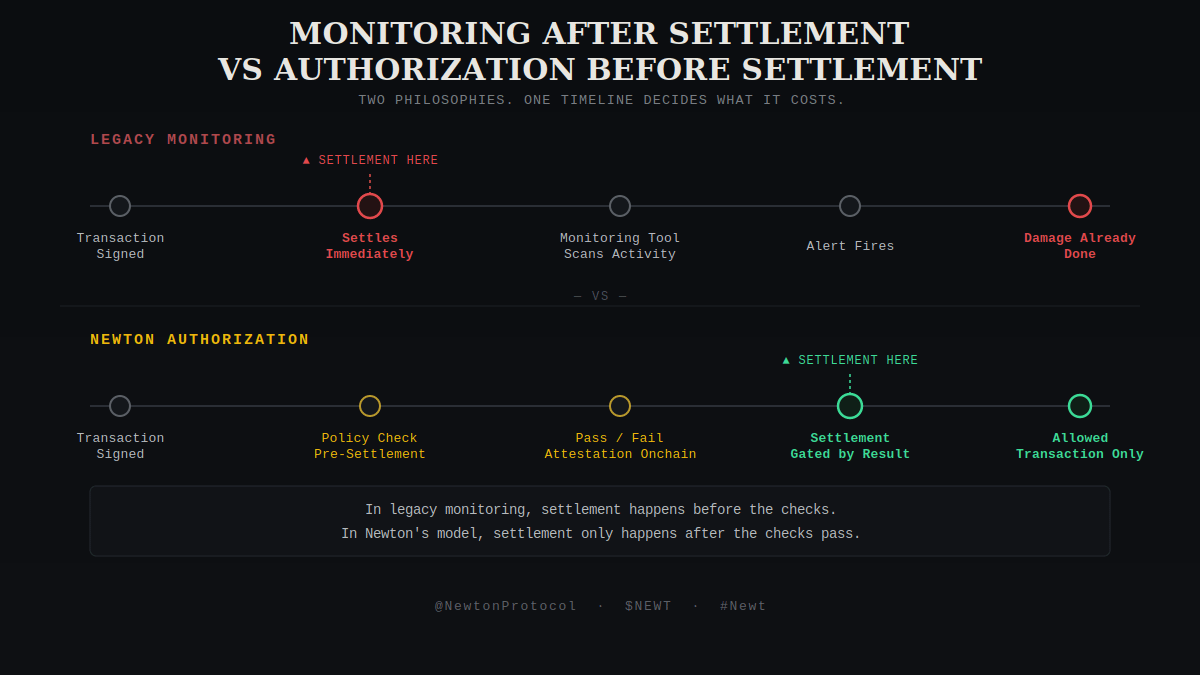
Monitoring is after the fact.
Authorization is before the damage.
An alarm says:
“This happened.”
Authorization says:
“This cannot happen.”
That difference matters more as DeFi moves beyond individual users.
We are now talking about curated vaults, AI-driven strategies, automated trading systems, stablecoins, RWAs, institutional flows, and compliance-sensitive capital.
In that environment, speed without control becomes dangerous.
Automation without boundaries becomes fragile.
Trust without enforcement becomes expensive.
🧩 Where NewtonProtocol Fits In
This is the problem @NewtonProtocol appears to be targeting.
Not as a magic shield.
Not as a guarantee that DeFi becomes safe overnight.
But as infrastructure for transaction authorization.
The idea is simple but serious:
Before a transaction settles, it can be evaluated against programmable policies.
Does it pass the rule?
Does it violate a limit?
Does it depend on suspicious conditions?
Should this vault, agent, or automated system be allowed to execute this action?
With Newton Mainnet Beta live, the more interesting piece is not the branding around $NEWT .
It is the shift toward policy-based control.
Newton’s recent messaging around VaultKit points to transaction checks before settlement and signed pass/fail attestations written onchain.
That means decisions are not just whispered in a backend.
They can become visible, verifiable, and part of the execution trail.
🧱 Who Actually Needs This?
Vault managers need enforceable strategy rules.
AI agents need boundaries so they do not operate with unlimited wallet freedom.
Institutions need audit trails that show why transactions were allowed.
Stablecoin issuers and RWA platforms need compliance boundaries that are not only manual.
Builders need safer automation.
Communities need more than trust when capital is being managed on their behalf.
This is where Newton’s infrastructure argument becomes relevant.
Not because everyone will use it.
But because more DeFi systems are starting to need permission logic that lives closer to settlement.
⚠️ The Limitation Is Real
Still, authorization layers create friction.
They require integrations.
They depend on good policy design.
They may add cost, latency, or confusion.
If policies are weak, the enforcement will be weak.
If builders can bypass the layer, the protection becomes optional.
If users do not understand failed transactions, trust may suffer instead of improve.
🧭 The Real Question
Newton Protocol might work if DeFi decides that prevention is worth more than faster alarms.
It could matter most for vaults, automated systems, AI agents, RWAs, stablecoins, and institutional rails.
But it could fail if adoption stays shallow, if integrations are painful, or if the policies themselves are poorly designed.
Crypto already knows who signed.
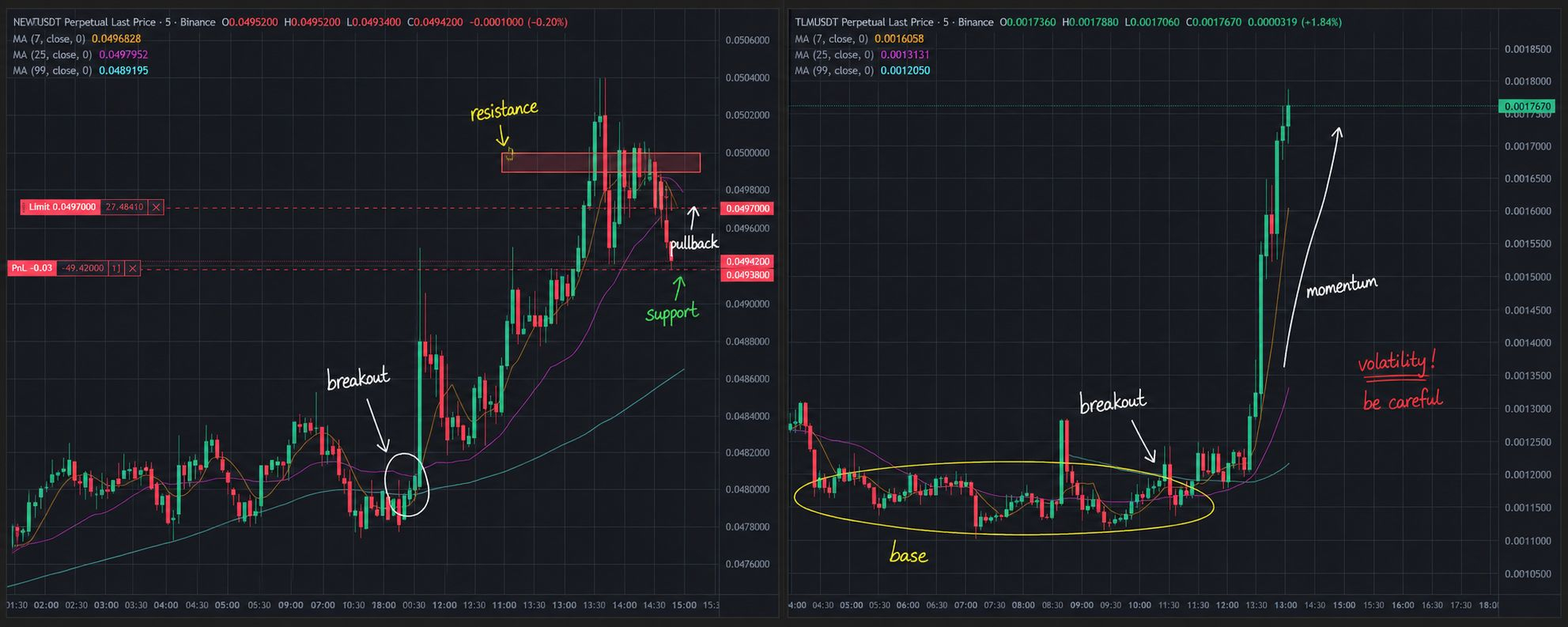
⚠️ NEWT and TLM both look weak on the 5m chart.
NEWT is losing short-term momentum after rejection near 0.0504, now slipping around 0.0494.
Bulls need to reclaim 0.0497–0.0500 fast, or this becomes a lower-high trap.
TLM is the opposite: a violent vertical breakout toward 0.00176.
Strong, yes — but stretched.
The real question is not “how high?” It is whether buyers can defend the first pullback.
Chase carefully.
The next question is harder:
Can the system prove the action was allowed before it becomes another valid transaction everyone regrets?
#Newt #NEWT $TLM $M