
In the fast-moving world of decentralized finance (DeFi), capital efficiency is the ultimate goal. Crypto investors are constantly searching for ways to maximize the yield on their digital assets without locking them away and missing out on other market opportunities.
Enter Solayer, a groundbreaking protocol built on the Solana blockchain. Solayer introduces the concept of "restaking" to the Solana ecosystem, aiming to solve network congestion while making staked assets vastly more productive.
Here is everything you need to know about Solayer, how it works, and why it is transforming the blockchain landscape.
What is Solayer?
Solayer is a high-performance restaking protocol and hardware-accelerated network built natively on Solana. To understand Solayer, it helps to look at Ethereum's famous restaking platform, EigenLayer. Solayer brings a similar economic security model to Solana but optimizes it to match Solana's ultra-fast speed and unique architecture.
At its core, Solayer allows users to take their already-staked Solana tokens ($SOL) and use them to secure auxiliary applications, decentralized applications (dApps), and infrastructure layers outside the main blockchain.
How Solayer Works: The Core Mechanics
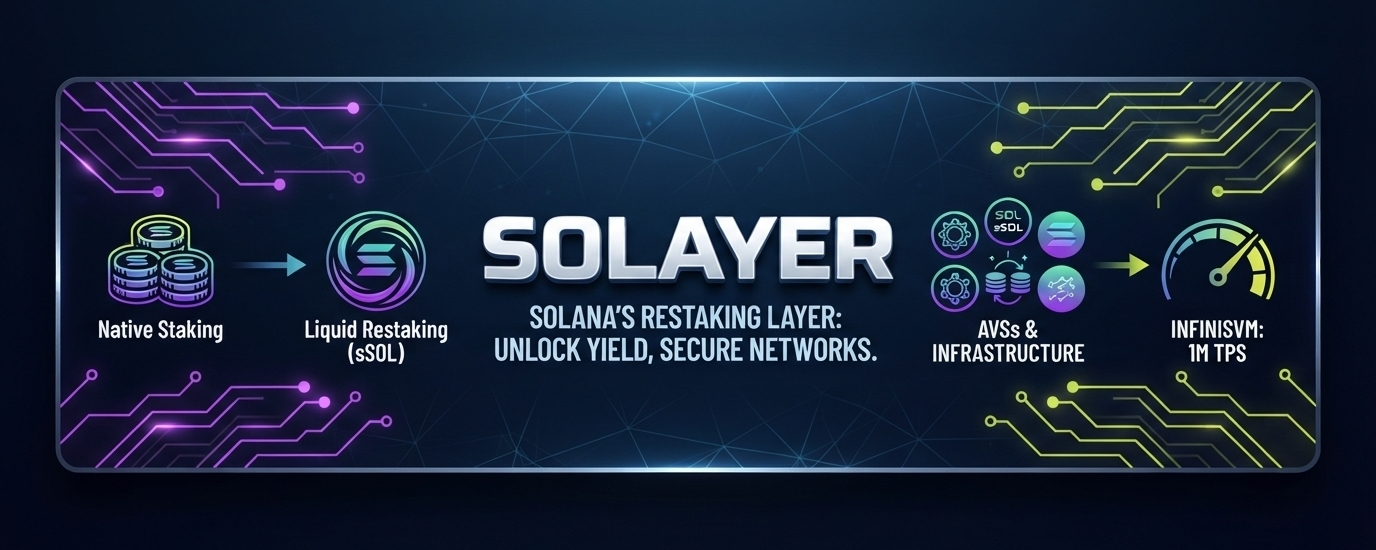
Solayer operates through three main pillars that enhance both user yield and network performance:
1. Liquid Restaking (sSOL)
Normally, when you stake SOL to secure the Solana network, your funds are locked up. Solayer allows you to "restake" that asset. When you deposit your SOL or liquid-staked SOL into the protocol, you receive a liquid restaking token called sSOL.
The Yield Boost: sSOL automatically compounds native Solana staking rewards.
The DeFi Utility: Because sSOL is liquid, you can still trade it, use it as collateral, or provide liquidity across the broader Solana DeFi ecosystem while it continues to earn rewards.
2. Actively Validated Services (AVSs)
The restaked crypto assets in Solayer are used to protect Actively Validated Services (AVSs). These are external web3 building blocks—like oracle networks, bridges, or specialized data layers—that require strict security. Instead of these networks launching their own expensive tokens to secure themselves, they "rent" security from Solayer’s restaked pool.
3. Solving Network Congestion
Solana is famous for its speed, but viral NFT mints or intense trading days can occasionally clog the network. Solayer introduces a system where dApps can reserve dedicated network bandwidth based on how much stake is allocated to them. This ensures that a localized traffic spike for one app will not slow down the rest of the ecosystem.
InfiniSVM: Reaching 1 Million TPS
Solayer is not just a software layer; it is also a hardware-focused scaling solution. It utilizes a custom execution framework called InfiniSVM.
By leveraging advanced, enterprise-grade networking hardware—specifically InfiniBand and Remote Direct Memory Access (RDMA)—Solayer bypasses traditional software bottlenecks. This tight integration of cutting-edge hardware and software allows the platform to target near-zero latency and an eventual throughput capacity of over 1 million transactions per second (TPS).
The Token Ecosystem
The network operates smoothly by utilizing a multi-token architecture:
$LAYER: The native ecosystem utility and governance token. It is used to pay network fees, vote on protocol upgrades, and reward validators.
sSOL: The liquid asset representing a user's restaked SOL position.
sUSD: A protocol-native, yield-bearing stablecoin pegged to the US dollar to handle transaction liquidity.
Real-World Utility: Solayer Pay
To bridge the gap between blockchain innovation and everyday life, Solayer has expanded into consumer finance with Solayer Pay. By launching a Solayer Pay Visa Card, the network allows users to spend their on-chain stablecoins (like USDC) globally at traditional payment terminals, bringing real-world utility to its digital ecosystem.
The Bottom Line
Solayer represents a massive leap forward for the Solana network. By introducing restaking, it provides users with higher yield potential, gives dApps a way to bypass network congestion, and leverages hardware acceleration via InfiniSVM to push blockchain speeds to unprecedented heights. As crypto continues to mature, protocols like Solayer that maximize capital efficiency will likely remain at the forefront of innovation.