@NewtonProtocol Most systems we rely on give us a way to take something back.
You can dispute a card charge weeks after it happens. You can cancel a wire transfer if you catch it early enough. Even a clumsy email can sometimes be recalled before anyone reads it.
We build for regret because mistakes are normal. Somewhere behind almost every financial process, there's an escape hatch a person or a process that can step in and reverse things.
I assumed onchain finance worked on the same principle, just with sharper technology behind it.
The more I looked into automated crypto transactions, especially ones where an AI agent is acting on someone's behalf, the weaker that assumption became.
What happens when a system genuinely has no "undo"?
That question is where Newton Protocol's design starts to make sense.
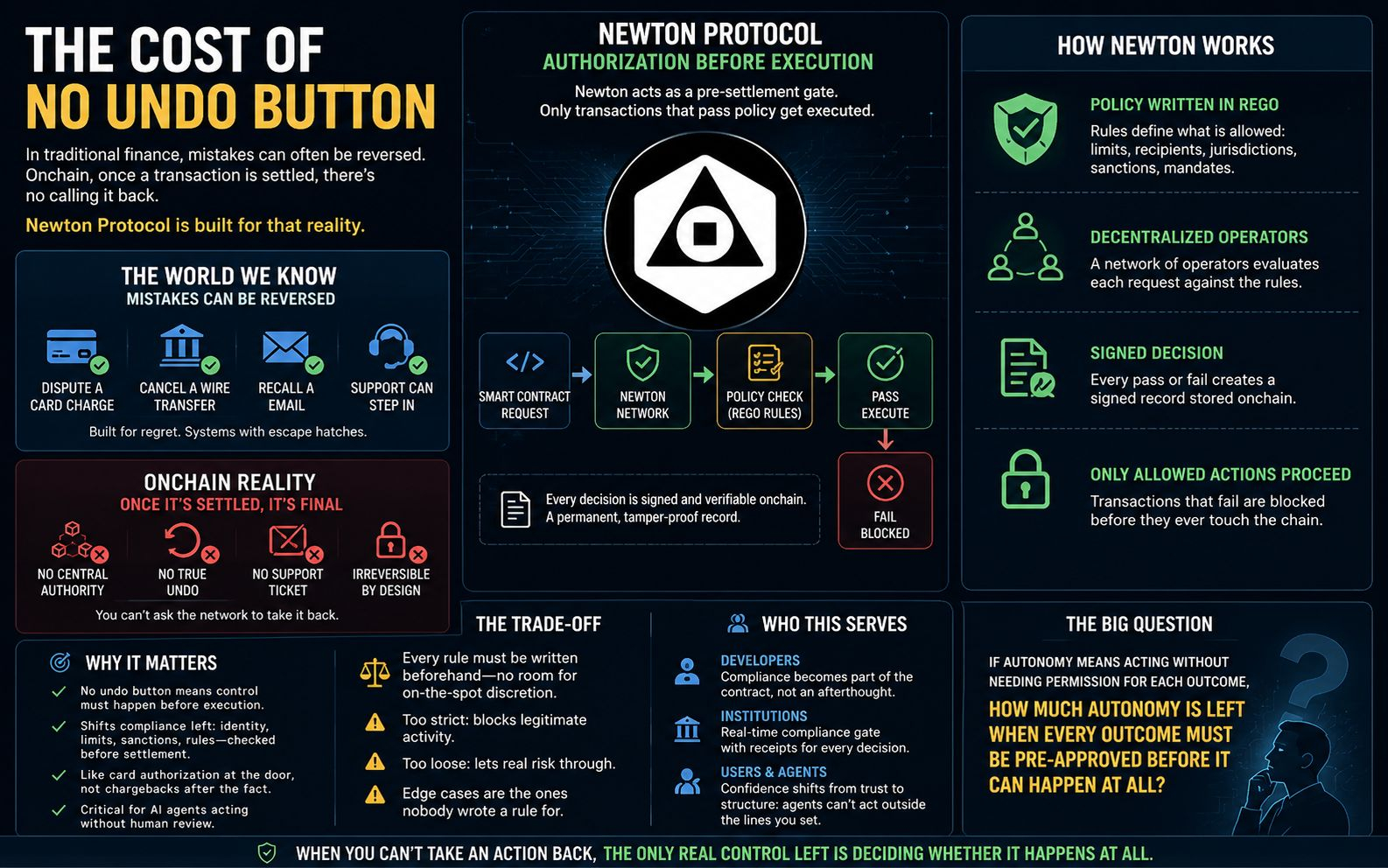
Newton describes itself as an authorization layer for onchain transactions. Instead of monitoring activity after it happens, it evaluates a transaction against a set of rules before it's allowed to settle. A lightweight snippet added to a smart contract routes each request to Newton's network, where a decentralized set of operators check it against policies written in Rego, a rules language built for exactly this kind of automated evaluation.
Only transactions that pass get to move forward. Every check, whether it passes or fails, produces a signed record that can later be verified onchain.
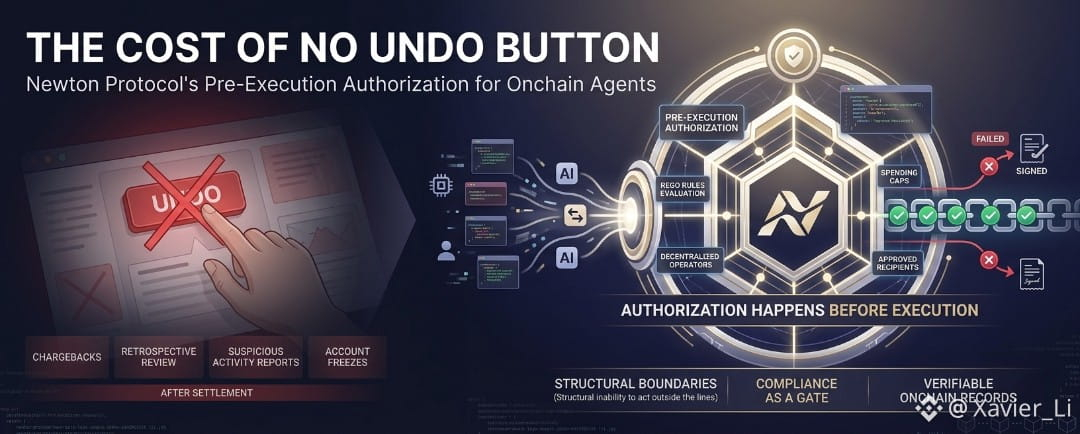
That's the design decision worth sitting with: authorization happens before execution, not after.
It sounds almost too obvious to be interesting, until you compare it with how most compliance actually works. Banks and card networks lean heavily on retrospective review. Suspicious activity reports, chargebacks, account freezes most of that machinery kicks in once money has already moved.
Onchain, that safety net mostly doesn't exist. Once a transaction settles, reversing it isn't a support-ticket problem, it's closer to asking the entire network to disagree with itself. That almost never happens, and for good reason.
I think that's the actual driver behind Newton's design. If you can't undo a transaction, the only place left to exert control is the moment right before it happens. Everything shifts earlier: identity checks, spending limits, sanctions screening, jurisdictional rules. All of it has to resolve before the transaction touches the chain, not after.
It's a bit like how a bank authorizes a card payment before the merchant gets paid, rather than clawing the money back afterward. The check happens at the door, not in the aftermath.
This matters even more once AI agents enter the picture. An agent making decisions and moving funds without a human reviewing every step is a different kind of risk than a person clicking "confirm." Newton's approach to this is to enforce boundaries like spending caps, approved recipients, and defined mandates at the same pre-settlement checkpoint, rather than trusting the agent's own judgment to stay inside the lines.
None of this comes free, though. Pre-execution enforcement means every rule has to be written down in advance, in a language a machine can evaluate. There's no room for a human to look at unusual context and use discretion in the moment, the way a bank fraud analyst might when something looks off but isn't clearly against policy.
That's a real trade-off. A policy strict enough to block genuine harm will inevitably block some legitimate activity it wasn't written to anticipate. A policy loose enough to avoid that friction risks letting through exactly what it was meant to stop. Someone still has to write these policies well, and edge cases are, by definition, the ones nobody thought to write a rule for.
For developers, this changes when compliance work actually happens. Instead of an audit trail assembled after the fact, it becomes part of the contract itself something you design around rather than clean up later. For institutions, it turns compliance into something closer to a real-time gate, with a receipt attached to every decision, rather than a quarterly review of what already happened.
For users delegating tasks to an agent, the confidence on offer is different too. It's not "I trust this agent to behave." It's closer to "this agent is structurally unable to act outside the lines I drew," regardless of what it decides to do.
The more I think about it, the more this feels like a consequence of irreversibility rather than a preference for one kind of control over another. When you can't take an action back, the only real control left is deciding whether it happens at all.
I'm still not fully settled on what that trade-off costs in practice. Every action an agent takes has to fit inside a policy someone wrote ahead of time, for a situation they may not have fully anticipated.
If autonomy means acting without needing permission for each specific outcome, how much of that is left once every outcome has to be pre-approved before it can happen at all?