
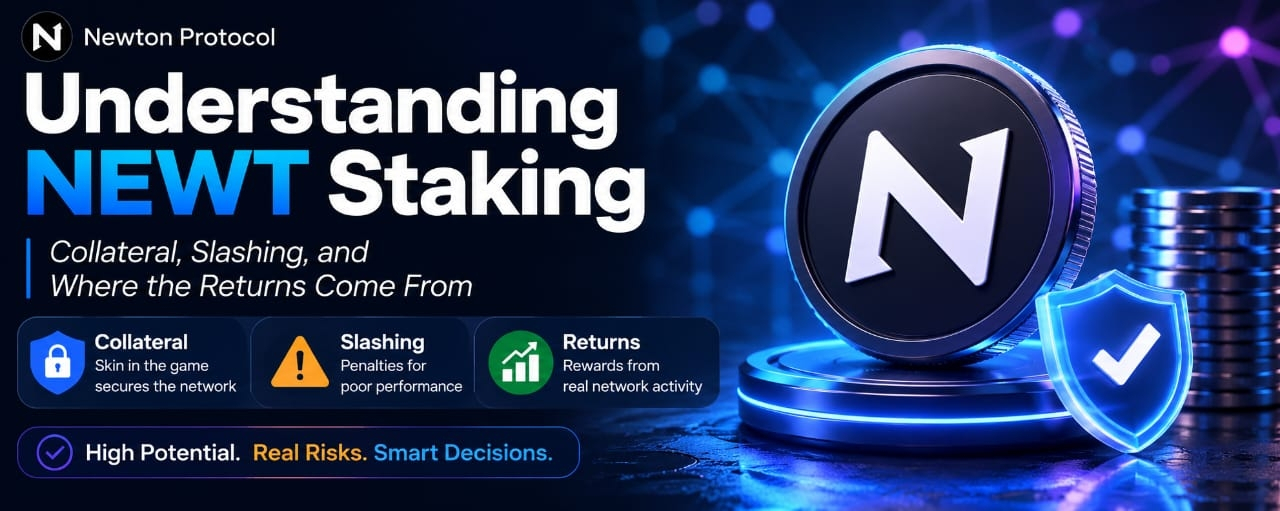
When people talk about staking, the conversation usually starts with APY. Higher rewards attract attention, and lower rewards often get ignored. But with $NEWT, I think the more interesting discussion is not how much staking pays today—it's what actually supports those returns over time.
That question becomes even more important because Newton Protocol is building something different. Instead of securing a traditional blockchain alone, it aims to create infrastructure where AI Agents can operate in a verifiable and accountable way. That makes staking more than a passive investment. It becomes part of the protocol's security model.
At the center of this system are Validators and Operators. Validators help secure the network and verify protocol activity, while Operators run AI Agents that provide services to users. Both roles require economic commitment through staking. The idea is simple: participants should have something at risk if they fail to perform their responsibilities properly.
On paper, that makes sense. Economic incentives have always been one of the strongest tools for securing decentralized networks. When participants have capital at stake, they are naturally encouraged to act responsibly. But the real challenge isn't introducing collateral—it's defining exactly when that collateral should be penalized.
This is where slashing becomes one of the most important parts of the discussion.
The purpose of slashing is straightforward. It is designed to discourage malicious behavior, reduce negligence, and compensate users if the network is harmed. In theory, that creates a healthier ecosystem because everyone has clear incentives to perform honestly.
The difficult part is that AI Agent infrastructure is very different from traditional validator systems.
In networks like Ethereum, certain violations are easy to verify. If a validator signs conflicting blocks, the evidence is visible on-chain and the penalty is relatively straightforward. AI Agent execution is much more complex. Performance can be affected by external APIs, RPC providers, network latency, infrastructure outages, or data sources that are not always under an operator's direct control.
That creates a grey area.
If every execution failure is treated the same way, operators may end up carrying risks that extend beyond their own actions. On the other hand, if penalties are too lenient, users lose confidence in the network's security. Finding the right balance is one of the biggest design challenges for any protocol trying to secure off-chain AI execution.
This is why transparency matters just as much as technology.
Participants should be able to understand exactly what behaviors trigger penalties, how those penalties are calculated, and whether there is any review process if disputes arise. Clear rules reduce uncertainty, while vague rules often discourage long-term participation.
Returns deserve the same level of attention.
Every staking protocol eventually reaches a point where investors ask a simple question: where does the yield actually come from?
In the early stages of many blockchain networks, staking rewards are often supported by protocol incentives or foundation allocations. There is nothing unusual about that. Bootstrap incentives are common throughout the industry because they encourage early participation while the network grows.
The more important question is what happens later.
As incentive programs gradually decrease, sustainable rewards need to come from real network activity. That means transaction fees, service demand, and genuine usage must eventually replace emissions as the primary source of returns. Otherwise, attractive yields may become difficult to maintain over the long run.
This is why staking should never be evaluated by APY alone.
Lock-up periods, token price volatility, protocol maturity, and operational risks all influence the real outcome. A generous annual yield can easily be outweighed by a significant decline in token value or unexpected operational penalties. Looking at rewards without considering risk only tells half of the story.
Personally, I see NEWT as a project that is still building its foundation rather than presenting a finished product. The vision of creating verifiable infrastructure for AI Agents is interesting, and the direction has genuine long-term potential. At the same time, early-stage infrastructure naturally comes with unanswered questions that only time, adoption, and governance can fully resolve.
For me, that means approaching the opportunity with curiosity rather than certainty.
There is value in following the project's development, understanding how its economic model evolves, and watching whether real demand grows alongside the technology. If those pieces come together, staking could become increasingly sustainable over time. If they don't, incentives alone will not be enough to support long-term value.
That is why I don't see NEWT staking as guaranteed passive income.
I see it as participation in an infrastructure project that is still evolving. The opportunity is real, but so are the uncertainties. For anyone considering staking, the best approach is probably the simplest one: understand the mechanism first, size your position responsibly, and let conviction grow alongside the protocol rather than ahead of it.
In the end, successful staking is not only about earning rewards. It is about understanding the system that generates them. And for a project as early as NEWT, that understanding may prove far more valuable than chasing the highest yield.
