What caught my attention wasn’t transaction speed.It was how much manual work still sits behind stablecoin operations.@NewtonProtocol #Newt
Crypto infrastructure has improved a lot over the past few years. Transfers settle quickly. Liquidity moves across chains without much friction. Treasury systems are becoming more automated.
But once companies start moving serious amounts of money, another problem shows up almost immediately: compliance.
Who approved the payment?
Was the wallet screened first?
Did the transaction break any internal limits?
Was the sender verified before funds moved?
Most of these checks still happen through disconnected systems. One team handles sanctions screening. Another reviews approvals. Compliance data sits in separate dashboards. Audit records live somewhere else entirely. Sometimes people are still confirming things through email threads and spreadsheets.@NewtonProtocol $NEWT #Newt
Meanwhile, the blockchain only shows the final transfer.It usually has no idea whether any compliance process happened beforehand.
That seems to be one of the core problems Newton is trying to solve.
The interesting part is that Newton treats compliance as something that can actually be verified, not just claimed internally.
That difference matters more than it sounds.
Right now, when a stablecoin transaction happens, outside parties only see assets moving from one wallet to another. They do not see the checks behind the transaction. A company may say policies were followed, but there is often no cryptographic proof attached to that process.
Newton appears to approach this differently through policy evaluation and attestations.
The idea itself is fairly practical.Before a transaction is executed, the system can evaluate a predefined set of rules automatically.The rules could cover things like sanctions checks, KYC verification, transfer limits, wallet risk checks, treasury approvals, location-based restrictions, or proof of where the funds came from.
Instead of teams manually checking every step, the system automatically verifies whether the transaction follows the required rules.If everything passes, it can generate an attestation confirming the checks were completed properly.That attestation works like proof that the transaction followed the required compliance rules before the funds moved.What stood out to me is that the sensitive information itself does not necessarily need to be exposed onchain.$SPCXB 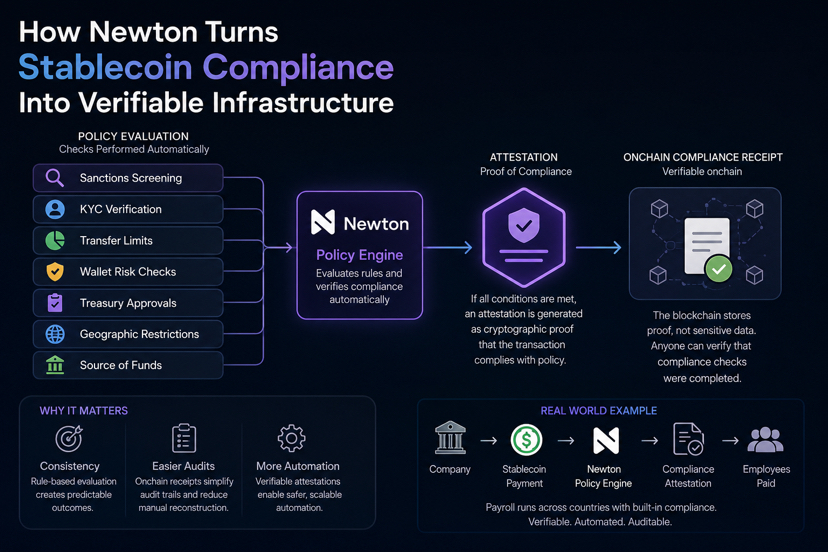
That has always been one of the uncomfortable tradeoffs in crypto compliance.
Institutions want verifiable records. Users and businesses usually do not want personal information permanently visible on a public blockchain.
Newton seems to separate those two things.
The identity or compliance data can remain encrypted or stored offchain, while the blockchain only receives proof that the checks were completed successfully.
In practice, it works more like an onchain compliance receipt.That structure could become increasingly important as stablecoins move deeper into real business operations.
Take a simple example.Imagine a company using stablecoins to pay employees in different countries.
Before the payment goes through, a few things may need to be checked first:
• The receiving wallet is not connected to sanctioned entities
• The payment amount stays within company limits
• The employee already completed KYC checks
• The transfer was approved internally
• The destination country follows the company’s compliance policies
Right now, many companies still manage these checks through separate platforms and manual approvals.
Newton seems to bring much of that logic into one programmable framework.
Once the required rules are satisfied, the system can generate attestations that smart contracts or counterparties can verify automatically.
That changes the role compliance plays inside crypto systems.
Instead of being mostly a manual review process happening in the background, compliance starts becoming part of the infrastructure itself.
There are some obvious advantages to that approach.The first is consistency.Manual reviews often depend on who is reviewing the transaction, how much pressure the team is under, or which jurisdiction the company operates in.Using fixed rules makes the decision process more consistent and easier to predict.
Another advantage is that auditing becomes much simpler.If compliance receipts are linked directly to transactions, companies may no longer need to reconstruct fragmented approval histories later during audits or investigations.
The third is automation.A lot of stablecoin treasury activity still depends on human approval because counterparties cannot independently verify whether required checks actually happened. Verifiable attestations reduce part of that uncertainty.
Of course, there are still open questions.
The system is only as reliable as the policies behind it. Weak screening standards would still produce weak attestations. Governance also matters. Someone still decides which compliance standards are trusted, how sanctions data is updated, and how disputes get resolved.
There is also the question of interoperability.Compliance frameworks become much more useful when multiple institutions recognize the same verification standards. Building that kind of network trust usually takes time.
Still, the direction feels important.Crypto spent years improving execution speed.Now the bigger challenge may be authorization itself.
Not whether assets can move across blockchains.Whether institutions can verify the conditions under which those assets are allowed to move.Newton seems focused on that exact problem.
And honestly, that could end up being one of the more important infrastructure layers for institutional stablecoin adoption over the next few years.
If compliance eventually becomes programmable and verifiable instead of manual and fragmented, does that change how institutions trust onchain financial systems?@NewtonProtocol $NEWT #Newt 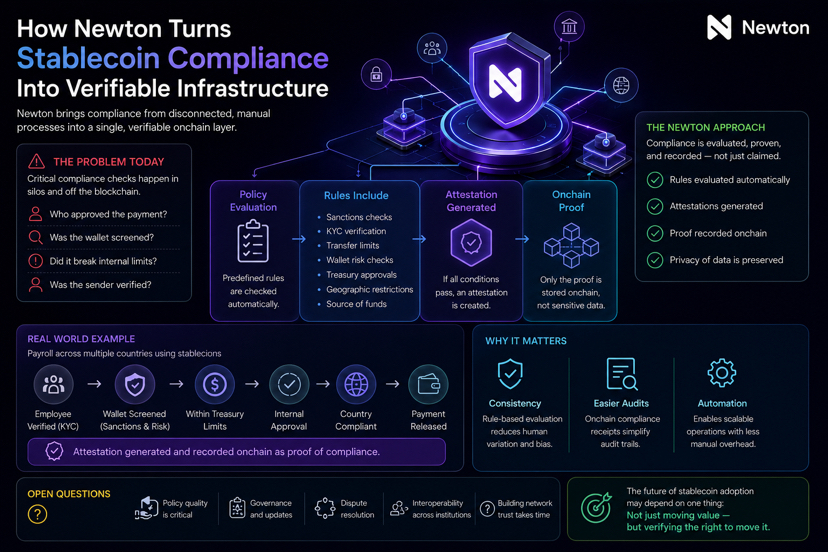

Статья
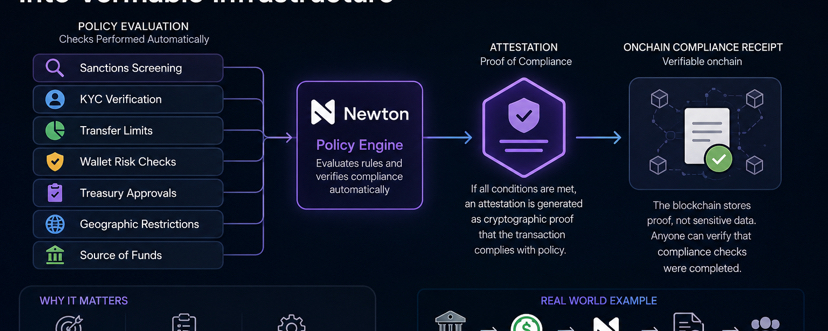
How Newton Turns Stablecoin Compliance Into Verifiable Infrastructure
--
Отказ от ответственности. Содержит мнения третьих сторон. Не является рекомендацией. Binance AI не предоставляет гарантий. См. Правила и условия.