The crypto market is often presented as the ultimate financial equalizer a decentralized economy where anyone with an internet connection can participate, innovate, and build wealth. But anyone who spends enough time looking beneath the surface quickly realizes that transparency does not automatically create fairness. Every transaction is public, yet very few people possess the infrastructure or expertise required to understand what those transactions actually mean. Retail traders frequently enter markets believing they are competing on equal footing, when in reality they are often trading against sophisticated participants equipped with advanced analytics, automated infrastructure, high-speed execution, and deep on-chain intelligence. Traditional charts teach traders to identify support, resistance, and moving averages, but they cannot reveal coordinated wallet behavior, hidden supply concentration, treasury movements, contract upgrades, or the subtle flow of capital that often precedes major market events. A candlestick chart cannot reveal intent. It cannot expose coordination. It cannot explain what is happening beneath the surface before price reacts. That is why I have made the decision to open-source the Early Threat Detection System (ETDS) not as a commercial product locked behind subscriptions, but as a public intelligence framework built to help level the playing field for every retail trader.
Traditional technical analysis has served financial markets for decades, but it was designed for markets where price and volume were the primary observable variables. Blockchain networks introduce an entirely new layer of publicly available information that traditional indicators simply cannot interpret. Every wallet transfer, liquidity adjustment, governance proposal, contract deployment, multisig approval, bridge transaction, and exchange deposit leaves a permanent record long before its consequences become visible on a price chart. By the time a breakout, breakdown, or liquidation cascade appears on the chart, the underlying blockchain activity has already occurred. In highly speculative markets, waiting for confirmation from price alone often means reacting after better-informed participants have already positioned themselves. ETDS is built on a fundamentally different philosophy. Instead of analyzing only price action, it continuously analyzes blockchain behavior itself. It monitors how capital moves, how wallets interact, how liquidity evolves, how protocols change, and how entire ecosystems behave in real time. By open-sourcing this intelligence engine, the objective is not to replace technical analysis but to complement it with an entirely new category of indicator one capable of revealing blockchain behavior before it fully manifests in market price.
To understand why an open-source Web3 intelligence indicator is necessary, consider how many newly launched tokens evolve during their earliest stages. On the surface, a project may appear healthy, decentralized, and rapidly growing. Marketing campaigns create excitement, social media amplifies momentum, and aggressive price appreciation attracts new participants. Yet beneath that public narrative, the underlying blockchain may tell a very different story. Token ownership may remain highly concentrated among founders, early investors, treasury wallets, or interconnected clusters of addresses. Liquidity may be significantly thinner than traders realize. Wallets that appear independent may actually behave as coordinated groups through shared funding sources, synchronized activity, or repeated interaction patterns. None of these observations automatically imply malicious intent many legitimate projects exhibit concentrated ownership during their early development but understanding these structural characteristics provides critical context that price charts alone cannot offer.
Liquidity plays an equally important role. In many emerging markets, relatively small liquidity pools can produce dramatic price movements because even modest buying pressure significantly shifts the market. This characteristic can create spectacular rallies during periods of excitement while also amplifying downside volatility when selling pressure appears. Automated trading bots, arbitrage systems, market makers, and sophisticated trading firms continuously interact within these environments, creating complex market dynamics that are largely invisible to ordinary traders. Someone watching only candles may interpret rapid price appreciation as broad organic demand, while on-chain analysis might simultaneously reveal increasing holder concentration, declining liquidity resilience, or coordinated wallet activity. ETDS is designed to surface these hidden signals, not by making assumptions about intent, but by transforming millions of blockchain events into understandable intelligence that anyone can inspect.
The same information gap becomes even more significant once tokens begin attracting leveraged participation through perpetual futures markets. As volatility increases, traders often make decisions based almost entirely on momentum, funding rates, and chart structure, while remaining unaware of changes occurring beneath the surface of the blockchain. Large exchange deposits, coordinated treasury movements, unusual bridge activity, liquidity withdrawals, synchronized wallet activation, or significant shifts in holder behavior may all occur before those developments become fully reflected in price. ETDS is designed to observe these changes as they happen, continuously building a behavioral picture of the network instead of relying solely on historical price movement. Rather than attempting to predict prices, ETDS seeks to identify when blockchain behavior itself begins deviating from historical norms and provide users with explainable evidence supporting those observations.
For too long, the most sophisticated blockchain intelligence has remained available primarily to institutions capable of investing heavily in proprietary infrastructure, data engineering, and internal research teams. Retail traders are often left navigating markets using fragmented tools, delayed information, and isolated datasets that rarely communicate with one another. They blame poor timing, weak psychology, or flawed strategies without realizing that the information available to them is fundamentally incomplete. The blockchain itself already contains many of the signals that explain market behavior; the real challenge is transforming those raw events into accessible intelligence before they disappear beneath millions of new transactions. ETDS exists to help close that information gap not by guaranteeing profits or eliminating risk, but by giving every participant access to the same categories of behavioral intelligence that sophisticated organizations already use.
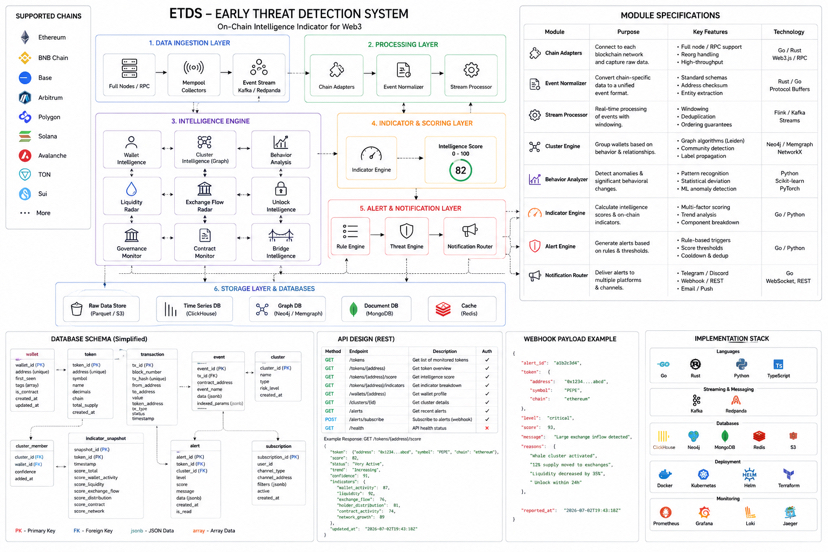
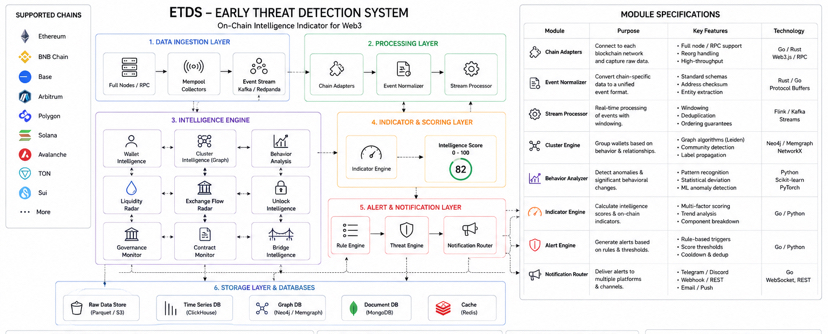
This is precisely why ETDS cannot remain a closed-door project. Blockchain networks evolve too quickly, new protocols emerge too rapidly, and adversarial behavior adapts too constantly for any single company or development team to build the definitive intelligence platform alone. By open-sourcing the entire architecture from distributed event-streaming pipelines and blockchain adapters to graph-based wallet clustering, behavioral analytics, intelligence scoring, explainable alerts, and visualization tools we are inviting developers, researchers, data scientists, security professionals, and traders to build a decentralized defensive shield together. The objective is not merely to detect threats, but to create an open framework capable of exposing hidden supply concentration, highlighting unusual wallet behavior, tracking liquidity evolution, identifying coordinated activity, and transforming blockchain transparency into actionable intelligence. The blockchain already preserves a permanent record of the truth. The next step is ensuring that everyone has the tools to read it.