
I don’t know why this thought refused to leave my mind…..but it followed me for almost the entire evening. 🤔
I was reading about @NewtonProtocol and its Newton Mainnet Beta, expecting to learn about another piece of blockchain infrastructure. Instead, I ended up questioning something much more ordinary.
We always talk about creating better rules.
But when was the last time we asked whether those rules are actually being followed?
At first, I didn’t think much of that question.
Every system already has rules.
Banks have policies.
Companies have internal approvals.
Investment firms have risk limits.
Even the apps we use every day quietly rely on conditions running in the background before something important happens.
Rules have never been rare.
Then why do expensive mistakes still happen?
The more I sat with that question…..the more I realized something that felt almost obvious.
Writing rules has never been the difficult part.
Following them consistently is.
That was the moment Newton Mainnet Beta started making much more sense to me.
Before this, I honestly thought the interesting part of Newton would be automation.
Maybe AI.
Maybe another infrastructure upgrade.
But the deeper I went into my research, the less interested I became in automation itself.
Instead, I found myself thinking about something much quieter.
Who makes sure the decision everyone already agreed on is actually respected when money starts moving?
Crypto has become incredibly good at execution.
Every day, billions of dollars move across different protocols without anyone stopping to admire the technology behind them.
Most conversations sound almost identical.
How fast was it?
How much did it cost?
How many transactions happened today?
They’re all reasonable questions.
I just don’t think they’re the only questions worth asking anymore.
Because execution only tells us what happened.
It doesn’t tell us whether it should have happened in the first place.
That distinction kept bothering me.
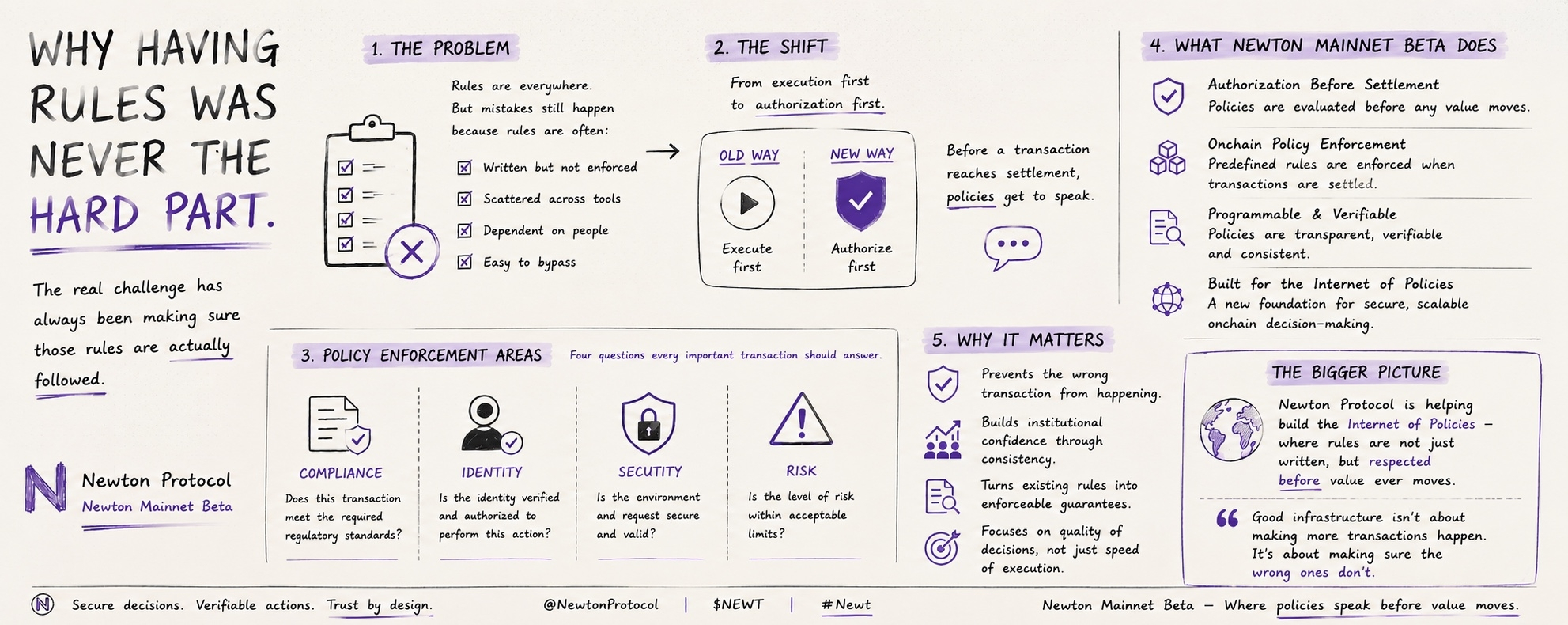
The more I looked into Newton Protocol, the more I realized the Mainnet Beta isn’t trying to compete over who can settle transactions faster.
It’s trying to make something else happen before settlement even begins.
Authorization.
At first, I thought that simply meant another approval step.
Then I kept reading…..
And I realized authorization isn’t really about adding more clicks or making transactions slower.
It’s about giving predefined policies the chance to speak before value moves.
That feels like a very different way of thinking.
One example that kept coming back while I was reading was DeFi vaults.
Many curated vaults already operate with clear expectations.
There are spending limits.
Risk frameworks.
Identity requirements.
Compliance considerations.
None of those ideas are new.
What surprised me was realizing that many of those rules still live across different processes, different tools, or different teams.
The transaction eventually happens onchain.
The reasoning behind the transaction often doesn’t.
That separation suddenly felt much bigger than I expected.
Because the more I thought about it…..the more I realized a policy doesn’t become valuable simply because someone wrote it down.
It becomes valuable the moment it can actually influence a decision.
That’s where Newton Mainnet Beta really caught my attention.
Not because it creates new rules.
Because it gives existing rules the opportunity to become enforceable before settlement.
I kept coming back to that one word.
Enforceable.
There’s a huge difference between saying,
“This is how things should work.”
And actually making sure they do.
I started comparing it with everyday life.
Almost every workplace has written policies.
Almost every school has written policies.
Almost every financial institution has written policies.
But we also know something else.
A policy sitting inside a document doesn’t automatically change behavior.
Someone still has to apply it.
Someone still has to verify it.
Someone still has to stop the wrong decision before it becomes tomorrow’s problem.
The more I reflected on that…..the less Newton Protocol felt like another infrastructure project.
It started feeling like a protocol asking a much simpler question.
What good are rules if nobody can guarantee they’ll be followed?
The more I stayed with that question…..the more I realized it doesn’t only apply to crypto.
It applies almost everywhere.
Every important decision usually passes through a series of invisible checks before anyone notices the final outcome.
We rarely think about those checks because, when they work, nothing dramatic happens.
Maybe that’s why they’re so easy to overlook.
One thing that stood out while I was researching Newton Protocol was how its policy enforcement revolves around four areas.
Compliance.
Identity.
Security.
Risk.
The first time I saw them, I treated them exactly like most people probably would.
Four features.
Four categories.
Read them once and move on.
A few hours later, I found myself looking at them differently.
Instead of four features…..
They started feeling like four different questions every important transaction should answer before it’s allowed to continue.
Is this transaction compliant?
Is the identity actually verified?
Does everything still look secure?
Is the level of risk acceptable?
Suddenly, the list didn’t feel technical anymore.
It felt practical.
Because those are exactly the kinds of questions serious financial systems have always asked before money moves.
Newton Mainnet Beta simply brings that way of thinking into an onchain environment.
That realization stayed with me longer than I expected.
Maybe we’ve spent years trying to make DeFi faster…..
When part of the next evolution is making it more disciplined.
Those aren’t the same thing.
And maybe they shouldn’t be.
Something else also crossed my mind while reading.
People often celebrate successful transactions because they’re easy to see.
Charts record them.
Dashboards display them.
Volume increases because of them.
Everything visible gets measured.
But nobody celebrates the transaction that never happened because a policy quietly stopped it.
Nobody posts about the exploit that never happened.
Nobody notices the treasury mistake that was prevented before settlement.
Infrastructure has a strange relationship with success.
When it works perfectly…..
Almost nothing happens.
Ironically, that might be the strongest proof that it’s working.
Of course, I don’t think any policy framework magically solves every problem.
Rules still need to evolve.
Markets change.
Organizations change.
Risk changes.
The policies protecting a vault today may need to look very different a year from now.
Making policies enforceable doesn’t remove responsibility.
It simply makes today’s decisions respect today’s rules.
I also found myself wondering who benefits from this kind of infrastructure first.
Retail users usually care about convenience.
Most people simply want transactions to work.
Institutions often think differently.
Large organizations managing significant capital usually care about consistency, accountability and predictable processes just as much as speed.
For them, knowing that every transaction is evaluated against predefined policies before settlement isn’t just another feature.
It becomes operational confidence.
Maybe that’s why Newton is beginning with vaults before expanding toward broader use cases.
That sequence actually makes sense the more I think about it.
The more time I spent researching…..the less I saw Newton Mainnet Beta as another product launch.
I started seeing it as a shift in where attention belongs.
For years we’ve celebrated execution.
Maybe the next conversation is about authorization.
Not because transactions stopped mattering.
But because the quality of the decision before the transaction might eventually matter just as much.
I definitely didn’t expect that to be my biggest takeaway.
When I first opened the documentation, I thought I was going to learn how another protocol worked.
Instead, I walked away questioning something much simpler.
Maybe every financial system eventually reaches the same realization.
Writing good rules is only the beginning.
The real challenge has always been making sure those rules still matter when the moment to act finally arrives.
And for me…..that’s what made Newton Protocol and its Mainnet Beta worth thinking about long after I finished reading.