
Ask almost anyone why Bitcoin has value and you'll probably hear the same answer:
"Because there will only ever be 21 million coins."
It's not wrong.
It's just incomplete.
Scarcity is one of Bitcoin's defining characteristics, but scarcity alone has never been enough to create lasting value. History is full of rare objects that remain economically insignificant because almost nobody needs them.
The more interesting question isn't whether Bitcoin is scarce.
It's why millions of people across different countries, financial systems, and political environments continue choosing to hold it.
The answer lies in something much bigger than supply.
Scarcity Doesn't Create Trust
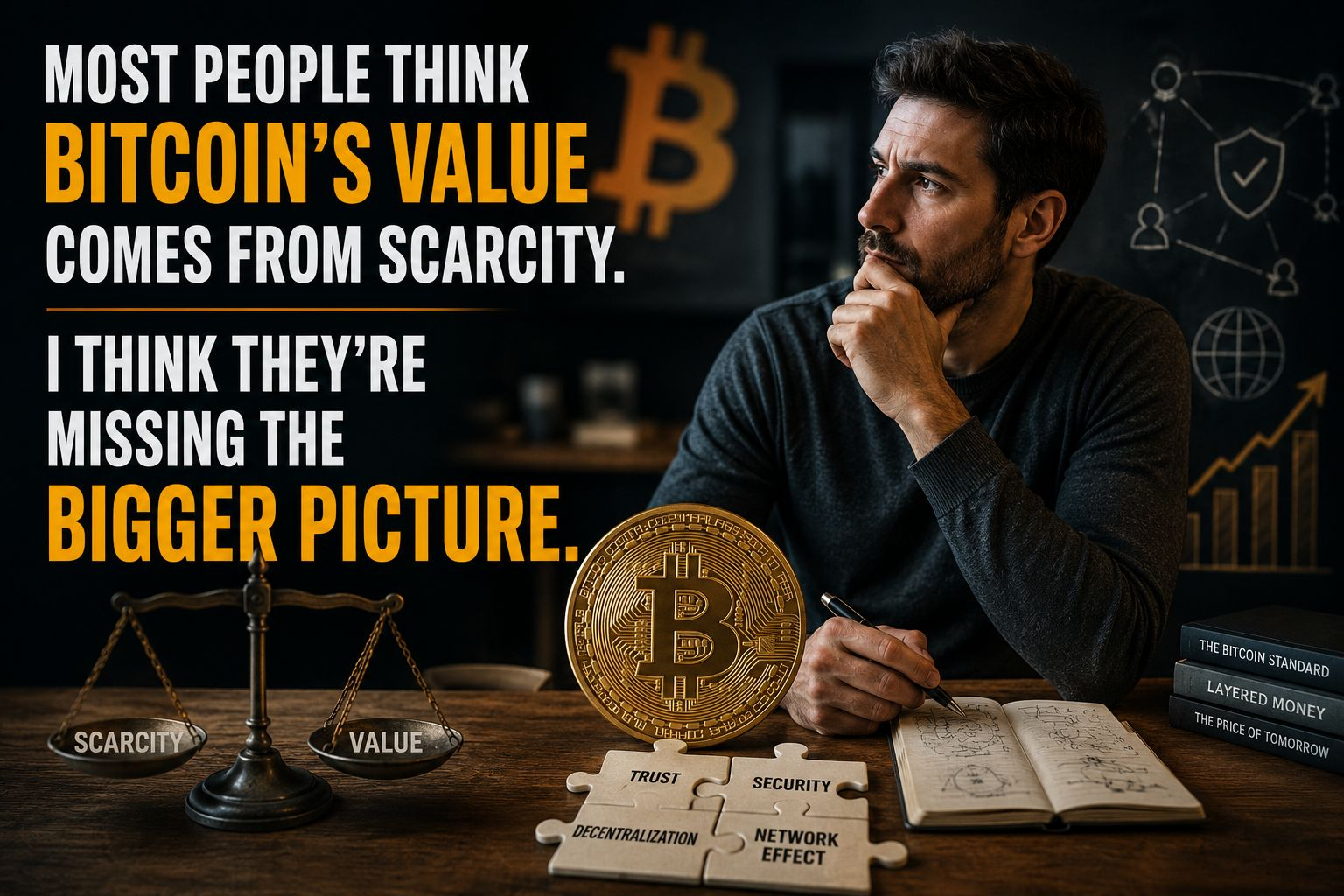
Imagine creating a cryptocurrency today with a fixed supply of one million coins.
Would it automatically become valuable?
Of course not.
The market would immediately ask harder questions.
Who controls it?
Can its monetary policy change?
How secure is the network?
Can transactions be censored?
Will it still exist in twenty years?
Scarcity only matters after trust exists.
Without trust, limited supply is just a marketing slogan.
Bitcoin earned that trust over time through consistent operation, transparent rules, and a monetary policy that has remained predictable despite years of economic and political change.
Bitcoin Doesn't Ask You to Trust People
Traditional financial systems depend on institutions.
Banks protect deposits.
Governments issue currency.
Central banks influence monetary policy.
Whether those institutions perform well or poorly, users ultimately place trust in human decision-makers.
Bitcoin approaches the problem differently.
Instead of asking participants to trust an organization, it asks them to trust publicly verifiable rules.
Every participant follows the same protocol.
Every transaction can be independently verified.
No central authority can create additional coins outside the network's consensus rules.
That shift—from institutional trust to verifiable trust—is one of Bitcoin's most significant innovations.
Security Is an Economic Feature
Bitcoin's security is often discussed as a technical achievement.
I think it's better understood as an economic one.
The network doesn't rely on promises that no one will attack it. It relies on incentives that make honest participation more rewarding than dishonest behavior.
Miners invest real resources to secure the blockchain because the system aligns their economic interests with the health of the network.
Over time, this has created one of the most resilient public computing systems ever built.
For someone storing wealth over years rather than days, that resilience can matter more than faster transactions or additional features.
The Network Becomes More Valuable as Confidence Grows
Bitcoin's value isn't produced by one characteristic.
It's the result of several reinforcing forces working together.
A predictable monetary policy encourages long-term confidence.
A decentralized network reduces dependence on individual institutions.
Strong security protects the integrity of the ledger.
Global accessibility allows anyone with an internet connection to participate.
Transparent rules make the system easier to verify than many traditional financial processes.
Each element strengthens the others.
Remove one, and the entire system becomes less compelling.
That's why reducing Bitcoin's value to "only 21 million coins" misses the broader picture.
The supply cap matters because it exists inside a network that has spent years proving its credibility.
$BTC IS AN INFRASTRUCTURE AND NOT JUST AN INVESTMENT
Much of the public conversation still treats Bitcoin as a trade.
Will it rise this month?
Will it fall next week?
Can it reach another all-time high?
CLOSING THOUGHT
The market will continue to measure Bitcoin by its price. Its long-term importance, however, is increasingly being defined by its role in the financial system. As adoption broadens and new use cases emerge, Bitcoin is evolving from a standalone investment into infrastructure that supports the next phase of digital finance. That transition is likely to matter long after today's market cycle has passed.