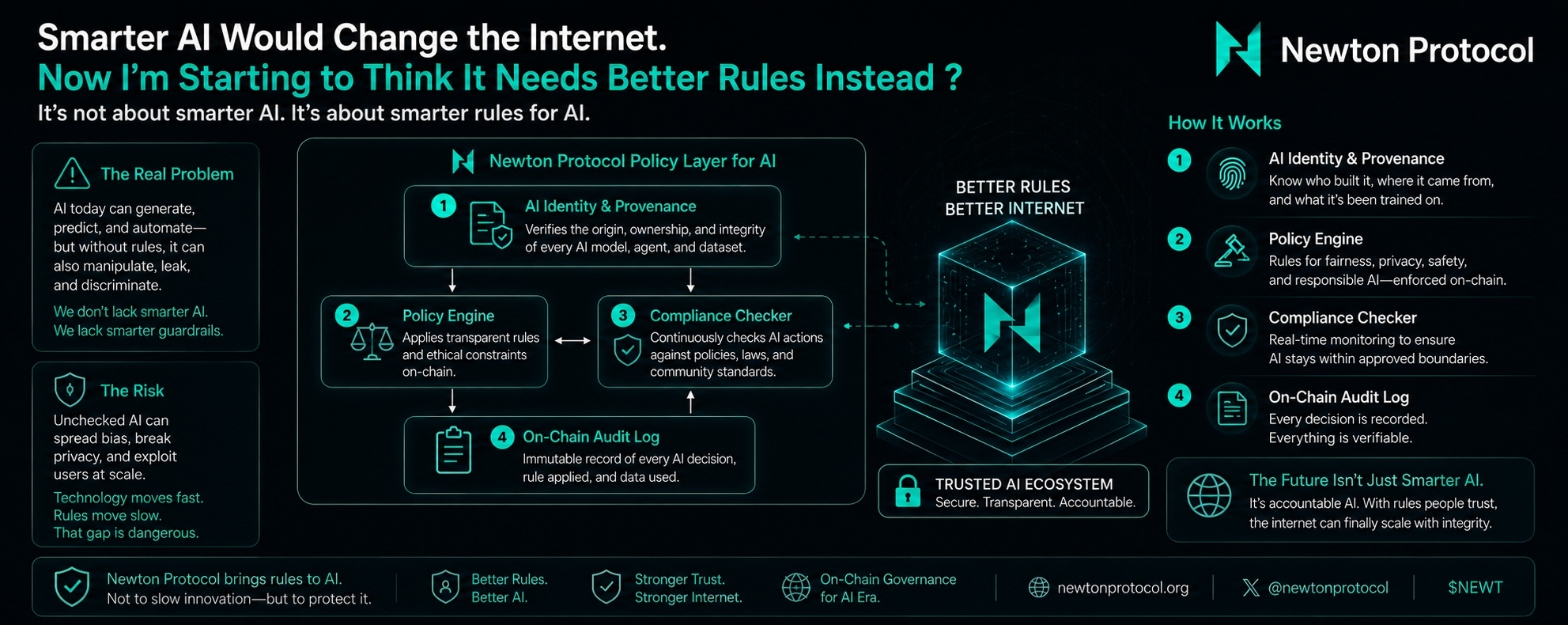
@NewtonProtocol I’ll Be Honest… A few months ago, I caught myself asking a simple question.
If AI is getting smarter every week, why does using it on-chain still feel like such a trust exercise?
An AI agent can analyze markets, rebalance portfolios, move liquidity, bridge assets, or execute complex DeFi strategies faster than any human. That’s impressive. But speed has never been the biggest problem. Trust is.
From what I’ve seen, crypto doesn’t really struggle because we lack intelligence. It struggles because we still don’t have a reliable way to tell intelligent systems what they are allowed to do.
That’s why Newton Protocol grabbed my attention.
At first I assumed it was just another AI project trying to ride the current narrative. After spending time reading its whitepaper and documentation, I realized the interesting part isn’t the AI itself. It’s the policy layer sitting underneath it.
I think that’s a much bigger idea than most people realize.
For years, Web3 has focused on building faster blockchains, cheaper transactions, better bridges, stronger security, and more scalable infrastructure. Every cycle seems to revolve around making the engine more powerful.
But imagine putting an incredibly smart driver inside a race car with almost no traffic rules.
Eventually something goes wrong.
That feels surprisingly close to where decentralized AI is today.
AI agents are becoming capable enough to manage wallets, automate trades, interact with multiple protocols, and even coordinate investment strategies. Yet every action still needs boundaries.
Should an AI spend more than a certain amount?
Can it interact with unknown contracts?
Should it bridge funds automatically?
What happens if market conditions suddenly become abnormal?
Those questions aren’t really AI questions.
They’re policy questions.
Newton Protocol approaches this from a different angle. Instead of only making AI agents smarter, it introduces programmable rules that can be verified before important actions happen. Developers can define policies, attach them to applications, and allow decentralized operators to evaluate whether transactions satisfy those rules before execution. The goal isn’t replacing decentralization—it’s making autonomous behavior more predictable without relying on centralized gatekeepers.
That’s the part I find genuinely interesting.
We’ve spent years talking about “code is law.”
Maybe the next stage is “policy becomes infrastructure.”
Think about DeFi for a second.
Today, most users still double-check every wallet connection, every transaction, every permission request. Even experienced users hesitate before approving large transfers.
Now imagine AI handling hundreds of these actions every day.
Without guardrails, automation simply multiplies risk.
With programmable policies, automation starts becoming something people may actually trust.
That feels like an important difference.
The same idea extends beyond trading.
An on-chain treasury could automatically reject transfers above predefined limits.
DAO operations could require certain risk conditions before funds move.
Institutions entering Web3 could enforce compliance logic directly inside decentralized workflows instead of relying entirely on off-chain monitoring.
Even consumer wallets could eventually include personal spending policies that AI agents must obey.
None of this makes blockchain less decentralized.
If anything, it reduces the need for centralized oversight because the rules themselves become transparent and verifiable. That’s a subtle shift, but I think it’s one of the more practical directions blockchain infrastructure is taking.
Another thing I appreciated is that Newton isn’t trying to compete with every Layer-1 or replace existing DeFi protocols.
It feels more like an additional layer sitting between applications and execution.
Instead of asking, “Can AI perform this transaction?”
Newton asks, “Should AI perform this transaction?”
That single word changes everything.
Of course, I don’t think this is a guaranteed success story.
There are still questions worth asking.
Policy systems are only as useful as the rules developers create. Poorly written policies could become restrictive, incomplete, or outdated as markets evolve. There’s also the challenge of convincing builders to adopt another infrastructure layer in an ecosystem where everyone already has their own architecture and security assumptions.
Infrastructure projects often solve real problems long before users notice them.
That usually means slower adoption compared to flashy consumer apps.
Still, history tends to reward infrastructure that quietly becomes indispensable.
The internet didn’t become useful because websites looked prettier.
It became useful because invisible protocols allowed everything else to work together.
Maybe Web3 follows a similar path.
Maybe the next upgrade isn’t another chain promising more TPS.
Maybe it isn’t another AI model claiming higher accuracy.
Maybe it’s giving autonomous systems a decentralized way to understand boundaries before they act.
After digging into Newton Protocol, that’s the idea I kept coming back to.
Smarter AI will absolutely matter.
But I wouldn’t be surprised if policy-aware infrastructure ends up being the missing piece that allows AI, DeFi, blockchain, and decentralized applications to scale together without asking users to blindly trust every automated decision.
And honestly… that sounds like a future worth paying attention to ?