

@NewtonProtocol i remember the first time an automation bot cost me money not because it was hacked, but because it trusted the wrong doorway. The trade looked normal. The logic looked normal. What I missed was one weak API boundary nobody cared about until funds had moved. That’s why Newton’s oracle sandbox caught my attention. Not because sandboxes are exciting. They aren’t. Because in trading, boring boundaries are often what keep you alive.
Newton Protocol is trying to sit in a narrow but important spot: after a transaction is proposed, but before it settles. Its mainnet beta went live on June 23, 2026, on Base and Ethereum, with Newton positioned as an authorization layer that checks policy rules before value moves. A vault, agent, or protocol says, “This action is allowed only if these conditions are true.” Operators evaluate the policy, issue an attestation, and the contract uses that proof as the gate. For traders, that matters because it turns risk controls from a dashboard promise into something settlement has to respect.
Now here’s the sandbox part. Newton’s PolicyData oracles are WASM components. They fetch or compute outside data during evaluation, then feed the result into Rego policy logic as data.wasm. The docs say these components run inside sandboxed Wasmtime, with private IP ranges, loopback, and link-local addresses blocked. So an oracle can call a public HTTP endpoint, but it can’t quietly probe 127.0.0.1 or a private internal service. It can also ship JSON schemas for expected inputs, catching malformed arguments early.
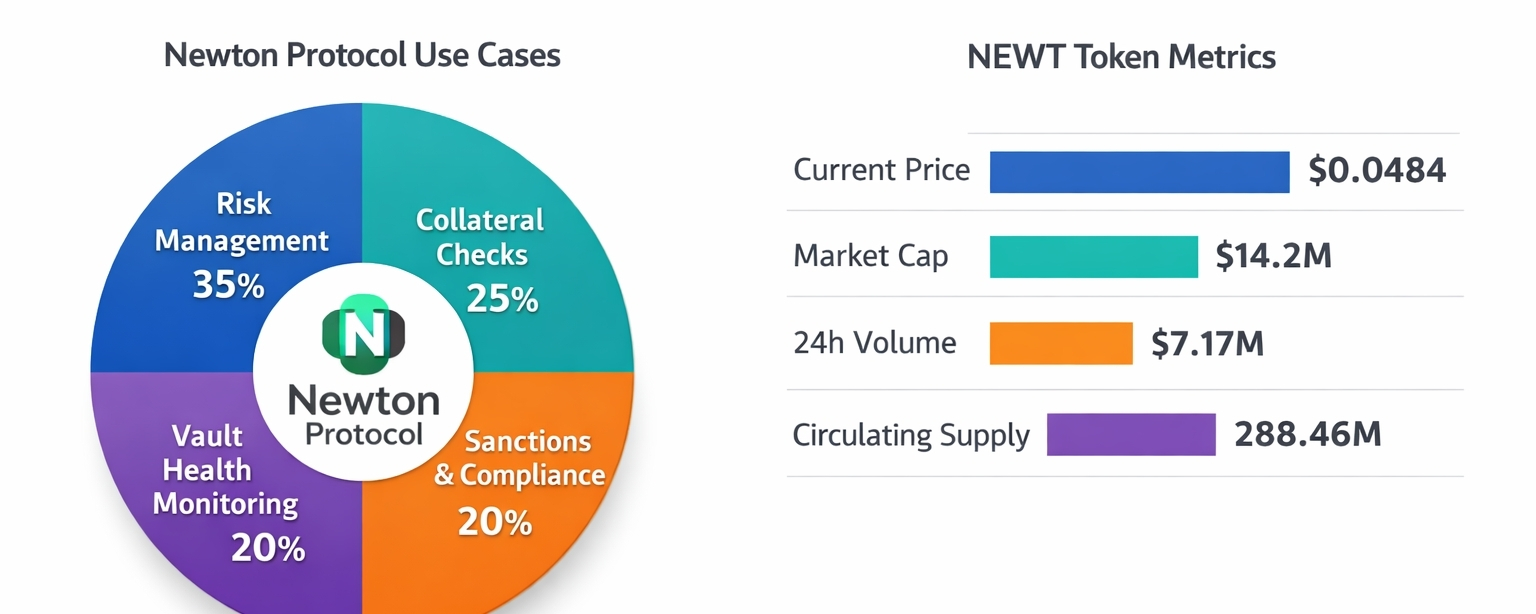
That sounds technical, but think of it like this. If a trading agent can ask an oracle for collateral prices, risk ratings, sanctions status, or vault health, the oracle shouldn’t also wander through the operator’s basement. Isolation by design gives the oracle a smaller room. It doesn’t make the data true. It doesn’t make the policy smart. But it does reduce the blast radius when someone writes bad oracle code or passes weird inputs.
I like that design. I also find it frustrating. Many real risk systems are not public URLs. A serious desk may have internal exposure data or approval services behind closed infrastructure. Newton’s sandbox says, fairly, “Bring the endpoint into a safer public shape.” That protects operators, but it creates integration work. You may need a gateway, a new access layer, or a sanitized data feed. Security is never free. Here, the cost is operational friction.
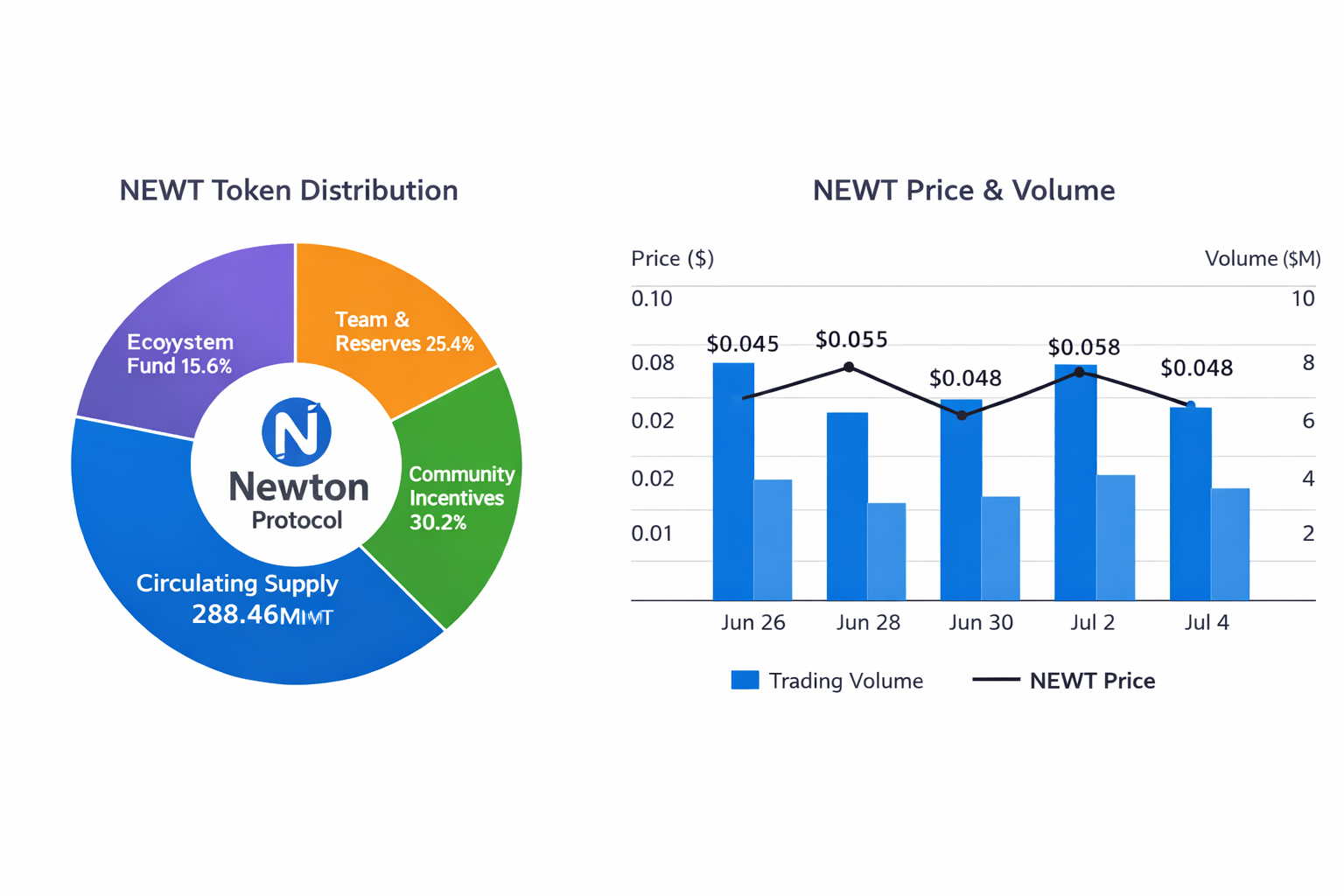
The market is pricing that uncertainty openly. As I write this on July 2, 2026, NEWT trades around $0.0484, while CoinMarketCap shows about $14.2 million in market cap, $7.17 million in 24 hour volume, 288.46 million circulating NEWT, and a 1 billion max supply. It is still about 94 percent below its listed $0.8337 all time high from June 24, 2025, and only recently bounced from a $0.04496 all time low on June 26, 2026. That’s not a clean strength chart. That’s a token trying to prove it isn’t just another post-launch bleed.
The realistic bull case is not “everyone uses Newton tomorrow.” It’s narrower. If the market starts believing Newton can become a serious authorization layer for vaults, agents, and institutional DeFi, the current valuation leaves room. At $0.10, with CoinMarketCap’s circulating supply unchanged, NEWT would be around a $28.8 million circulating market cap. At $0.15, it would be around $43.3 million. Fully diluted those prices imply $100 million and $150 million. Those numbers are not wild in crypto, but they require proof that integrations stick.
That brings me to the Retention Problem. Traders love launches. They love partner names. They love beta narratives. But infrastructure tokens live or die after the first attention cycle fades. Do vault curators keep using Newton after the demo? Do agents route real volume through policies when gas spikes, latency matters, or an oracle returns an error? Do partners like RedStone, Chainalysis, Credora, Veriff, Persona, Webacy, and vaults.fyi become daily dependencies, or just launch page logos? Newton’s error docs list DataProviderError, task timeout, no operators available, expired attestations, and BLS verification issues. None of that kills the thesis. It reminds me that production systems age differently than launch posts.
The bear case is cleaner. If policies are too hard to integrate, if private data owners don’t want public endpoints, if oracle failures create user pain, or if traders decide the token has weak value capture, NEWT can stay cheap for a long time. Price being down more than 90 percent from the high is not automatically opportunity. Sometimes it’s the market saying, “Show me usage.”
What would change my mind? Sustained task growth on Newton Explorer. Real vault capital using policy checks under stress. Clear operator decentralization beyond beta. Fewer ambiguous tokenomics questions. Better evidence that sandboxed oracle design improves safety without slowing down traders and curators who need fast execution.
So don’t buy the phrase. Watch the boundary. Watch what breaks. Watch who keeps building after attention moves on. If Newton’s oracle sandbox turns isolation into a habit rather than a feature label, then traders have something worth tracking. Not because it sounds safe but because it makes unsafe shortcuts harder to hide.