
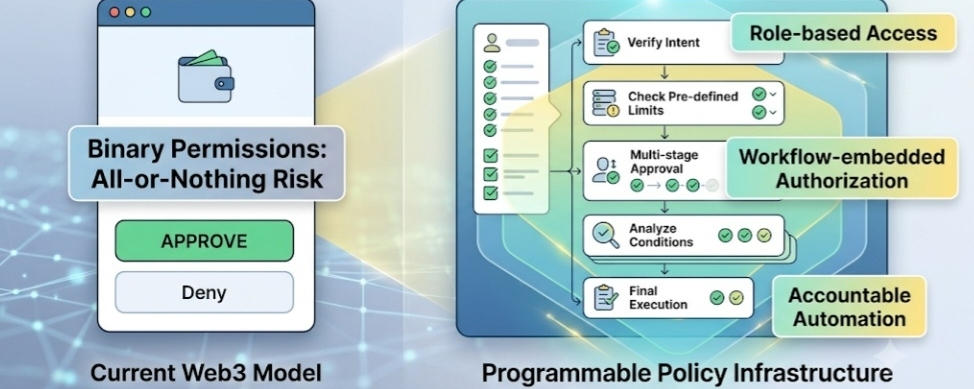
The biggest challenge in Web3 is no longer moving value. It is deciding whether value should move at all. Speed without intelligent control creates systems that are efficient but increasingly difficult to trust as automation becomes the default.
Today, blockchain applications are handling larger transactions, automated treasury operations, tokenized assets, and AI-assisted decision-making. Yet many wallets still operate with an all-or-nothing permission model. As decentralized finance expands into institutional use cases, that design becomes a growing operational risk rather than a technical limitation.
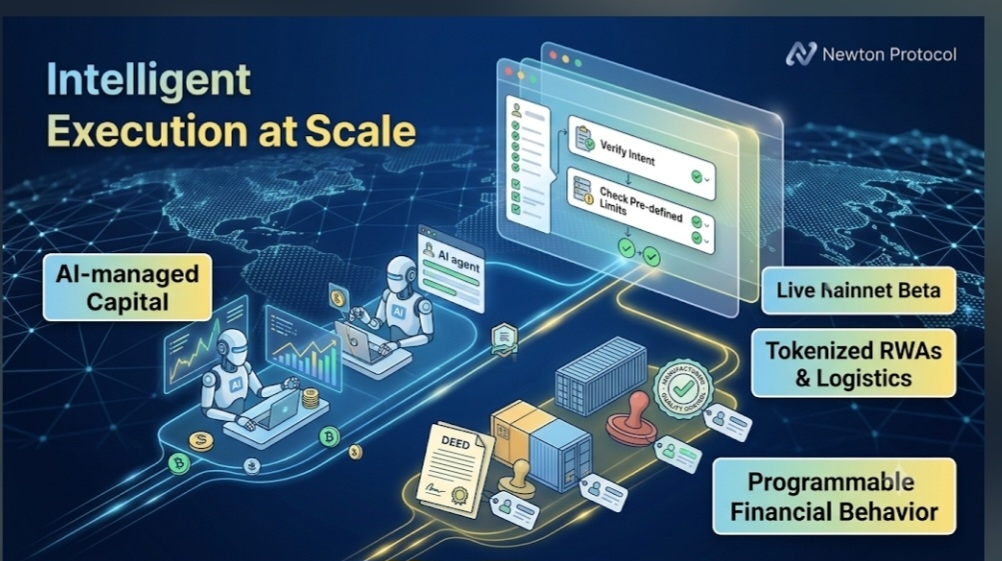
The pressure will only increase as AI agents manage capital, stablecoins become part of everyday payments, and tokenized RWAs connect traditional markets with blockchain infrastructure. Financial systems will need programmable rules that evaluate intent before execution instead of relying solely on irreversible transactions.
Several industries already demonstrate this principle. Banks enforce transaction policies before funds are transferred. Aviation relies on layered checklists before every flight leaves the runway. Hospitals require multiple approval stages before sensitive treatments are administered. Global logistics verifies customs documentation before cargo crosses borders. Cloud platforms assign role-based permissions before workloads are deployed. Modern manufacturing allows production lines to continue only after automated quality inspections pass. Each system succeeds because authorization is embedded into the workflow rather than added afterward.
This is where @NewtonProtocol introduces an important architectural shift. Instead of treating authorization as a simple wallet feature, it builds programmable policy infrastructure capable of defining who can act, under which conditions, and within predefined operational limits. That foundation allows automation while preserving accountability, making decentralized systems more suitable for complex financial environments.
The arrival of Newton Mainnet Beta transforms these ideas from architectural concepts into live infrastructure. Developers can begin testing programmable financial policies directly on-chain, organizations can experiment with controlled automation, and the broader ecosystem gains practical insight into how authorization logic performs in real network conditions. As adoption expands, $NEWT becomes closely connected to the network supporting this programmable permission layer.
Looking ahead, the most valuable blockchain networks may not be those that execute transactions the fastest, but those that make intelligent execution reliable at scale. Web3 is gradually evolving from programmable money toward programmable financial behavior, and authorization infrastructure will likely become one of its defining building blocks.