
A few weeks ago I came across a hypothetical example about an institutional fund
The details weren't particularly memorable
An AI agent had been asked to allocate capital only into established yield vaults that satisfied a predefined investment mandate
Then someone casually asked what would happen if the model became convinced that a vault deployed only a few minutes earlier was actually a legitimate tokenized Treasury strategy
I remember thinking that the answer was obvious
The model would be wrong
Language models have always been wrong in interesting ways
They misunderstand context
They confidently connect unrelated facts
None of that felt new
What stayed with me wasn't the hallucination
It was realizing that once the agent held the private key, there wasn't another decision left to make
The blockchain wouldn't pause to question the reasoning
It would simply verify the signature and continue
I didn't think much more about it after that
The next morning looked exactly like every other morning
Coffee
Governance proposals
Vault dashboards
A few AI summaries of everything that had happened overnight
Markets opened
Nothing unusual happened
Still, I noticed that I was thinking less about the market itself and more about that imaginary transaction
I wasn't entirely sure why
For most of the past year I have gradually let AI absorb more of my research process
Not because I wanted it making investment decisions
Mostly because information became too fragmented to process manually
One protocol updates its treasury
Another adjusts collateral parameters
Somewhere else a governance proposal quietly changes incentive structures
Individually none of those events matter very much
Together they become difficult to hold in your head
So the workflow slowly changed
One prompt became several
Research became recurring
Morning reviews became automated
Without planning it, I stopped evaluating every intermediate step and focused almost entirely on whatever reached the end of the pipeline
At the time I called that efficiency
Now I'm less certain that efficiency was the only thing changing
Looking back, I think my attention had quietly migrated without me noticing
The AI wasn't replacing my judgment
It was changing where my judgment entered the system
I don't remember making that decision consciously
Maybe that's why it took me so long to notice
For a while I assumed the weakest part of autonomous systems would always be reasoning
Better models seemed like the obvious answer
Fewer hallucinations
Larger context windows
More reliable outputs
Every new release appeared to move in that direction
Yet the pattern that kept bothering me wasn't really about reasoning anymore
Sometimes the AI reached a perfectly sensible conclusion using incomplete information
The reasoning itself wasn't irrational
The problem appeared only after reasoning crossed an invisible boundary
A mistaken research summary is easy to correct
A mistaken transaction settles anyway
Those two mistakes don't belong to the same category
One changes an opinion
The other changes ownership
I found myself coming back to that distinction more often than I expected
Not because it answered anything
Mostly because it made some of my earlier assumptions feel incomplete
Maybe I had been treating execution like the final step of intelligence
When in reality it might belong to an entirely different system
That thought stayed unresolved until I happened to spend an evening reading through Newton Protocol
I wasn't looking for a protocol to explain the problem
If anything, I was still assuming the answer would come from better models
Instead I found myself paying attention to something surrounding the model
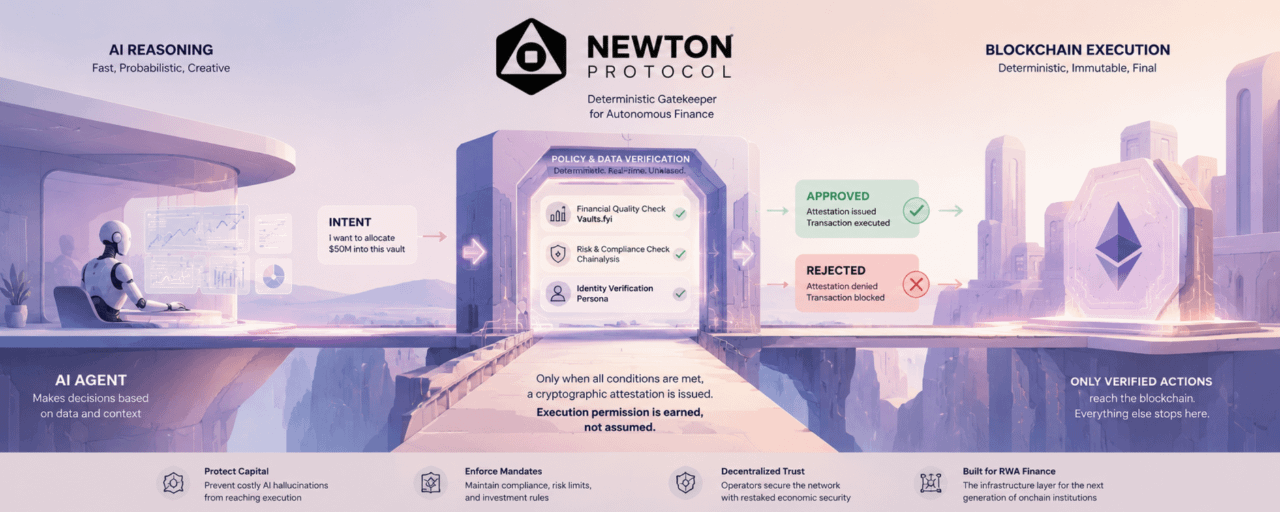
Newton asks the AI to express an intent rather than immediately authorize execution
At first that sounded like a small implementation detail
The longer I sat with it, the less small it seemed
Reading through the Vaults.fyi integration made me think back to the example I had almost forgotten
If an agent mistakes a brand new vault for an established Treasury product, the blockchain cannot distinguish confidence from correctness
A valid signature is still a valid signature
Newton quietly changes where certainty becomes necessary
Instead of trusting the model, deterministic Rego policies evaluate whether the intended allocation satisfies measurable conditions
Vault liquidity
Historical performance
Risk thresholds
Those conditions are verified against live data from Vaults.fyi before operators produce the cryptographic attestation required for execution
If the vault was deployed only minutes earlier, nothing dramatic follows
No emergency response
No attempt to unwind the trade
The transaction simply never receives permission to exist
The more I looked at that architecture, the less it felt like adding another security layer
It felt like relocating trust to somewhere the model could never claim on its own
What surprised me most was how quickly that observation stopped feeling specific to DeFi
Institutions allocating capital into tokenized Real-World Assets don't simply care about expected returns
They operate inside legal mandates, compliance requirements and fiduciary responsibilities that exist whether markets are rising or falling
Those constraints aren't missing because language models are unintelligent
They're missing because they were never reasoning problems in the first place
They're operational boundaries
Reading further, I noticed Newton could combine independent sources inside the same permission check
Vaults.fyi evaluates financial quality
Chainalysis evaluates sanctions exposure
Persona evaluates identity
Individually none of those systems decides whether capital should move
Collectively they decide whether the AI is allowed to transform an interpretation into an irreversible action
Somewhere along the way I realized I had quietly stopped asking whether AI could become trustworthy enough
I had started wondering whether trust was ever supposed to live inside the model at all
My mornings haven't changed very much
The coffee is still there
The dashboards still refresh before I finish the first cup
The AI summaries still save hours every week
From the outside almost nothing looks different
The only change is that I notice another layer now
A layer I don't think I was paying attention to before
I used to believe autonomous finance would mature as models became increasingly intelligent
I'm no longer convinced that's where institutions have been waiting
Perhaps they were waiting for infrastructure that knows when intelligence should stop and authorization should begin
I'm not completely sure yet
I only know that ever since I noticed that boundary, it's become much harder not to see it everywhere