
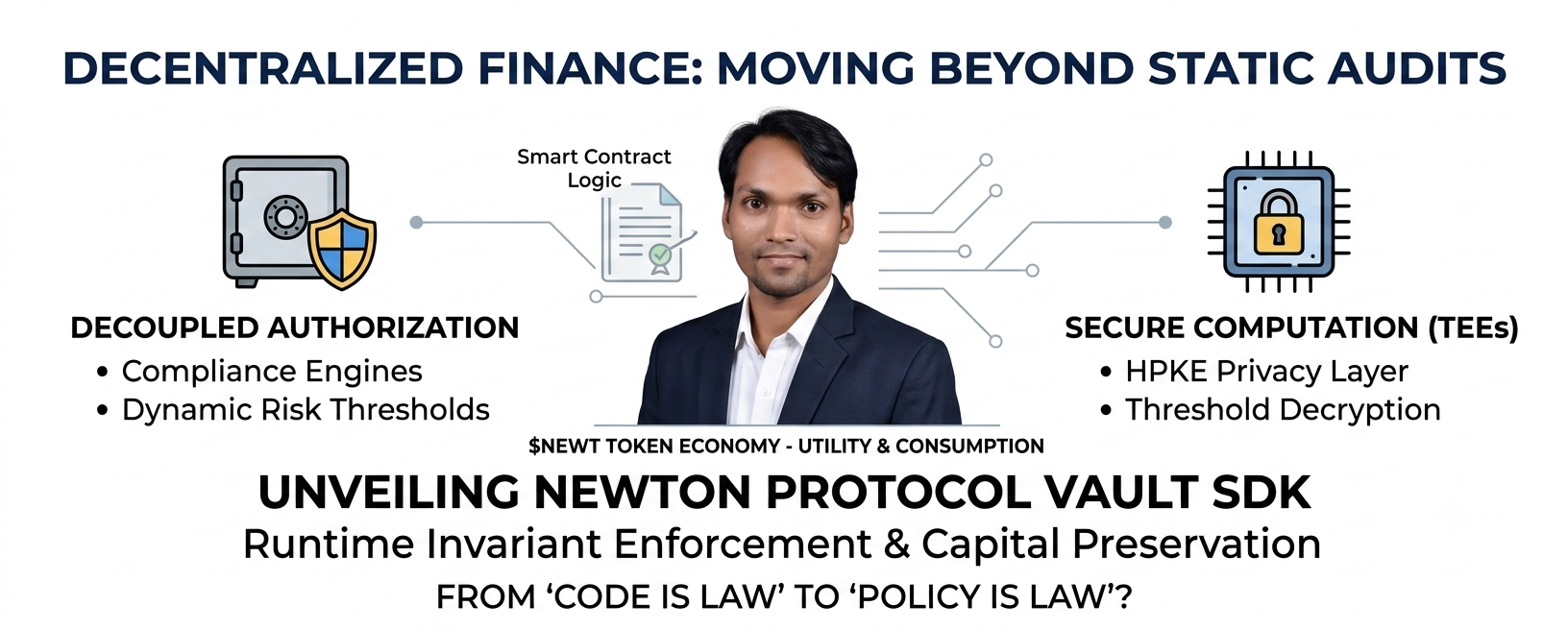

Yesterday I caught my Attention towards the white paper because, I really saw something useful information which kept my mind shocked. Static audits are a false comfort. We spend hundreds of thousands of dollars analyzing smart contract code before deployment, verifying mathematical formulas, and checking for reentrancy bugs. Yet, the history of decentralized finance shows that the vast majority of economic failures do not happen because a developer forgot a basic syntax check. They happen because execution assumptions silently break at runtime when volatile market forces collide with complex cross-contract composition.
This gap between code deployment and live execution is where liquid capital is most vulnerable. The release of the Newton Protocol Vault SDK by Magic Labs aims to completely re-engineer this dynamic, shifting from general transaction monitoring to strict runtime invariant enforcement at the smart contract level.
To understand why a dedicated Vault SDK changes the game for capital preservation, we must look at how liquidity pools manage risk. Traditionally, a vault relies on internal state logic to keep assets balanced. If an unexpected spike in market volatility occurs or an external dependency acts maliciously, the contract simply processes the inbound transaction because it fits the basic rules written in its code.
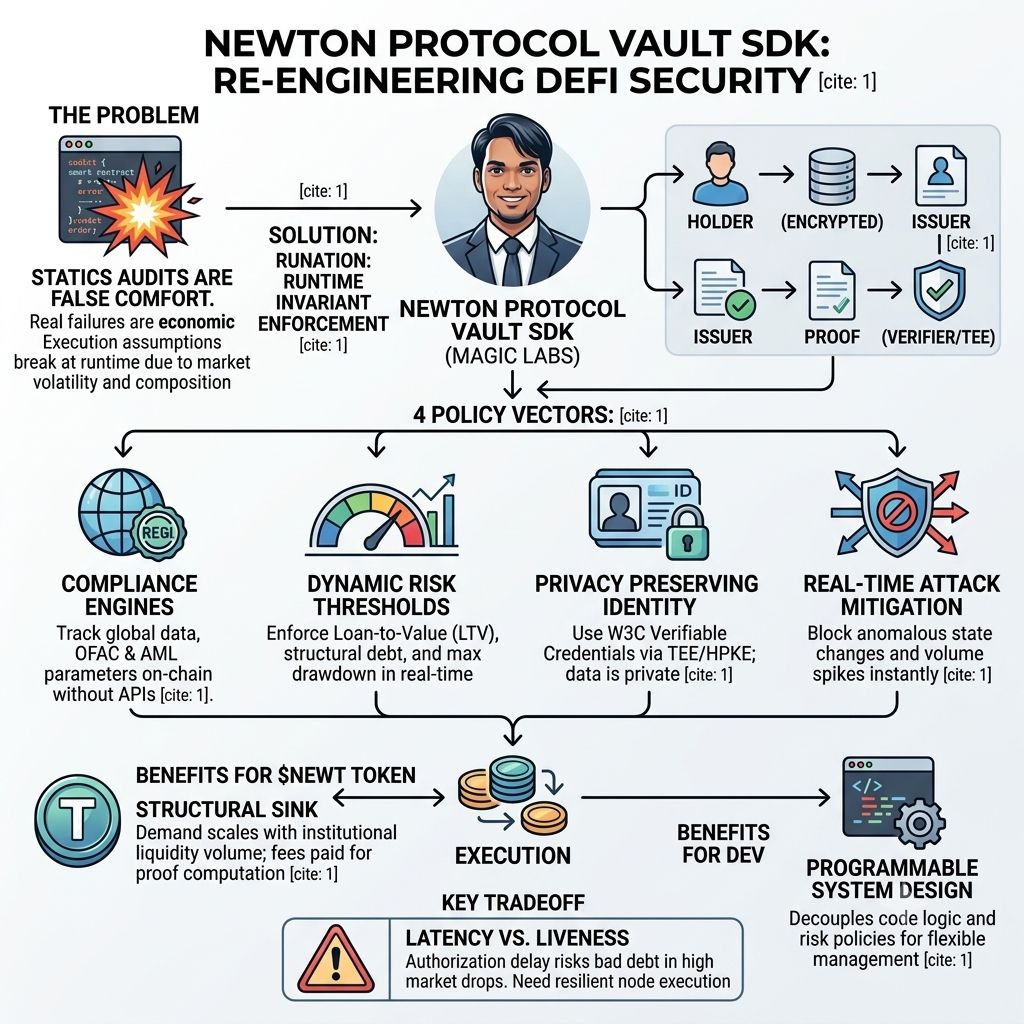
Newton introduces an external, decoupled authorization layer built precisely to protect these capital pools. Instead of hardcoding complex risk vectors directly into a Solidity contract, developers use the SDK to apply a separate policy layer. This structural decoupling means the core smart contract handles asset movement while the SDK evaluates compliance and system health beforehand. The code focuses on moving tokens, and the engine focuses on validating variables.
Inside the SDK Architecture: Four Policy Vectors
The Vault SDK wraps execution constraints into an easily deployable package, allowing teams to plug institutional-grade guardrails into their architecture within minutes. The core engine organizes these rules into four specific categories.
Compliance Engines: Direct, onchain evaluation of global regulatory data, automatically tracking OFAC lists and AML parameters without needing heavy offchain APIs.
Dynamic Risk Thresholds: Enforcing structural debts, Loan to Value ratios, and maximum drawdown during time of extreme market stress.
Privacy Preserving Identity: Utilizing W3C Verifiable Credentials via an Issuer, Holder and Verifier flow to verify participant criteria seamlessly.
Real Time Attack Mitigation: Blocking anomalous state changes or sudden volume spikes before liquidity can leave the pool.
To ensure performance remains lightning fast, the SDK processes these checks via an off-chain interpreter written in Rust (Regorus). This execution happens inside secure hardware (TEEs), keeping private data safe and reducing gas overhead, while generating lightweight cryptographic proofs that settle on the network.
The Privacy Layer: HPKE and Threshold Decryption
A significant concern for institutions deploying large amounts of capital has always been privacy. If you require users to verify their jurisdiction or financial status before joining a yield pool, how do you prevent that sensitive data from leaking onto a transparent blockchain?
Newton solves this by implementing Hybrid Public Key Encryption (HPKE) combined with threshold decryption. When a user presents their identity credentials to a vault using the SDK, the data is heavily encrypted before it interacts with the policy engine. The TEE validator enclaves checks the eligibility criteria entirely within a shielded computing environment. The underlying blockchain never stores or sees the personal information; it saves records in a cryptographic attestation that the user met the specific vault requirements.
Macro Implications for Token Velocity
For the $NEWT token economy, the adoption of the Vault SDK introduces a unique structural sink. Instead of relying on retail trading speculation, utility scales relative to the volume of institutional liquidity running through protected vaults. Every time a smart contract evaluates a transaction against the policy framework, a small gas fee is paid to compute the proof. As total value locked scales and transaction velocity increases, the demand for computational verification creates a continuous, programmatic consumption mechanism for the asset layer.
The Friction Point: Systemic Latency vs. Liveness
However, an honest technical assessment requires looking at the tradeoffs. Adding a pre-transaction validation step inevitably introduces a critical question: What happens if the authorization layer goes offline or experiences latency during a market liquidation event?
If the Newton engine delays an evaluation during a massive market drop, a vault might be unable to process critical margin adjustments, leading to unintended bad debt. Developers using the SDK must think carefully about their system liveness backups. Relying on external policy enforcement can create a new dependency vector that requires highly resilient node execution to avoid getting stuck during times of high network congestion.
The Programmable System Design
The long-term value of the Vault SDK goes far beyond basic security. It represents a fundamental shift in how developers design financial software. Instead of building monolithic, unchangeable smart contracts that struggle to adapt to changing environments, developers can now build minimal, highly efficient codebases and manage their operational risk through upgradeable, external policy rulebooks.
By separating execution from authorization, Newton provides the structural foundation needed to turn volatile, high risk code into a highly secure environment fit for global institutional capital.
Turning the Point of view
If smart contracts begin offloading their safety checks to external policy engines, does this mean we are moving away from the classic code is law principle toward a more flexible policy is law framework?
For developers, what is your biggest hesitation when considering an external verification layer for a high TVL application?
Let me know your thoughts in the comments below, and share this breakdown with your technical network!