
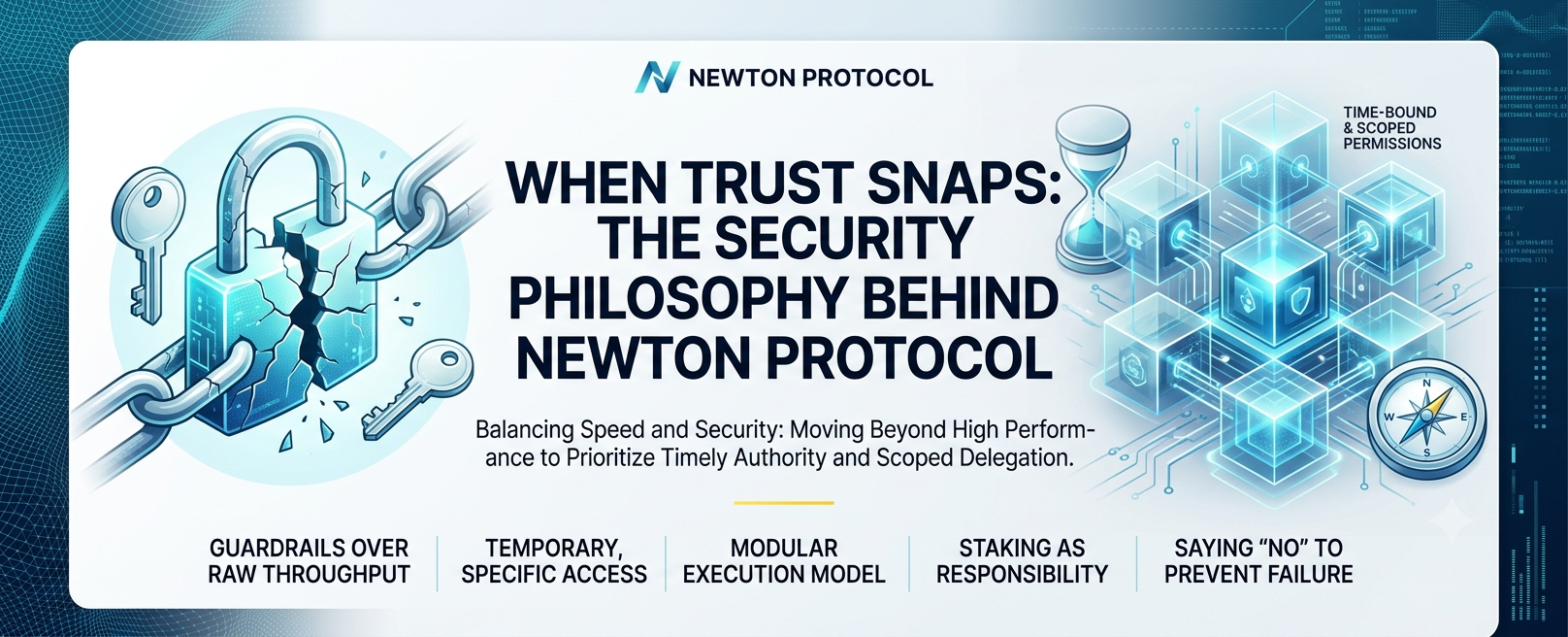
I used to think every blockchain conversation eventually came down to speed. Higher TPS, lower latency, faster confirmations. Those numbers looked convincing until I started reading incident reports instead of marketing pages. The pattern was surprisingly consistent. Most failures weren't caused by blocks arriving too slowly. They started with wallet approvals that never expired, permissions that granted more authority than intended, or private keys that quietly became exposed. By the time anyone noticed, the ledger was only recording a failure that had already happened.
That is why risk committees spend more time debating wallet approval policies than transaction throughput. Audits rarely begin by asking how many transactions fit inside a second. They begin by asking who was allowed to sign, for how long, and under what conditions. The uncomfortable truth is that security usually collapses long before performance does.
Newton Protocol approaches this reality from a different direction. As an SVM-based high-performance Layer 1, it treats execution speed as valuable, but never as an excuse to weaken control. The interesting part is not raw throughput. The interesting part is the guardrails that decide when authority begins and when it must end.
Newton Protocol Sessions reflect that philosophy. Instead of permanent authority, delegation is enforced through permissions that are both time-bound and scope-bound. Access becomes temporary, specific, and measurable rather than open-ended. Scoped delegation + fewer signatures is the next wave of on-chain UX. Convenience matters, but only when it reduces unnecessary exposure instead of increasing it.
Its modular execution model operates above a conservative settlement layer, allowing innovation without forcing every component to inherit the same level of risk. EVM compatibility helps reduce tooling friction for developers, but compatibility alone is not a security model. Every bridge still introduces additional assumptions, and every external dependency expands the attack surface. Trust doesn’t degrade politely—it snaps.
The native token exists once in this equation as security fuel, while staking represents responsibility rather than passive yield. Participants are not simply earning rewards; they are helping maintain the conditions that allow the network to reject unsafe behavior before it becomes irreversible.
Perhaps that is the lesson hidden beneath every performance chart. Speed matters, but only after authority has clear limits. A ledger that accepts everything quickly is not necessarily reliable. A fast ledger that can say “no” prevents predictable failure.
