
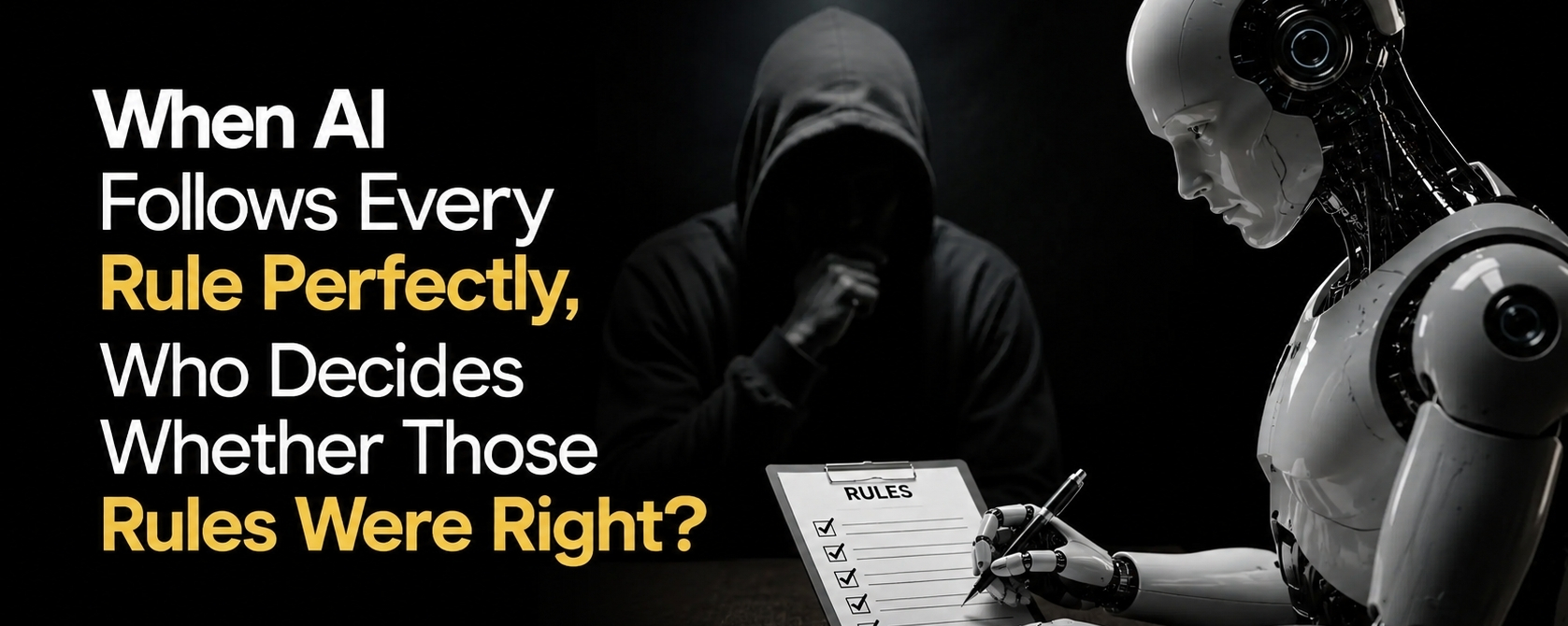

The thing that stayed with me after looking at Newton Protocol was not the usual promise of verification. It was the awkward question sitting behind it.
What does it actually mean for an AI agent to “follow the rules”?
Newton is useful because it tries to make AI behavior provable. An agent is given a policy, it acts within that policy, and later there can be evidence that it did not cross the line. That matters. In a world where AI agents may move funds, execute trades, approve actions, or interact with contracts, “trust me, it behaved correctly” is not enough.
But verification only proves a very specific thing.
It can show that the agent followed the rulebook.
It cannot show that the rulebook was good.
That sounds simple, but it changes how I think about the whole project. Imagine a company using an AI agent to handle refunds. The agent follows every internal policy exactly. It rejects late claims, approves eligible ones, escalates edge cases, and produces proof for every decision.
From a technical perspective, everything worked.
But what if the refund policy was unfair? What if it ignored situations a human support worker would have understood immediately? What if the rules were written quickly, by people trying to reduce costs rather than solve customer problems?
Newton could prove the agent obeyed.
It could not prove the company had good judgment.
That is not a failure of Newton. It may actually be one of the most honest things about the design. The protocol does not magically decide what is fair, wise, or context-aware. It deals with execution. Humans still have to deal with meaning.
The danger is that people may forget this distinction. Once something becomes verifiable, it starts to feel legitimate. A clean proof can make a bad process look disciplined. An audit trail can make a poor decision look responsible.
But some of the worst decisions in the world were made by people who followed procedure.
This is where Newton becomes more interesting to me. It does not remove trust. It moves trust to a different place. Instead of asking, “Did the AI secretly break the rules?” we start asking, “Who wrote these rules, and were they thoughtful enough?”
That second question is harder.
Rules get old. Markets change. Users behave in unexpected ways. A policy that made sense three months ago can become dangerous today. An AI agent may keep following it perfectly while reality has already moved on.
So the protocol can give us confidence in compliance, but not confidence in wisdom.
That boundary matters.
The documentation, to its credit, seems more focused on verifiable execution than on pretending to solve every AI governance problem. That restraint is important. Still, the unresolved part is where the real tension lives.
Who updates the policies?
Who notices when the rules are no longer working?
Who is responsible when an agent does exactly what it was told and the result is still wrong?
Those are not cryptographic questions. They are human ones.
Maybe Newton’s biggest contribution is not that it makes AI agents “trustless.” Maybe it makes the remaining trust more visible. If execution can be proven, then weak governance has fewer places to hide.
And that leaves us with a less comfortable but more useful question:
As AI agents become easier to verify, will we become better at writing the rules they follow?
