
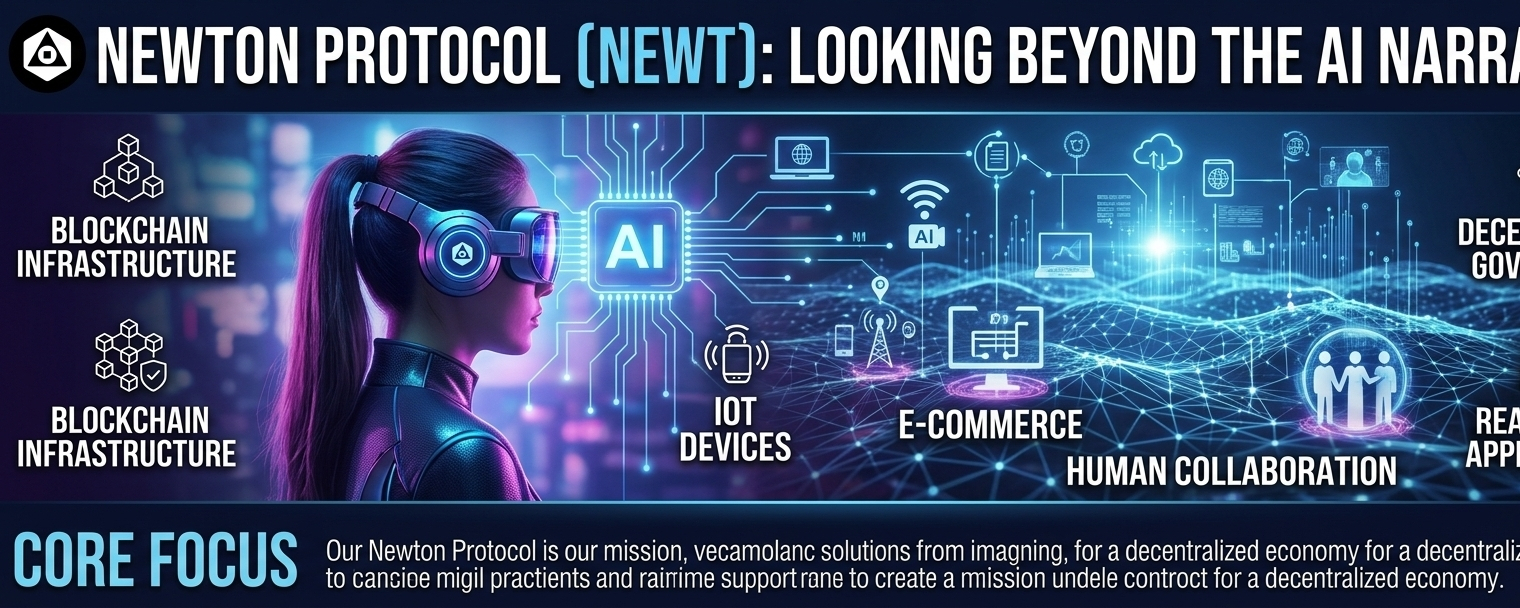
I've been thinking about how quickly the crypto market falls in love with new narratives and how rarely it pauses to ask whether the underlying economics deserve that attention. I've watched layer 1s promise to replace everything, infrastructure protocols claim they would become the internet's backbone, and AI tokens arrive carrying expectations that no early-stage project could realistically satisfy. That history makes me slower than most when I look at something like Newton Protocol. I keep coming back to the same question that has saved me through multiple market cycles: if the market stopped rewarding stories tomorrow, what would still be worth studying?
Newton Protocol is trying to build secure infrastructure around AI-driven financial strategies, automated trading, and an open marketplace where developers can deploy and monetize intelligent agents. At first glance, that sounds like another attempt to combine the two strongest narratives in crypto today: rollups and artificial intelligence. Markets usually pay a premium for projects sitting at the intersection of popular themes. The difficult part is separating temporary attention from lasting utility.
I've learned that infrastructure projects rarely succeed because they sound technically impressive. They succeed because people eventually depend on them without thinking about the technology underneath. That difference matters. Investors often celebrate complicated architectures while ignoring whether anyone is actually using them. A protocol can have elegant cryptography, sophisticated virtual machines, and an active social media presence while producing almost no meaningful economic activity. Eventually the numbers catch up with the narrative.
When I evaluate Newton Protocol, I find myself paying far less attention to promotional material and far more attention to incentives. AI-driven trading sounds attractive because everyone imagines machines discovering profitable opportunities faster than humans. The reality is less glamorous. Financial markets adapt quickly. If an AI strategy consistently generates excess returns, competitors eventually discover similar approaches, compressing those profits over time. Sustainable value therefore comes less from the intelligence of the algorithms and more from the infrastructure enabling developers to build, verify, deploy, and improve those systems securely.
That is where Newton's design becomes more interesting than the marketing headline. A secure rollup focused on AI strategies acknowledges an uncomfortable truth: automation introduces new risks alongside new efficiencies. If autonomous agents are making financial decisions, users need confidence that execution is transparent, assets remain protected, and incentives discourage malicious behavior. Security is not simply another feature. It becomes the foundation upon which every other promise depends.
Still, security claims deserve skepticism. Every protocol advertises robust architecture before it faces real economic stress. Markets have repeatedly demonstrated that theoretical security and operational security are not always the same thing. Smart contracts behave differently once billions of dollars begin interacting with edge cases that developers never anticipated. Governance decisions become more contentious. Economic incentives evolve. Attack surfaces expand. Time remains one of the few forms of due diligence that cannot be accelerated.
Tokenomics deserve equal attention because they determine whether network growth benefits long-term participants or merely early insiders. I've seen projects with exceptional engineering gradually lose investor confidence because token issuance overwhelmed organic demand. High inflation can quietly dilute ownership even while headlines remain optimistic. On the other hand, aggressive token burning means little if genuine network activity never materializes. Supply dynamics only become meaningful when paired with real usage. Otherwise, they are accounting exercises rather than economic signals.
This is why I prefer watching on-chain activity over social engagement. Wallet growth by itself tells me very little because creating addresses is almost free. Transaction counts can also mislead if incentives encourage meaningless activity. Even total value locked should be interpreted carefully. Liquidity mining campaigns often inflate deposits that disappear as soon as rewards decline. What interests me more is whether users continue interacting with the protocol after incentives normalize. Retention tells a more honest story than acquisition.
Developer activity offers another useful perspective, although it is frequently misunderstood. A growing number of contributors does not automatically translate into a healthier ecosystem. What matters is whether developers continue shipping improvements over extended periods and whether external builders choose to create applications without direct financial encouragement. Open-source ecosystems become durable when independent participants believe the opportunity extends beyond grant programs.
Governance also deserves closer examination than it usually receives. Decentralization is often measured by token distribution alone, yet influence frequently concentrates elsewhere. Large holders, core contributors, and infrastructure providers can shape outcomes in ways that voting statistics fail to capture. Healthy governance requires more than participation. It requires aligned incentives that encourage decisions benefiting the protocol years from now rather than the next quarterly announcement.
The AI marketplace concept introduces another layer of complexity. Network effects are powerful but notoriously difficult to establish. Developers will only build where users exist, while users only arrive where valuable applications already operate. Breaking that cycle requires more than technology. It requires thoughtful incentive design, competitive developer tooling, and enough differentiation that participants choose the ecosystem for reasons extending beyond temporary token rewards.
I also think about competition because crypto rarely rewards being merely good. Projects compete not only with direct rivals but also with established ecosystems possessing larger developer communities, deeper liquidity, and stronger institutional relationships. Newton Protocol therefore needs to create advantages that remain meaningful after the excitement surrounding AI inevitably cools. Temporary trends attract attention. Enduring infrastructure survives changing narratives.
One lesson I've carried through several market cycles is that timing often matters as much as execution. Building during periods of excessive optimism creates unrealistic expectations. Building during quieter markets often produces stronger foundations because teams spend less energy satisfying short-term speculation. I don't know which path Newton Protocol will ultimately follow, but I do know that markets eventually become less interested in vision decks and more interested in measurable adoption.
Perhaps the most encouraging aspect is that the project is attempting to solve problems emerging from genuine technological evolution rather than manufacturing demand that never existed. AI systems are becoming increasingly capable, and automated financial decision-making will likely become more common. The unanswered question is whether blockchain infrastructure becomes an essential component of that future or merely an optional layer that certain applications choose to use. That distinction will determine far more than token price.
After enough years in crypto, I've become comfortable admitting what I cannot know. I cannot predict whether Newton Protocol will become critical infrastructure or remain a niche experiment. I cannot confidently estimate future adoption curves before observing sustained developer commitment and real user behavior. What I can do is continue watching the evidence accumulate instead of allowing narratives to replace analysis.
The market will undoubtedly produce stronger opinions than mine over the coming months. Some will dismiss the project because AI has become an overused buzzword. Others will embrace it precisely for that reason. I suspect the truth, as usual, will emerge somewhere between those extremes. The more interesting questions are not whether AI belongs in crypto, but whether secure infrastructure can create lasting economic value, whether developers will continue building after incentives fade, whether users will trust autonomous financial systems with meaningful capital, and whether the protocol can still justify its existence once the excitement surrounding today's narratives eventually moves elsewhere.
