
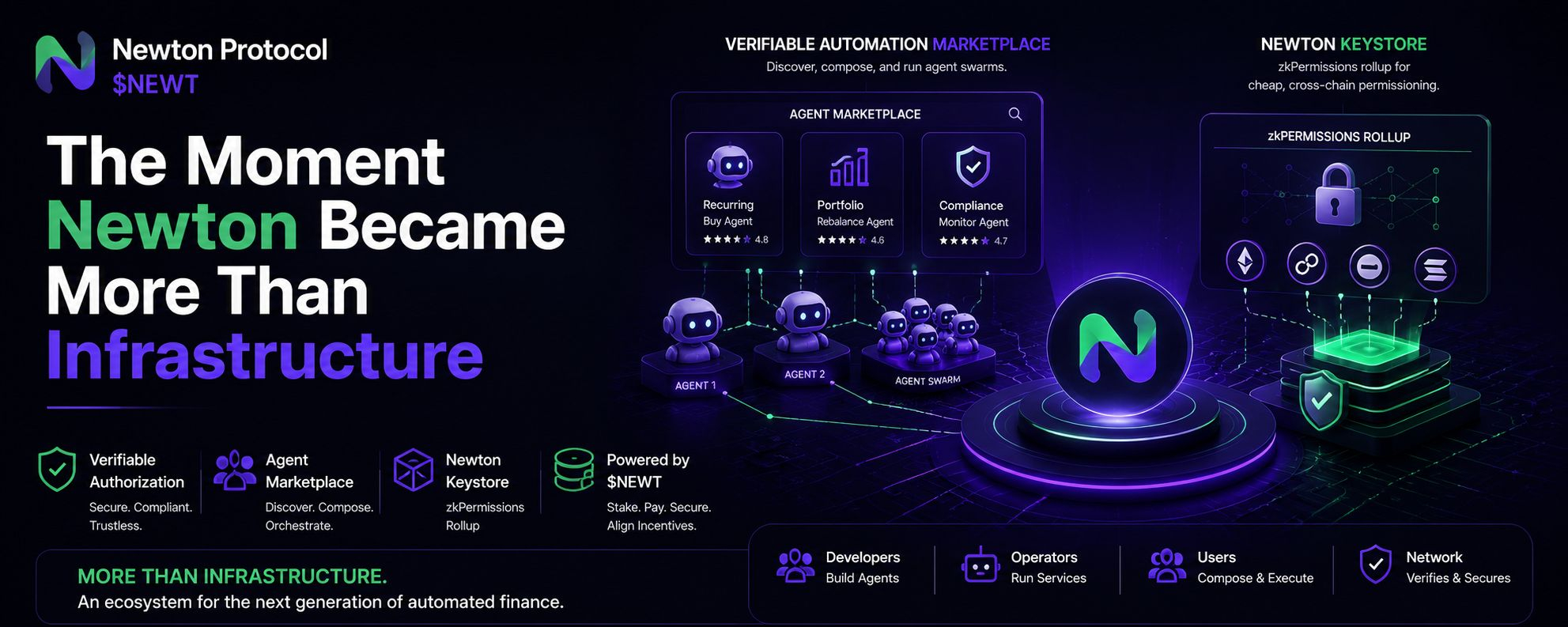

There's a detail in Newton's roadmap that I keep returning to, mostly because it feels like a quiet admission that the "authorization layer" framing was only ever half the plan.
The team is building a Verifiable Automation Marketplace on top of something called the Newton Model Registry. Developers publish agent models. Users discover them, compose them, and apparently can even orchestrate "agent swarms" made of multiple agents working together. Alongside that, there's a separate piece called the Newton Keystore, described as a zkPermissions rollup meant to make cross-chain permissioning cheap enough to actually use at scale.
Put those two things next to each other and something shifts.
Everything I'd looked at from Newton before was framed as infrastructure that sits quietly underneath someone else's application. A policy client gets attached to a contract. Attestations get checked before execution. The value proposition was that you barely notice it's there until the moment it stops something bad from happening. That's a classic infrastructure pitch — invisible until it matters.
A marketplace is not invisible.
A marketplace is a place people go. It has listings, discovery, reputation, and presumably some notion of which agents are good and which ones aren't. That's a completely different kind of product than "authorization middleware." It means Newton isn't only trying to be the thing developers plug into. It's trying to be the place where the agents themselves live, get found, and get combined into bigger automated workflows.
I don't think that's a small pivot, even if the team would describe it as a natural extension.
Once you have a marketplace, you need economics that make sense for a marketplace, not just for a policy engine. And that's apparently where NEWT comes back in more directly than before. Developers pay NEWT to register models in the registry. Operators stake NEWT as collateral to run agent services. If the marketplace gets any real usage, that's a demand loop that has nothing to do with attestation fees on individual transactions it's closer to how a real app store or plugin marketplace extracts value, except the currency is the network's own token and the "apps" are autonomous financial agents.
That's a more interesting bet than another restaking narrative, but it's also a harder one to pull off.
Marketplaces live or die on one thing: whether the supply side actually shows up before the demand side does, or vice versa, and whether either side has a reason to stay once they've shown up once. Newton currently has one live agent a recurring buy agent as the anchor product. Everything else on the roadmap is "upcoming." That's not a criticism so much as a timing observation. A registry with three listings and a registry with three thousand listings are not the same product, even if the smart contracts underneath are identical.
Then there's the Keystore rollup, which solves a different problem entirely but is clearly meant to be read alongside the marketplace.
If agents are going to be composed and discovered across chains, permission checks that only work well on one chain become a bottleneck fast. A dedicated zkPermissions rollup is Newton's answer to that take the guardrail logic off the host chain, make it cheap and consistent everywhere, and let developers define rules through an SDK instead of rebuilding attestation logic per chain. On paper that's the right architecture for a multichain agent economy. In practice it adds a rollup's worth of new attack surface, new validator assumptions, and a new dependency that the marketplace's entire value proposition now quietly relies on.
Newton's own roadmap acknowledges this is a staged rollout permissioned validators first, permissionless later, "pending technology maturation." I read that as reasonably honest, but it also means the marketplace's cross-chain promise is only as credible as a rollup that hasn't been battle-tested yet.
What I keep sitting with is this: infrastructure plays get judged on reliability. Marketplace plays get judged on liquidity of agents, of users, of trust between the two. Newton is now trying to be judged on both at once, using the same token to secure the rollup, price the registry, and collateralize the operators. That's elegant in a diagram. It's a lot to ask of one token's demand curve in practice, especially with a circulating supply that's still expanding and a price that's spent most of this year well below its highs.
Maybe the marketplace is what finally gives the compliance layer somewhere to point to besides "trust us, it's running underneath." Or maybe a permissions rollup and an agent marketplace end up as two ambitious builds competing for the same limited engineering bandwidth and the same thin liquidity.
I don't think that's decided yet. I don't think Newton thinks it's decided yet either.