
I keep coming back to the same uncomfortable question: if an AI agent can trade for me, what exactly am I giving up in exchange?
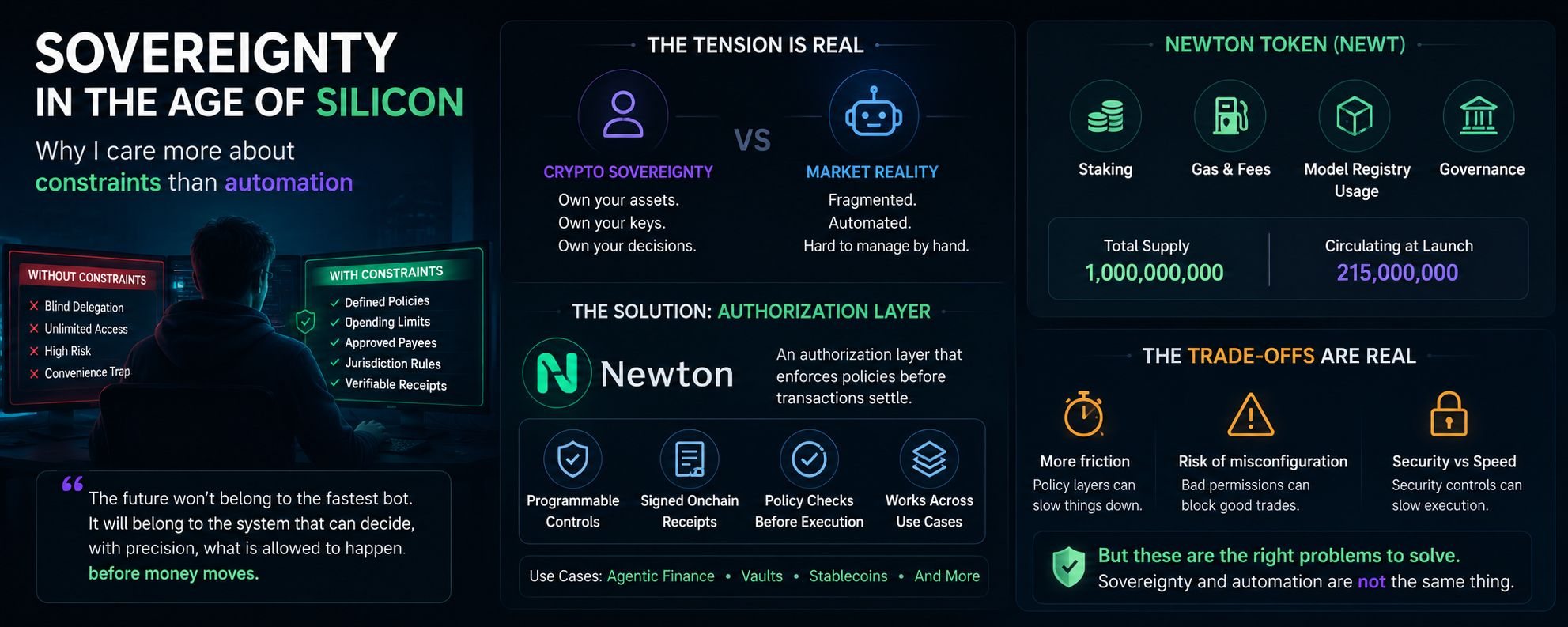
That tension is real. On one side, crypto asks us to own our assets, our keys, and our decisions. On the other, the market keeps getting more fragmented, more automated, and harder to manage by hand. The promise of self-driving money is attractive. The risk is obvious: convenience can quietly become delegation without guardrails.
That is why Newton Protocol is interesting to me. Its public materials describe it as an authorization layer that enforces policies before transactions settle, using programmable controls, signed onchain receipts, and policy checks across use cases like agentic finance, vaults, and stablecoins.
The deeper idea is not “trust the AI less.” It is “trust the action more carefully.” If a wallet can set spending caps, approved payees, and jurisdiction rules before execution, then automation becomes something closer to constrained delegation than blind surrender.
Newton’s token design also reflects that thesis. The foundation says NEWT is meant for staking, gas and fees, model registry usage, and governance, with a fixed 1B supply and 215M circulating at launch.
That does not remove the trade-offs. Policy layers add friction. Bad permissions can block good trades. Security controls can slow execution. But those are the right problems to be arguing about. The wrong problem is pretending sovereignty and automation are the same thing.
The future of onchain finance will probably not belong to the fastest bot. It will belong to the system that can decide, with precision, what is allowed to happen before money moves.
