Artificial intelligence is moving incredibly fast.
Every week we see new AI tools that can write code, answer questions, automate repetitive work, analyze markets, and even perform multi-step tasks without constant human input.
But there is one question that becomes more important every time AI gets smarter.
Can we trust what AI is doing with our assets, data, and permissions?
That question is exactly why I started paying closer attention to @NewtonProtocol and its Newton Mainnet Beta.
This isn’t simply another AI project trying to create hype around automation.
Instead, Newton Protocol is working on infrastructure that helps make AI-powered automation transparent, verifiable, and user-controlled, which I believe is something Web3 will increasingly need over the next few years.
$NEWT #Newt
AI Is Becoming an Execution Layer
Most people still think AI only means asking questions to a chatbot.
That picture is already changing.
The next generation of AI won’t just answer.
It will execute.
Imagine telling an AI assistant:
• Bridge my assets when gas fees are low.
• Claim staking rewards every week.
• Rebalance my portfolio.
• Renew blockchain domains.
• Move idle stablecoins into supported yield opportunities.
• Pay subscriptions automatically.
These aren’t impossible ideas anymore.
The challenge isn’t making AI capable.
The challenge is making sure every action happens safely and according to rules chosen by the user.
That’s where infrastructure matters.
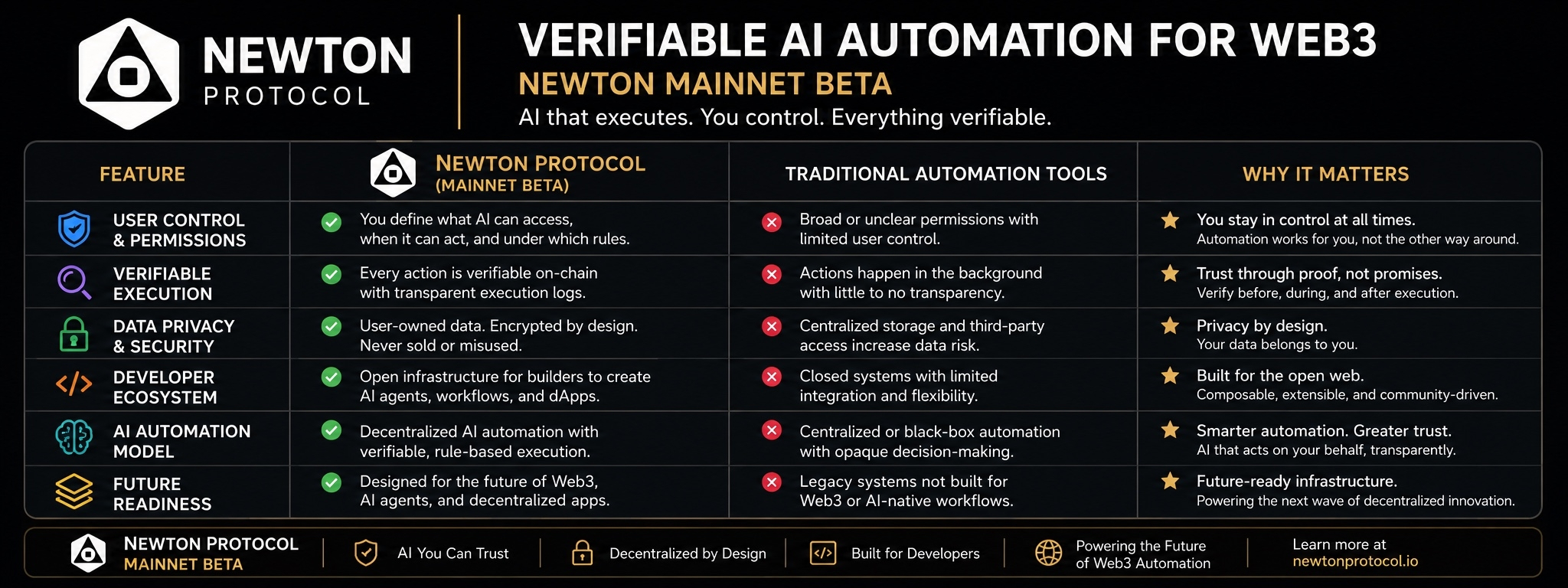
Why Traditional Automation Isn’t Enough
Today’s automation often depends on centralized services.
Users usually have no idea:
• Why an action happened
• What permissions were used
• Whether instructions changed
• Whether execution followed the original request
This creates unnecessary trust assumptions.
Web3 was created to reduce unnecessary trust.
If AI becomes part of Web3, it should follow the same philosophy.
That means automation should be:
• transparent
• verifiable
• permission-based
• user controlled
Instead of becoming another black box.
Newton Protocol’s Vision
Newton Protocol is approaching AI from a different angle.
Rather than asking,
“How can AI automate more things?”
it also asks,
“How can users verify those automated actions?”
That distinction matters.
The Newton Mainnet Beta focuses on building an environment where automation can operate while giving users greater visibility into execution.
Instead of simply trusting software, the goal is to create systems where actions can be verified and users remain in control of permissions.
For me, that’s a much stronger long-term direction.
What Makes the Mainnet Beta Interesting?
Mainnet Beta is important because this is where ideas begin interacting with real users and developers.
A beta network helps the ecosystem test:
✔ automation flows
✔ developer integrations
✔ network stability
✔ user experience
✔ smart contract interactions
✔ infrastructure improvements
Every successful blockchain reached an important stage when developers could finally build on top of working infrastructure.
Mainnet Beta represents that stage for Newton Protocol.
Why Verifiability Matters
Imagine giving an AI permission to manage part of your digital life.
Without verification, you simply hope everything happens correctly.
With verifiable execution, there is greater confidence that actions follow predefined rules.
This creates stronger trust between:
Users
↓
AI
↓
Blockchain
That trust layer may become one of the most valuable parts of future decentralized automation.
User Control Should Always Come First
One principle I appreciate about Newton Protocol is the emphasis on user control.
Automation shouldn’t mean losing ownership.
Instead, users should define:
What AI can access
When AI can execute
Which permissions exist
How actions are authorized
When automation should stop
This is a healthier model than giving unlimited access.
Good automation should always remain under user-defined boundaries.
Why This Matters for Developers
Developers are likely to play a huge role in Newton’s future.
Strong infrastructure allows builders to create new products without rebuilding every component from scratch.
Instead of focusing only on execution logic, developers can build applications on top of an ecosystem designed for AI automation.
As more developers experiment with the Mainnet Beta, we’ll likely see different ideas emerge across DeFi, wallets, gaming, consumer apps, and on-chain services.
Infrastructure often grows quietly before users notice its impact.
A Simple Example
Imagine you’re traveling overseas.
You don’t want to check your wallet every hour.
Instead you create a rule.
“If ETH gas fees fall below my chosen level, bridge these assets.”
Nothing happens until those conditions are met.
Once they are, automation executes according to your predefined instructions.
You remain the decision maker.
AI simply performs the work.
That feels much closer to how decentralized automation should operate.
Why Crypto Needs Smarter Automation
Crypto has become much more complex.
Users interact with:
multiple wallets
multiple chains
bridges
staking
governance
airdrops
restaking
DeFi
token management
Manually tracking everything becomes difficult.
Automation can reduce repetitive work.
But only if users remain comfortable trusting the execution process.
That’s why verification matters just as much as automation itself.
The Bigger Picture
Many blockchain projects compete by launching faster transactions or cheaper fees.
Newton Protocol is solving a different challenge.
How do we safely integrate AI into decentralized systems?
This feels like infrastructure rather than another short-term narrative.
Infrastructure usually isn’t the loudest part of crypto.
But it often becomes the foundation others build upon.
What I Find Most Interesting
Personally, three things stand out.
1. AI with accountability
Automation becomes more useful when users understand how actions happen.
2. User-defined permissions
Control stays with the user rather than the software.
3. Long-term infrastructure
If AI becomes a standard part of Web3, projects building trust layers today may become increasingly important tomorrow.
My Thoughts on the Future
We’re entering a period where AI agents may eventually help users manage increasingly complex digital lives.
Not by replacing people.
But by handling repetitive work more efficiently.
However, adoption will depend on trust.
Without trust, automation remains limited.
With transparent and verifiable execution, entirely new categories of decentralized applications become possible.
That’s one reason Newton Protocol has my attention.
Final Thoughts
The crypto industry has spent years building decentralized finance.
The next phase could be decentralized automation.
That won’t happen simply because AI becomes smarter.
It will happen because users trust how AI interacts with blockchain networks.
The Newton Mainnet Beta represents an important step toward exploring that future.
It’s still early, which means there is plenty to learn as developers continue building and the ecosystem evolves.
I’ll definitely be watching how Newton Protocol grows from here.
Paid Partnership
Follow @NewtonProtocol for the latest ecosystem updates.