
I’m waiting. I’m watching. I’m looking. I’ve been seeing the same question on loop: Okay, but how much can it really handle? I follow the numbers, but I also follow the silencesthe pauses between blocks,the little RPC hesitations,the moment traders start retrying and pretend it’s normal.I focus on what stays steady when it’s messy,not what looks pretty when it’s quiet.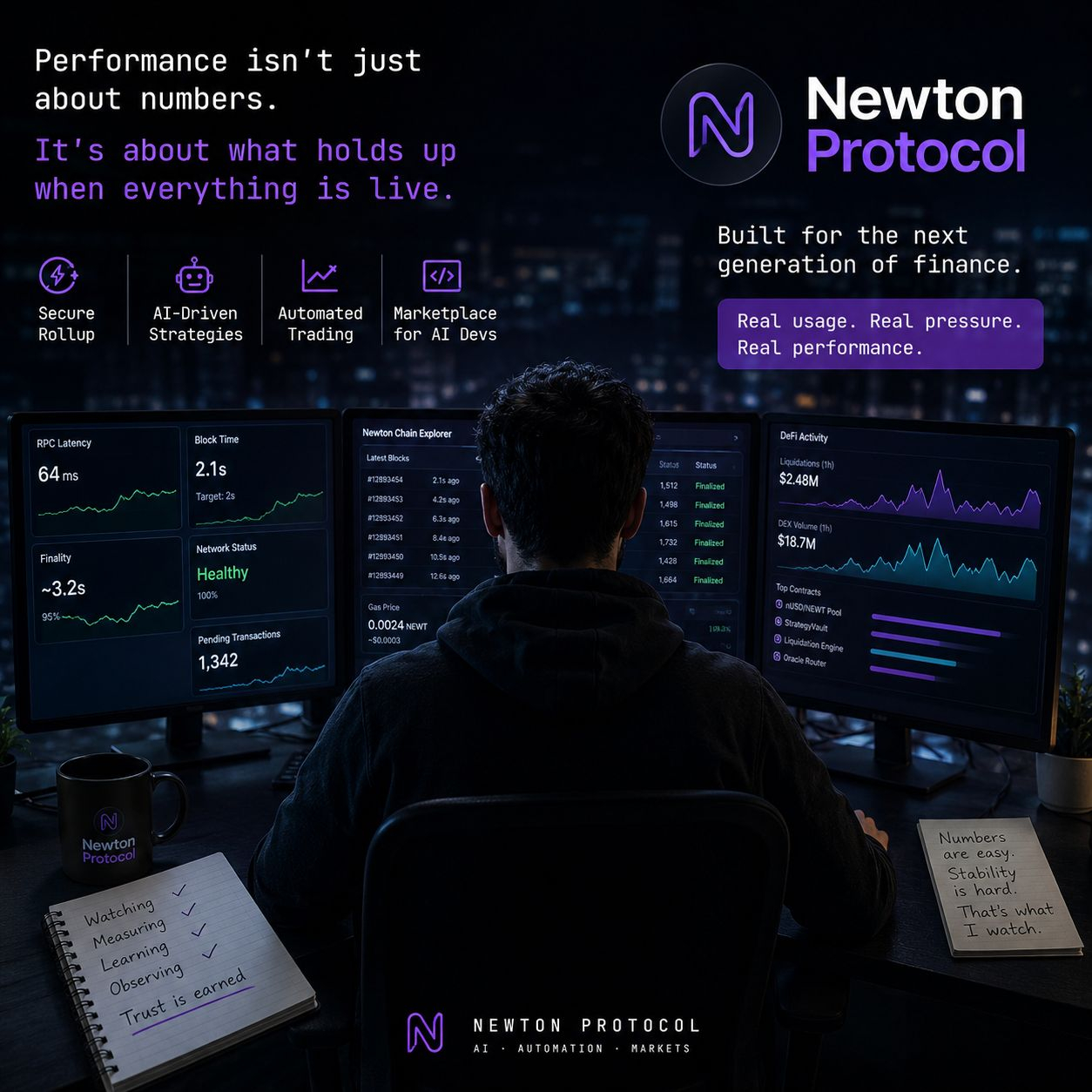
I've been checking Newton Protocol almost out of habit lately. Not because I'm expecting fireworks every day, but because I've learned that the real personality of a chain only shows up after the excitement fades. Launch week tells one story. Regular weekdays tell another.
The first thing people usually ask is how many transactions it can process. I get why—that's an easy number to compare. But I've stopped treating it as the answer. A network can look incredibly fast in a controlled environment and still feel slow when everyone arrives at once. Those are two completely different situationsNewton is building around AI-driven strategies and automated trading, which makes that difference even more important. Automated systems don't wait around. They all react to the same information within moments of each other. If a market moves sharply, dozens or even hundreds of strategies can end up chasing the exact same opportunity. That's when a chain gets tested for real.
I've noticed that the first signs of pressure usually aren't dramatic. Nothing crashes. Blocks still appear. What changes is everything around them. Wallets take a little longer to update. RPC requests become less consistent. A transaction that normally lands immediately suddenly needs another try. Individually those things seem small, but together they tell you far more than a TPS screenshot ever could.
Execution has always been more complicated than people make it sound. It's easy to imagine the processor doing all the work, but that's only part of it. Transactions have to move across the network, signatures need to be verified, work has to be scheduled, and different transactions often compete for the same piece of state. If everyone is trying to touch the same contract at once, there's only so much parallelism can do.
That's exactly why DeFi is such a useful stress test. Oracle updates arrive, liquidation bots wake up, arbitrage starts instantly, and everyone wants priority. The busiest moments aren't random. They're concentrated around a handful of contracts that suddenly become the center of attention. That's where retries increase, fees start changing, and users begin noticing the difference between theoretical capacity and actual experience.
I've also started paying more attention to the parts that sit around the chain instead of only the chain itself. If an explorer is behind, if an indexer can't keep up, or if public RPC endpoints begin slowing down, users don't separate those problems from the protocol. They simply feel that something is slower today than it was yesterday.
That's one reason I still like using ordinary public endpoints instead of relying only on official dashboards. They don't always tell a perfect story, but they often tell an honest one. You notice the small delays. You notice whether confirmations still feel predictable. You notice whether the overall experience stays smooth when traffic picks up.
Another thing I keep in the back of my mind is that every architectural decision comes with a trade-off. Lower latency between validators is useful. Better networking is useful. Smarter scheduling is useful. But every optimization usually asks for something in return, whether that's operational complexity, infrastructure concentration, or tighter coordination. None of those choices are automatically wrong. I just think they're worth watching instead of ignoring.
What keeps me interested in Newton isn't the promise that everything will always be fast. Every chain eventually runs into difficult moments. What matters is how gracefully it handles them. Does the network recover quickly? Do builders keep deploying? Do traders stop complaining because transactions simply work? Those are much harder achievements than posting an impressive benchmark.
For now I'm keeping my expectations simple. I want to see public RPC performance stay steady as activity grows. I want to see busy trading periods without retries becoming the normal experience. And I want wallets, explorers, bridges, and indexers to stay in sync instead of drifting apart whenever demand increases.
If those things keep improving over the next few weeks, I'll probably trust Newton more than I do today. Not because someone published a bigger number, but because the network quietly proved it could handle real users doing real things without making a lot of noise about it. #Newt @NewtonProtocol $NEWT
