
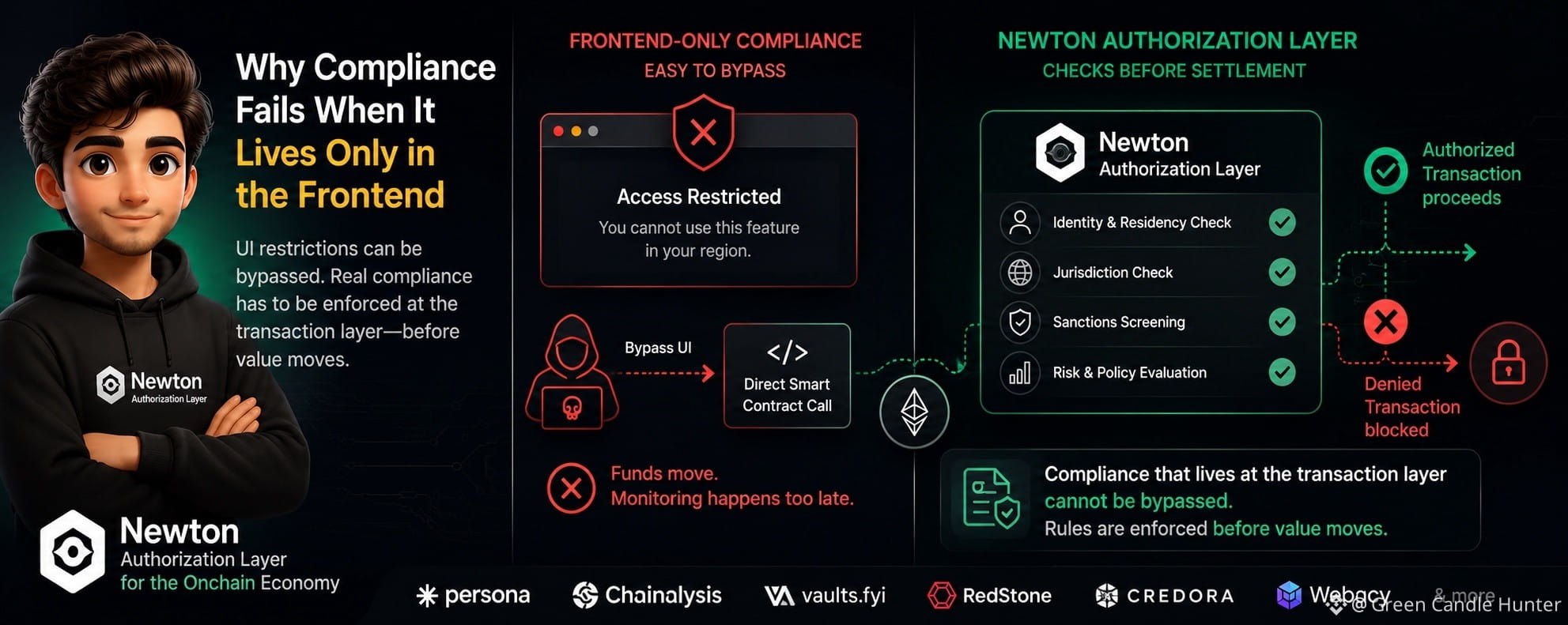

For a long time crypto products have treated compliance as something that happens around the transaction instead of inside it.
A frontend blocks a wallet from clicking a button. A web app hides a feature from users in a restricted region. An onboarding flow runs identity checks before giving access to a dashboard. On the surface that can look like compliance. The interface appears to enforce rules the user sees restrictions and the product can point to a visible control layer.
The problem is that none of those controls actually govern the transaction path itself.
If the smart contract can still be called directly then the rule doesn’t truly live in the system that moves value. It lives in the product layer sitting on top of it. And in onchain finance that distinction matters a lot more than it does in traditional web applications.
The more I think about Newton’s framing the more I think this is one of the clearest reasons an authorization layer exists in the first place.
A blockchain transaction doesn’t care what the frontend intended to prevent. It only cares whether the contract call is valid. If someone can bypass the interface and submit the transaction directly the blockchain will still execute it as long as the smart contract itself has no reason to reject it. That means UI restrictions can create the appearance of compliance without guaranteeing compliance at the moment that value actually moves.
Newton’s Persona integration article says this very directly: offchain identity checks and UI level controls create gaps because they are bypassable through direct smart contract calls. By the time monitoring flags an issue funds have already moved.
That line gets to the heart of the problem.
Frontend compliance is mostly a user experience control. It can shape who sees a button who completes a form or who gets routed through a specific onboarding flow. But it is not the same thing as transaction level enforcement. If the rule is not checked where the transaction is actually authorized then the system still depends on users behaving through the approved interface.
That is a weak assumption for any financial system and an even weaker one for an open blockchain environment where contracts are public and callable by anyone with the right transaction data.
This is where Newton’s architecture becomes much more interesting than a normal compliance integration.
Newton doesn’t frame compliance as something the application claims to have done. It frames compliance as something that should be evaluated before settlement and enforced at the transaction layer itself. In the Persona integration the verified identity and residency attributes aren’t just displayed in an app or used for UI gating. They are connected to Newton’s programmable authorization layer so that transaction rules can be evaluated before execution not after.
That difference changes the meaning of compliance.
A frontend only restriction says.
We tried to stop the user from initiating this action through our app.
A transaction layer authorization model says.
This action cannot execute unless it satisfies the required policy checks.
Those are not equivalent statements.
The first one is an interface safeguard.
The second one is enforceable infrastructure.
And when the asset movement is irreversible or difficult to unwind the difference between those two models becomes much more important than it might seem.
Newton’s broader documentation keeps returning to the same idea: the critical decision point is before settlement. In the mainnet beta and authorization layer materials Newton describes itself as the layer that sits between transaction initiation and transaction settlement checks whether the transaction satisfies policy and only then allows value to move.
That matters because post hoc compliance is not the same as preventative compliance.
If a transaction is flagged after execution the rule may have been observed but it was not enforced in time to stop the thing it was supposed to prevent. Monitoring analytics and audit trails still matter but they serve a different purpose. They tell you what happened. They do not necessarily control whether it happens.
Frontend checks have a similar limitation. They can reduce casual misuse and shape user behavior but they don’t close the execution path. In a permissionless environment the real question is not whether the app tried to stop a user. The real question is whether the transaction itself was impossible to execute without passing the required policy.
That’s why I think Newton’s framing is stronger than simply saying compliance should be onchain.
The more precise claim is that compliance should live at the same layer where the transaction gets permission to proceed.
If a product wants to restrict users from certain jurisdictions enforce age or residency requirements block sanctioned entities or apply transaction level risk rules those checks need to be attached to the path that actually reaches the contract. Otherwise compliance becomes a best effort filter sitting outside the system it is meant to govern.
The Persona integration gives a practical example of what this looks like. Identity attributes like age nationality residency and state can feed into Newton’s policy engine and the transaction can be authorized or denied based on those conditions before execution. The point is not just that identity is checked. The point is where it is checked not merely in the interface but in the authorization flow that determines whether the contract action can proceed.
I think that’s the real lesson here.
In onchain finance compliance fails when it lives only in the frontend because the frontend is not the final gate. The smart contract is.
If the contract path remains open then the rule is still bypassable.
And if the rule is bypassable it isn’t really enforcement. It’s just guidance wrapped in a user interface.
Newton’s model pushes that logic closer to where it actually matters the point right before value moves. In that sense the protocol isn’t just adding more compliance tooling. It’s changing the location of compliance itself from the application surface to the transaction path.
That’s a much more meaningful place for the rule to live.