
I'd be happy to. Here's an original reflective article of approximately 700 words that focuses on Newton Protocol and follows the tone you requested.
I’ve spent time thinking about Newton Protocol, and what continues to hold my attention isn't simply the combination of AI and blockchain. Those themes have become familiar across the industry, and they rarely surprise me on their own anymore. What keeps me reflecting is the quieter question beneath the technology. As intelligent systems begin taking on more responsibility, what makes people genuinely trust them? That feels like a much more important conversation than performance metrics or ambitious roadmaps. Technology evolves quickly, but confidence always seems to develop at a much slower pace.
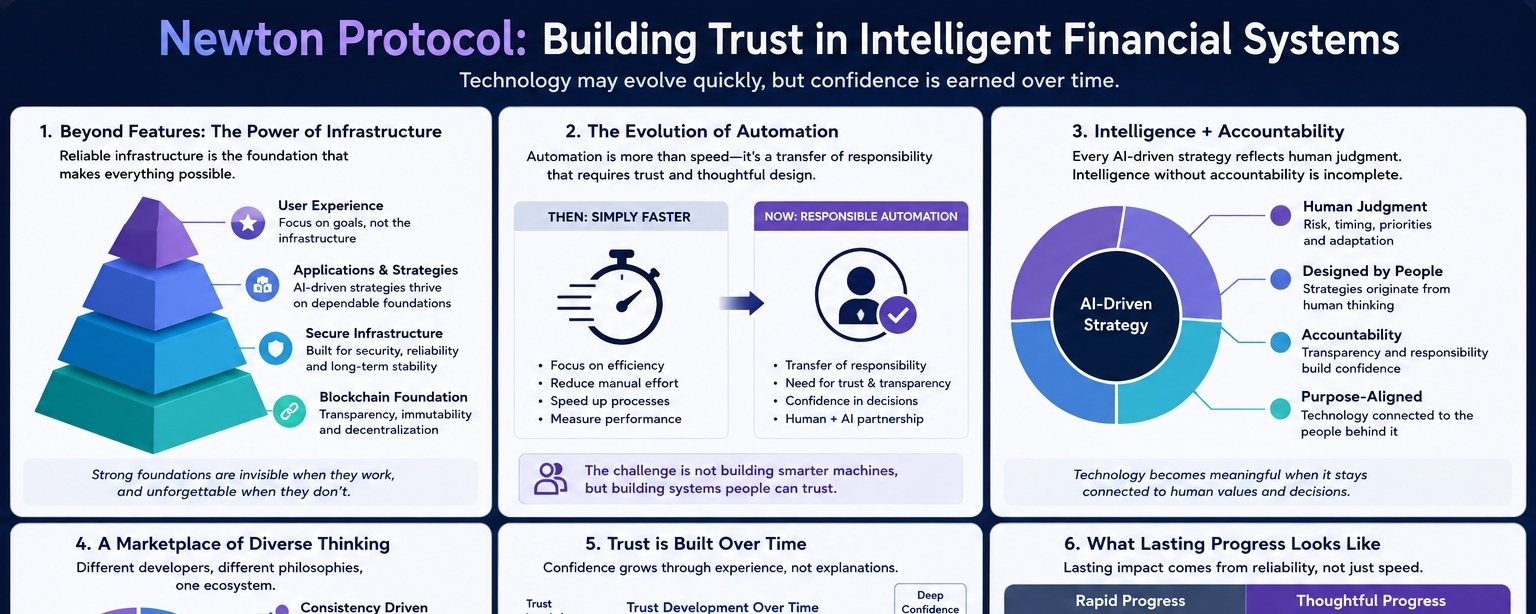
The more I observe Newton Protocol, the less I see it as a collection of individual features. Instead, I see an attempt to build an environment where AI-driven strategies can operate on infrastructure designed with security and long-term reliability in mind. That distinction matters because infrastructure quietly shapes every experience built on top of it. Most people never think about the foundations supporting the systems they use each day until something breaks. In many ways, dependable infrastructure succeeds by becoming almost invisible, allowing users to focus on what they want to achieve instead of worrying about what might fail.
I also find myself thinking differently about automation than I once did. There was a time when I believed its greatest value was simply making processes faster. Now I see something more complicated. Every automated decision represents a small transfer of responsibility from people to technology. That transfer only feels comfortable when it is supported by trust, transparency, and thoughtful design. Otherwise, convenience can quickly become uncertainty. The challenge is no longer teaching machines to make decisions. It is creating systems where people remain confident in the decisions being made, even when they are no longer involved in every step.
That perspective makes Newton Protocol's approach particularly interesting to me. AI-driven strategies are often described as if intelligence alone creates value, yet intelligence without accountability has always felt incomplete. Every strategy reflects the thinking of the people who designed it. Choices about risk, timing, priorities, and adaptation do not appear automatically. They originate from human judgment before they become part of an algorithm. Remembering that makes the technology feel less distant and more connected to the people behind it.
The marketplace for AI developers reinforces this idea in a subtle way. Rather than seeing it as a place where algorithms simply compete, I see it as a space where different philosophies of decision-making can exist together. Every developer approaches uncertainty differently. Some value consistency above everything else, while others embrace calculated risk. Those perspectives shape the behavior of every strategy they create. In that sense, the marketplace becomes more than a technical feature. It becomes a reflection of diverse ways of thinking about financial systems and the role intelligence should play within them.
Security also occupies a different place in my thoughts than it once did. Technical security is essential, but I have started believing that psychological security is equally important. People do not develop confidence simply because a protocol is cryptographically secure. Confidence grows through repeated experience, predictable behavior, and the feeling that the system continues to act responsibly even when conditions become uncertain. Trust is rarely built by explanations alone. It emerges gradually as expectations are consistently met over time.
As I continue following Newton Protocol, I find myself paying closer attention to its direction than to its momentum. Rapid progress is always impressive, but thoughtful progress tends to have a longer impact. Projects often compete to introduce new capabilities, yet lasting value usually comes from building systems that people can rely on without constantly questioning the foundation beneath them. That kind of reliability is rarely dramatic, but it often becomes the reason technology remains relevant long after initial excitement fades.
Perhaps that is why Newton Protocol continues to stay in my thoughts. It encourages me to think beyond automation and toward the relationship people will eventually have with increasingly intelligent financial systems. The future may not be shaped by which protocol introduces the most advanced AI, but by which one earns trust slowly, respects human judgment, and creates an environment where technology feels like a dependable partner rather than something people simply hope will make the right decisions. I still don't know exactly where that path leads, but I suspect the most meaningful innovations will be remembered less for what they promised and more for the confidence they quietly inspired over time.