
I have noticed something interesting over the past few years. Every new wave of blockchain innovation promises to remove another layer of trust, yet the arrival of AI seems to be adding a new one back. We are slowly reaching a point where an algorithm can make decisions involving digital assets faster than any human, but understanding why those decisions were made is becoming much harder. That contradiction feels more important than the speed of the technology itself.
Not long ago, automated trading was relatively simple. Most systems followed predefined rules that experienced users could inspect and understand. If a strategy bought an asset after a moving average crossed another, the logic was clear. Modern AI has changed that picture. Instead of following a fixed script, many models learn patterns from enormous amounts of data and continuously adapt. They may become smarter over time, but they also become more difficult to explain.
That growing complexity has created an uncomfortable gap. Blockchain was designed to make transactions transparent, while AI often operates like a black box. We can verify that an action happened on-chain, yet the reasoning behind that action may remain invisible. For users trusting software to manage funds or interact with decentralized protocols, transparency without understanding only solves part of the problem.
Several projects have tried to bridge this divide. Some focused on making AI more powerful, while others concentrated on making blockchain infrastructure faster and cheaper. Both approaches contributed valuable ideas, but they often developed in parallel rather than together. Intelligence improved on one side, scalability improved on the other, yet the connection between automated decision-making and verifiable execution remained surprisingly weak.
Developers also faced practical obstacles. Building an AI agent is already a demanding task, requiring expertise in machine learning, data engineering, security, and blockchain integration. After creating a useful model, another challenge appears: how can that work be shared, verified, and safely used by others without rebuilding the surrounding infrastructure from scratch? That question has never had an easy answer.
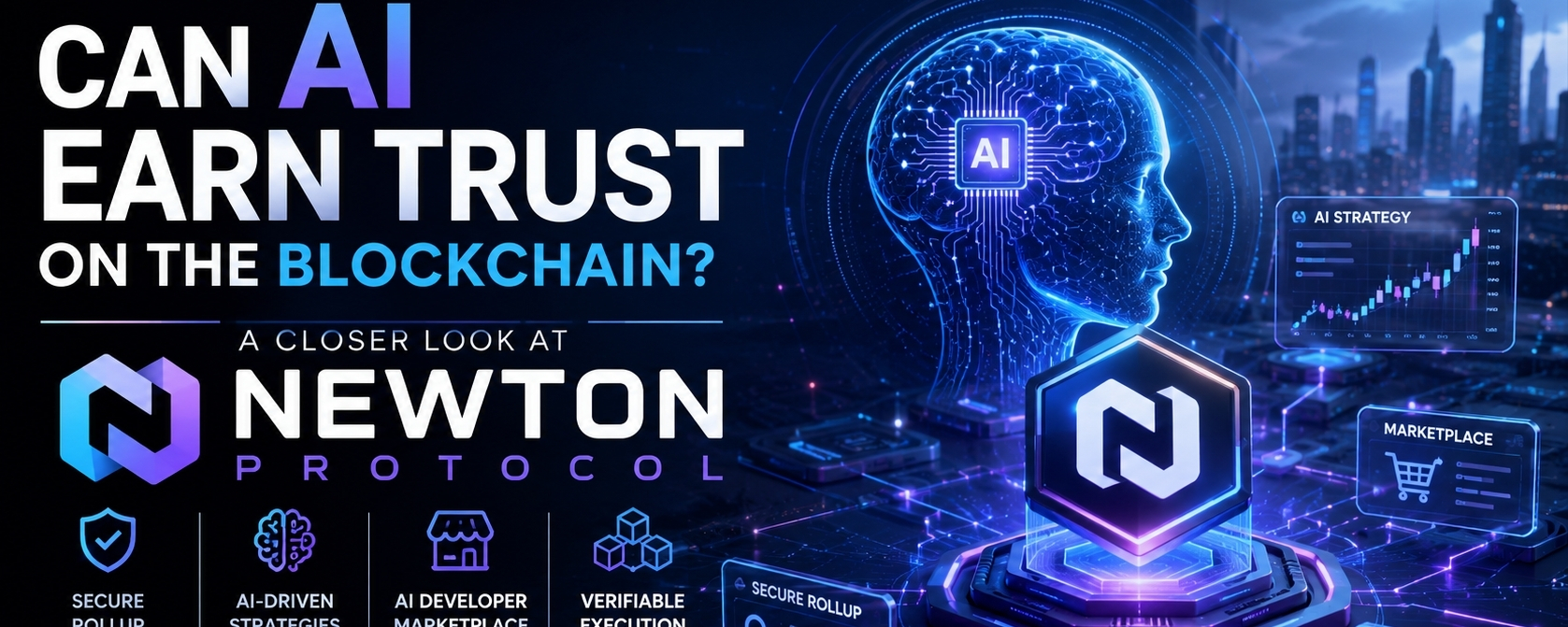
Newton Protocol enters this conversation with a different perspective. Instead of presenting AI as another application running on top of blockchain, it explores infrastructure designed specifically for AI-driven activity. The project appears less interested in making louder claims about artificial intelligence and more interested in asking how autonomous systems can operate inside an environment where security and verification are treated as essential features rather than optional additions.
One of the more interesting parts of the design is the use of a secure rollup. Rollups have already become familiar within Ethereum scaling discussions because they allow large amounts of activity to be processed efficiently while maintaining links to a broader blockchain ecosystem. Newton adapts that idea toward AI execution, suggesting that computationally intensive automation can happen in a dedicated environment while important records remain verifiable.
The project also introduces a marketplace intended for AI developers. That may sound like a simple feature at first, but it reflects a larger shift. AI development is becoming increasingly specialized. One team may excel at predictive models, another at risk management, and another at infrastructure. A shared marketplace creates the possibility that these contributions become building blocks within a larger ecosystem instead of isolated products existing behind closed platforms.
What makes this idea particularly interesting is that it recognizes developers as participants in the network rather than only users of it. If AI becomes an important part of decentralized finance and blockchain applications, the people building those models will likely need reliable methods to distribute updates, receive compensation, and establish credibility. Infrastructure supporting those relationships could become just as important as the AI models themselves.
Still, technology rarely solves every problem simply because it introduces a new architecture. AI systems continue to inherit the strengths and weaknesses of the data used to train them. A transparent execution environment cannot automatically prevent poor assumptions, incomplete information, or flawed reasoning from influencing decisions. Recording actions on-chain does not necessarily explain whether those actions were wise.
Security presents another layer of complexity. Opening a marketplace where developers contribute AI strategies encourages innovation, but it also creates opportunities for malicious software, exaggerated performance claims, or hidden vulnerabilities. Traditional software already struggles with these issues. AI adds another dimension because evaluating behavior often requires observing countless possible situations rather than reviewing static code alone.
Accessibility deserves attention as well. Sophisticated AI infrastructure naturally attracts technically skilled developers and organizations with research resources. Smaller builders and ordinary users may find the ecosystem difficult to navigate. If understanding how these systems work requires advanced expertise, participation could gradually concentrate among a relatively small community despite the decentralized ideals that inspired blockchain in the first place.
Perhaps the most valuable contribution of Newton Protocol is not that it claims to have solved decentralized AI, but that it encourages a more practical discussion about accountability. The industry has spent years asking how AI can become more capable. An equally important question is how people can confidently verify the behavior of systems that continue learning, adapting, and making increasingly significant decisions on their own.
As AI and blockchain continue moving toward each other, projects like Newton remind us that infrastructure often matters more than headlines. Faster automation is impressive, but dependable automation may prove far more valuable in the long run. Building environments where intelligence can operate responsibly may ultimately shape the next generation of decentralized applications more than any individual AI model ever could.
That leaves me wondering about something that may become increasingly important over the coming years. If autonomous AI agents eventually manage meaningful economic activity across decentralized networks, will the greatest breakthrough be creating smarter machines, or creating systems that allow ordinary people to understand, verify, and confidently challenge those machines whenever necessary?