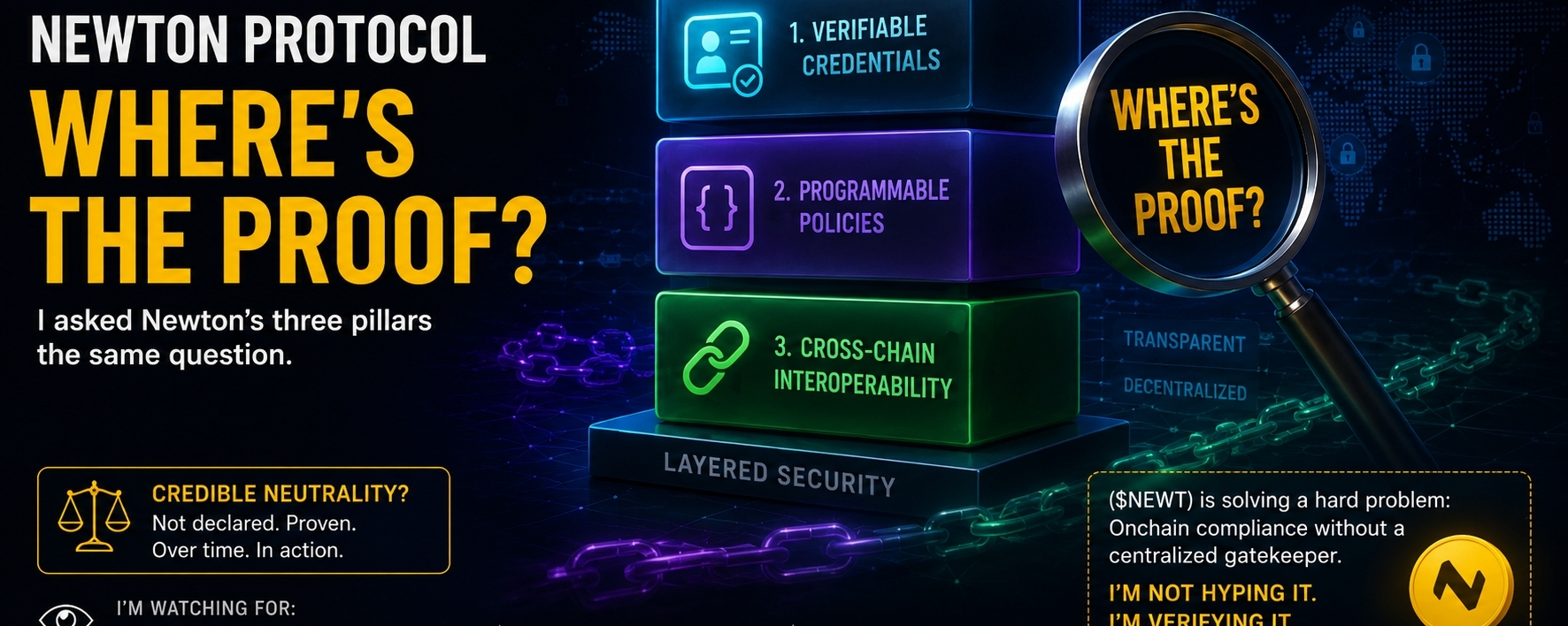
Zoomed into Newton's architecture diagram on my laptop screen. Three boxes... one stacked on another. The caption read "layered security." My cursor just sat there. Old habit kicked in... where's the proof?
I've spent five years in a job where a claim without evidence is just noise. Someone tells you something happened, fine, but show me the paper trail. That instinct doesn't switch off when I close my laptop and open a whitepaper instead of a case file, and honestly, reading Newton Protocol's documentation felt uncomfortably similar to reading a report that sounds too clean.
The first pillar is verifiable credentials, basically a way to prove jurisdiction or KYC status without showing the raw data behind it. On paper this is elegant. Zero knowledge proofs have been promising "trust without exposure" for years now, and I've watched enough of these promises get walked back once real adoption hits real friction. My question here isn't whether the cryptography works, it probably does, my question is who issues these credentials in the first place. A proof is only as honest as the source feeding it, and that source usually sits somewhere very centralized, whatever the diagram above it looks like.
Second pillar, programmable policies written in Rego through the Open Policy Agent framework. This part actually impressed me a little, because OPA isn't some invented buzzword, it's already used across enterprise cloud infrastructure, so Newton isn't reinventing a wheel here, it's borrowing one that already rolls. But policy code enforced by a "decentralized operator network" raises a familiar question from my line of work, who watches the watchers. If the network evaluating these rules can be economically influenced, staked into compliance, or quietly clustered among a handful of operators, then "decentralized" becomes a label rather than a fact. I'm not saying that's what's happening, I'm saying that's exactly the kind of claim I'd want independently audited before I repeat it as truth.
Third pillar is cross chain interoperability, authorizing transactions from one source chain out across many destinations. Practically speaking this solves a real headache, nobody wants to rebuild compliance logic for every chain they touch. But every cross chain bridge in this space has, at some point, been the exact seam where things broke. Newton isn't a bridge in the token sense, but it is a trust seam, and trust seams are where "verified" quietly becomes "assumed."
Then there's the phrase that made me pause the longest, "credible neutrality." Newton claims not even its own team can unilaterally control outcomes. That's a strong sentence to put in a whitepaper. In my experience, neutrality isn't something you declare, it's something you prove over time, through incidents handled transparently, through governance votes that actually go against the founding team's interest at least once. Words like "structural, not aspirational" are doing a lot of work in that document, and structural claims deserve structural evidence, not just architecture diagrams.
None of this means I think Newton is dishonest. What it means is that ($NEWT) is trying to solve a genuinely hard problem, onchain compliance without a centralized gatekeeper, and hard problems rarely get solved as cleanly as a three box diagram suggests. The comparison table against centralized APIs and soulbound tokens is fair criticism of existing approaches, I'll give it that much credit. But fair criticism of your competitors isn't the same as proof that your own system holds up.
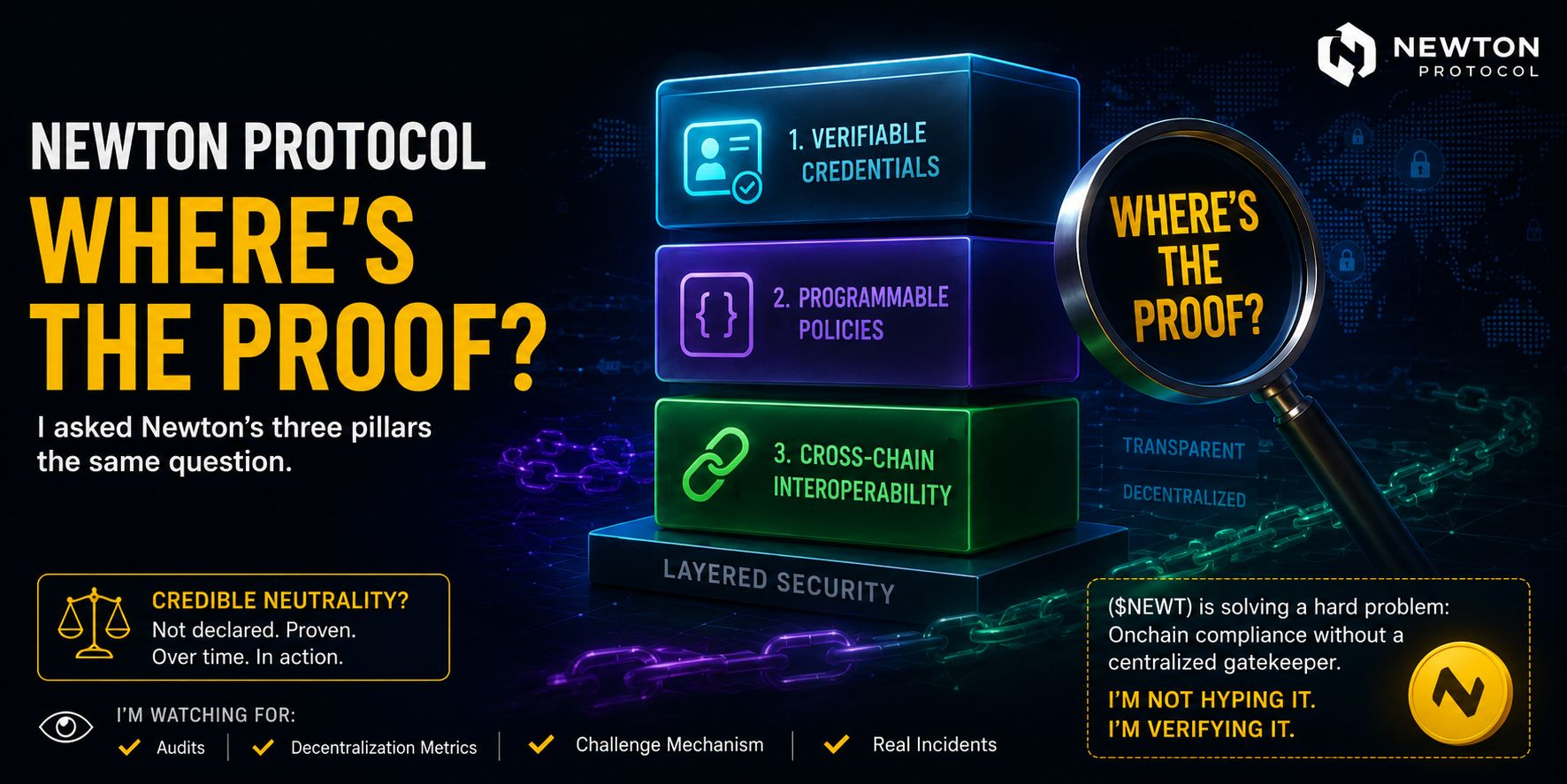
So I'm not dismissing ($NEWT), and I'm not hyping it either. I'm watching for the boring stuff, audit reports, operator decentralization metrics, an actual incident where the "challenge mechanism" gets tested for real. Until then, the diagram stays zoomed in on my screen, and the question stays open. DYOR, obviously 👀