
Guys, I spent more time thinking about @NewtonProtocol than I expected.
Not because I was trying to understand another protocol.
I was trying to understand the future it assumes already exists.
That sounds like a strange place to start, but the more I read, the less interested I became in the technology itself.
Instead, I kept coming back to a question I don't think crypto asks often enough.
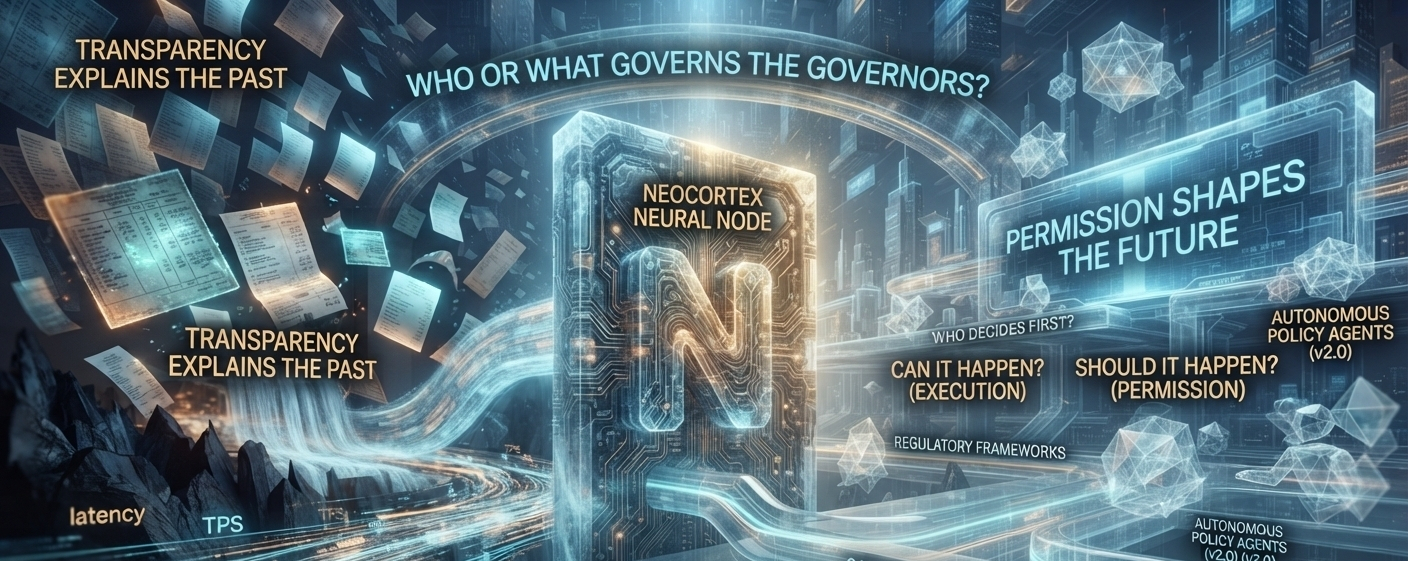
What happens when the hardest problem is no longer execution... but permission?
For years, crypto has been obsessed with execution.
Lower latency.
Higher throughput.
Cheaper transactions.
Better scalability.
Every cycle promises another way to move value faster.
And honestly, we've become pretty good at it.
But I think something changes once execution is no longer the bottleneck.
The question stops being,
"Can this transaction happen?"
And quietly becomes,
"Should it happen at all?"
That shift completely changed how I looked at @NewtonProtocol
Not because it's trying to make transactions faster.
But because it treats policy as part of infrastructure instead of something that lives outside it.
Think about how most financial systems work.
A transaction is created.
It's signed.
It's executed.
Only afterward do compliance teams investigate.
Fraud teams review.
Auditors reconstruct the story.
The system becomes excellent at explaining history.
But history is expensive.
Because every investigation begins with the same uncomfortable fact:
The transaction already happened.
That's why I no longer think transparency and security are the same thing.
Transparency explains the past.
Permission shapes the future.
To me, that's one of the biggest architectural shifts AI and on-chain finance are quietly pushing us toward.
As AI agents begin managing wallets, moving treasury assets, interacting with DeFi, and executing on behalf of users, execution becomes the easy part.
Computers have always been good at following instructions.
The difficult question is deciding which instructions should never be followed.
That's no longer just a governance problem.
It's becoming an infrastructure problem.
And infrastructure changes slowly...
Until one day everyone assumes it was always there.
Of course, programmable permission isn't automatically better.
The moment policy becomes code, the policy itself becomes critical infrastructure.
Who writes the rules?
Who updates them?
Who audits them?
Who gets to challenge them when they're wrong?
Because software doesn't eliminate discretion.
It simply moves discretion into a place where fewer people can see it.
That's why I don't think projects like Newton should only be measured by TPS, latency, or execution speed.
Those metrics tell us how efficiently a network moves value.
They don't tell us how wisely it decides value should move in the first place.
We've spent years making assets programmable.
We've spent years making execution trustless.
Maybe the next breakthrough isn't smarter AI or faster blockchains.
Maybe it's making permission programmable—without making it invisible.
And that's the question I can't stop thinking about.
If autonomous systems are going to move billions of dollars tomorrow... who should decide what they're’re allowed to do today?
