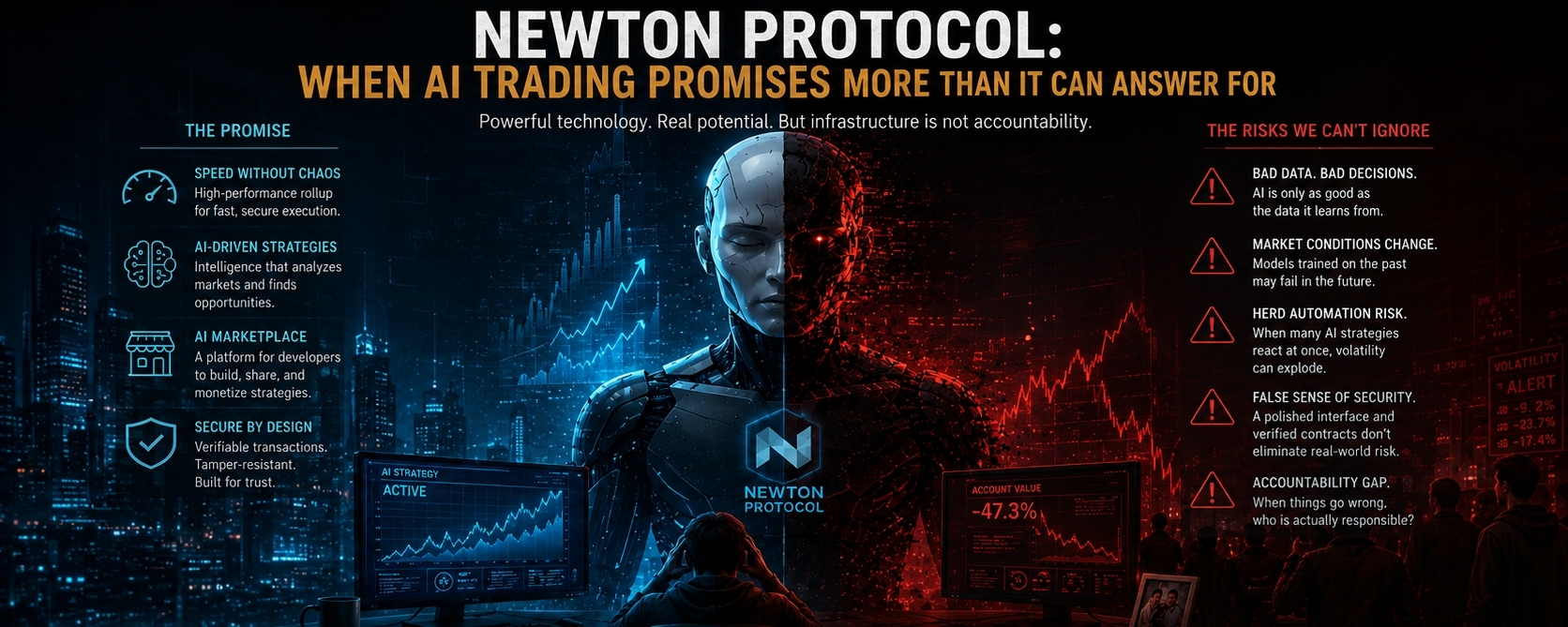
@NewtonProtocol Looking at Newton Protocol, I can understand why the idea feels so impressive at first. A secure rollup designed for AI-driven strategies, automated trading, and a marketplace where AI developers can build and sell their work sounds like a glimpse of a more efficient financial future. It promises speed without chaos, automation without constant human stress, and intelligence that can act while people sleep. For anyone who has watched markets move too fast to follow, that vision has real appeal. The thought of strategies running with discipline instead of emotion is powerful. The thought of AI finding opportunities that humans miss is even more powerful.
But the more I sit with that promise, the more I start to feel uneasy.
Because automation is not the same as responsibility. A secure rollup can protect transactions. It can verify execution. It can make records harder to alter. But it cannot explain why an AI strategy made a bad decision at the exact moment someone’s savings disappeared. It cannot sit across from a person who trusted a system, watched it trade automatically, and now has to explain the loss to their family. That’s the part that feels too easy to ignore when the conversation becomes focused on architecture, scalability, and performance.
AI-driven trading sounds exciting when the market is calm. It sounds efficient when the signals are clear. But what happens when the data is wrong? What happens when a model learns from a market condition that no longer exists? What happens when thousands of users follow similar automated strategies and all of them react at once? A system built to reduce human emotion could still create a new kind of panic, only faster and harder to stop.
I keep thinking about the word “secure.” Secure from what, exactly? Secure from hackers, perhaps. Secure from manipulation, maybe. But is it secure from bad incentives? Is it secure from developers releasing strategies they do not fully understand? Is it secure from users believing that an AI marketplace means every product inside it has been tested, proven, and safe? Technology often gives people confidence before it gives them clarity. A polished interface, a verified contract, a strong brand name—these things can make risk feel smaller than it really is.
And then there is accountability. If an AI strategy causes damage, who carries the weight of that decision? The developer who created it? The platform that listed it? The user who clicked “activate”? The protocol itself, which cannot feel regret or answer questions? Everyone may have a small piece of responsibility, which can sometimes mean no one has enough responsibility. That is uncomfortable. That is practical. That is real.
I do not doubt that Newton Protocol could open useful doors for AI developers and traders. I do not doubt that secure infrastructure matters. But infrastructure is never just infrastructure when money, trust, and people’s futures are moving through it. Behind every automated trade is still a human being hoping the machine understands more than they do. Behind every strategy is someone who may not know when to stop trusting it.
The real test is not whether the system can trade without humans—it is whether humans still have someone to answer to when it fails.