
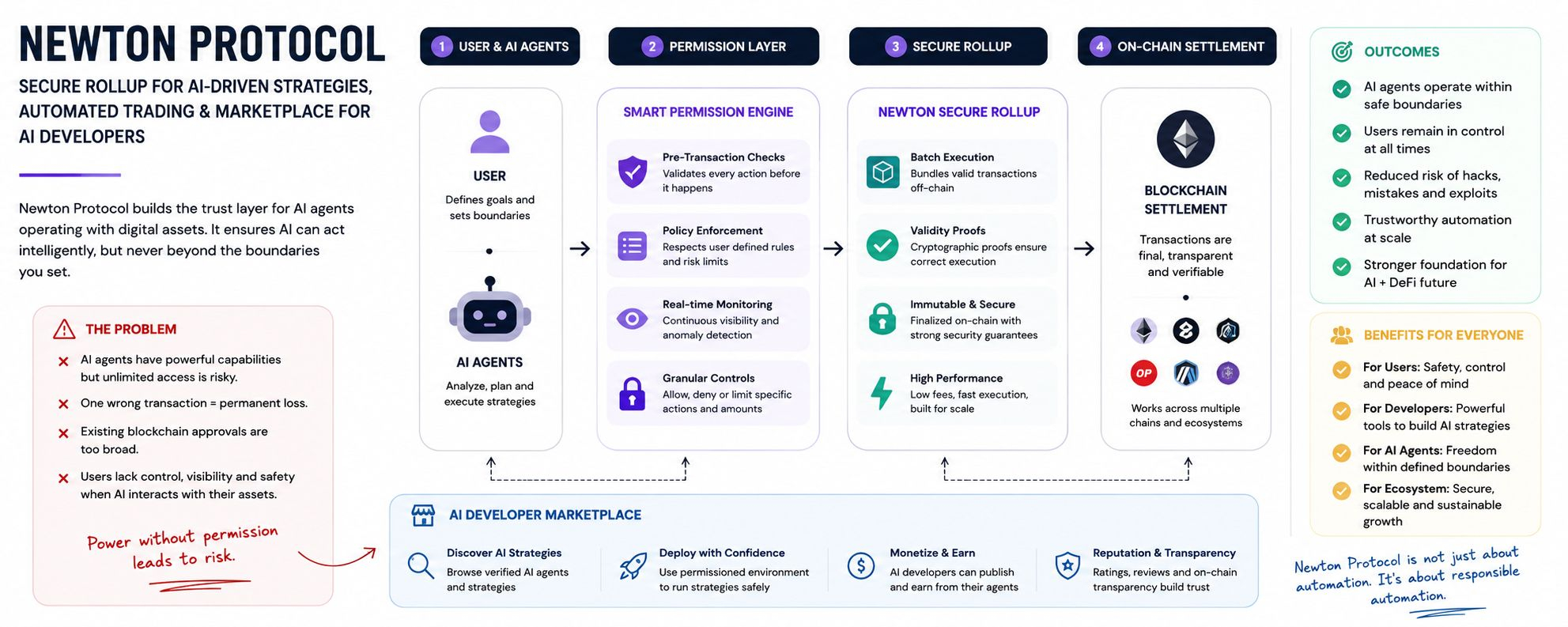
A few days ago, I wasn't planning to spend much time looking into Newton Protocol. It showed up on my timeline a couple of times, and my first thought was, "Here we go again... another crypto project talking about AI."
I don't even mean that in a negative way. It's just that AI has become one of those words that appears everywhere now. Every week there's another project promising smarter trading, autonomous agents, intelligent automation, or something similar. After seeing the same story repeated so many times, it's easy to become a little numb.
That's exactly how I felt before I started reading.
But curiosity got the better of me.
Instead of stopping at a few tweets or a quick overview, I spent a few hours digging through the project, reading about what it wants to build and, more importantly, why it wants to build it.
By the end, I realized something surprised me.
The AI part wasn't what stayed in my mind.
The idea of trust did.
The more I thought about it, the more I realized that everyone loves talking about what AI can do. People imagine AI agents trading assets, moving funds, interacting with DeFi protocols, managing portfolios, and completing complicated tasks without constant human input.
It all sounds exciting.
But I kept asking myself a much simpler question.
If an AI is making decisions involving my wallet, who decides what it's is allowed to do in the first place?
That question feels much bigger than most of the conversations happening around AI in crypto today.
We've spent years building systems where users control their own assets. That's one of the biggest reasons many people fell in love with crypto. You don't need permission from a bank, and you don't have to trust a middleman every time you want to move your money.
The downside, of course, is that mistakes can be expensive.
One wrong approval.
One bad signature.
One malicious smart contract.
Sometimes that's all it takes.
Adding AI into that environment creates even more possibilities, but it also creates more responsibility.
Personally, I don't think making AI more powerful is the hardest challenge anymore.
Making it trustworthy probably is.
That's where Newton Protocol started making more sense to me.
Instead of only focusing on building AI-powered automation, it seems to be thinking about the rules around that automation. In simple words, it's asking how AI should behave before it ever touches someone's assets.
The more I thought about that, the more important it felt.
Most people don't wake up thinking about permissions or authorization systems. Those aren't exciting topics, and they definitely don't create the same hype as flashy product demos.
But sometimes the boring parts become the most valuable parts later.
The internet wouldn't work without invisible infrastructure.
Neither would modern banking.
Maybe blockchain won't either.
If AI eventually becomes part of everyday crypto activity, then permission systems could quietly become one of the foundations people rely on without even noticing.
Of course, having an interesting idea is only the beginning.
Crypto has taught me to be careful about falling in love with concepts.
I've seen plenty of projects introduce brilliant ideas that never reached meaningful adoption. Sometimes the technology was good but the timing was wrong. Sometimes the market simply wasn't ready. Other times the team couldn't execute.
That's why I'm trying not to convince myself that Newton Protocol is guaranteed to become something huge.
Nobody knows that.
Not me.
Not anyone on social media.
Not even the people building it.
Execution is always the hardest part.
You can design impressive architecture, publish technical documents, and explain your vision perfectly, but eventually everything comes down to whether developers build on it and whether users actually trust it enough to use it.
That's a much harder challenge than writing a roadmap.
Another thing I kept thinking about is how quickly crypto narratives change.
A few years ago everyone was talking about NFTs.
Then it was the metaverse.
Then restaking.
Then meme coins.
Now AI seems to dominate almost every conversation.
Sometimes these trends create lasting infrastructure.
Sometimes they disappear almost as quickly as they arrive.
It's impossible to know which category any project will fall into while we're still in the middle of the story.
That's why I try to ignore the excitement and focus on the problem itself.
Is the problem real?
In Newton's case, I honestly think it is.
If autonomous software is going to become part of crypto's future, then someone needs to solve the issue of permissions, boundaries, and accountability.
Otherwise we'll end up with increasingly powerful systems that users are afraid to trust.
And if people don't trust them, widespread adoption becomes much harder.
That doesn't mean Newton Protocol has already solved the problem.
Far from it.
It simply means the project appears to be asking questions that I think deserve more attention.
Maybe that's why I found myself thinking about it long after I finished reading.
Not because I suddenly became convinced it's the next big thing.
Actually, I still have plenty of questions.
How easy will it be for developers to build with it?
Will users understand how these permission systems work?
Can the security model hold up under real-world pressure?
Can the ecosystem grow naturally instead of relying only on hype?
Those questions don't make me less interested.
They actually make me more interested because they're real questions instead of marketing slogans.
At the end of the day, crypto doesn't need more promises.
It needs infrastructure that quietly works.
It needs systems that reduce risk instead of creating new kinds of it.
It needs technology that people trust without having to think about it every five minutes.
Maybe Newton Protocol becomes part of that future.
Maybe it doesn't.
It's still far too early to say.
But I walked away from my research with something I didn't expect.
I wasn't thinking about AI anymore.
I was thinking about trust.
And honestly... I think trust might end up being the more important innovation.