


The fundamental problem with typical Web3 design is that it forces the user to sit in the waiting room while the network checks their identity and credentials. When a front end exposes the pre-transaction state making a user stare at a spinning loading wheel while waiting for wallet approvals, compliance checks, or gas estimations it shatters the illusion of a seamless digital experience. Newt solves this structural flaw by engineering the "invisible pause," entirely shifting the paradigm from execution latency to parallelized authorization latency. Through Newt, the front-end user experience transforms from a series of disjointed roadblocks into a continuous, reactive flow that rivals centralized alternatives.
Instead of the traditional, tedious loop of clicking a button, waiting for a wallet signature, waiting for the mempool and hoping for a confirmation, Newt shifts the entire security and compliance apparatus completely into the background. Because Newt utilizes Fully Homomorphic Encryption (FHE) and modular attestations, policy evaluation happens off-chain and in parallel, allowing the user interface to adopt a completely optimistic posture. The moment a user expresses intent within a Newt-powered application such as moving a liquidity slider or typing a token amount the front-end immediately renders the projected outcome as if it has already successfully occurred. While the user is still interacting with the UI, Newt’s off-chain layer is already quietly gathering trustworthy evidence, running the necessary regulatory policies and generating the cryptographic proof in the dark.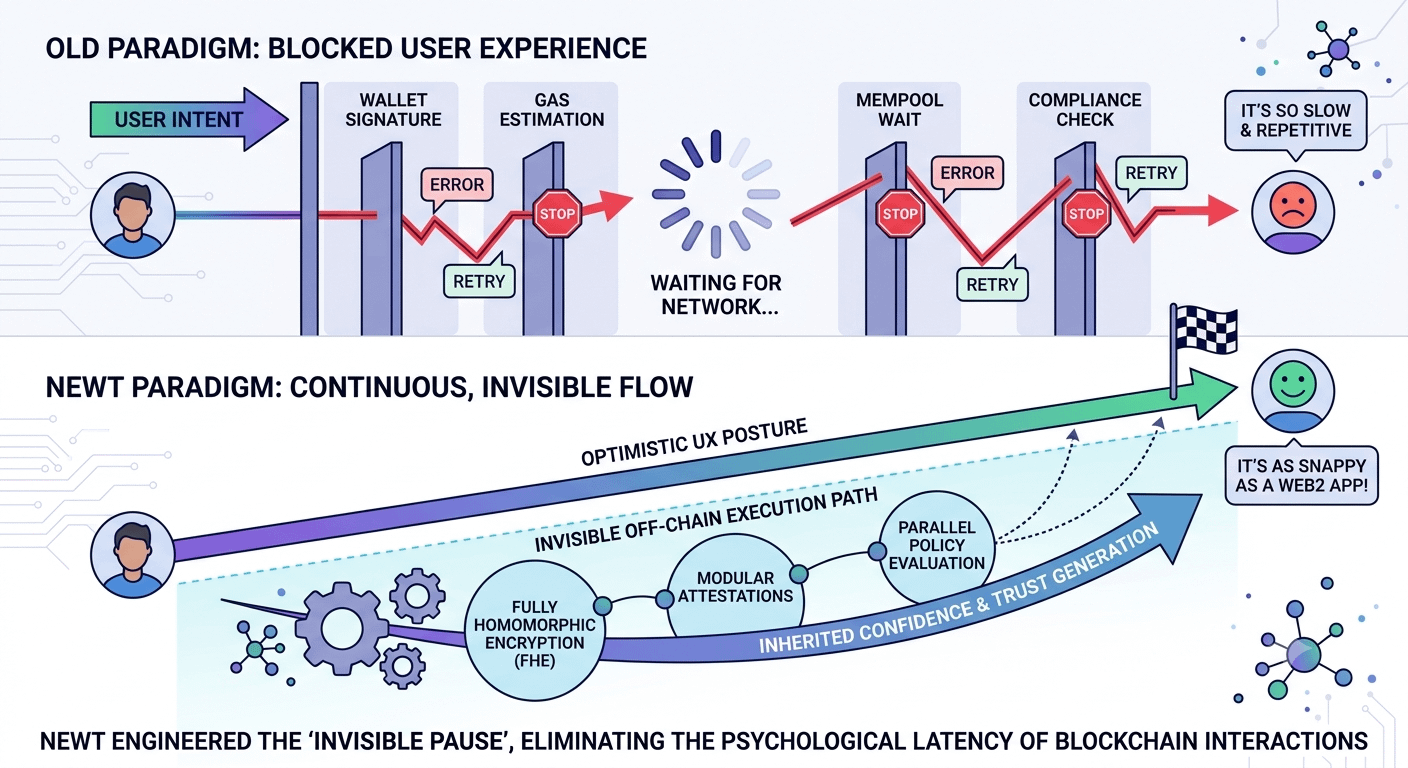
This architectural shift effectively collapses the psychological latency of blockchain interactions to zero. The user experiences an interface that feels as snappy, fluid and responsive as a centralized Web2 app, remaining completely unaware that a complex web of sovereign compliance, risk management and state validation is executing beneath the surface. Furthermore, because Newt's authorization tokens are fundamentally modular and reusable, the front-end stops acting as an aggressive, repetitive gatekeeper. In current Web3 environments, users face constant, redundant friction, such as re-verifying geographical eligibility or re signing allowances every single time they switch tabs, reload a page, or interact with a different protocol pool.
Under the Newt paradigm, the front end can silently pass a single, private, cryptographically provable attestation across entirely different modules and applications. The user signs exactly once and Newt’s concept of "inherited confidence" seamlessly carries them through an entire decentralized ecosystem without a single additional pop-up window or modal interruption. Ultimately, Newt achieves functional invisibility by pulling the heavy lifting of security entirely out of the critical execution path. Applications leveraging Newt no longer have to negotiate a compromise between speed and security. The network stops asking the user to wait while it manually builds trust, instead, Newt has already engineered that trust before the user even realizes they needed it. The competitive moat for future decentralized applications will no longer be determined by how fast they can process a single click, but by how effectively they deploy Newt to eliminate the need for the user to think about the underlying blockchain infrastructure at all. By hiding the mechanics of web3 in plain sight, Newt unlocks the true potential of decentralized software.
