
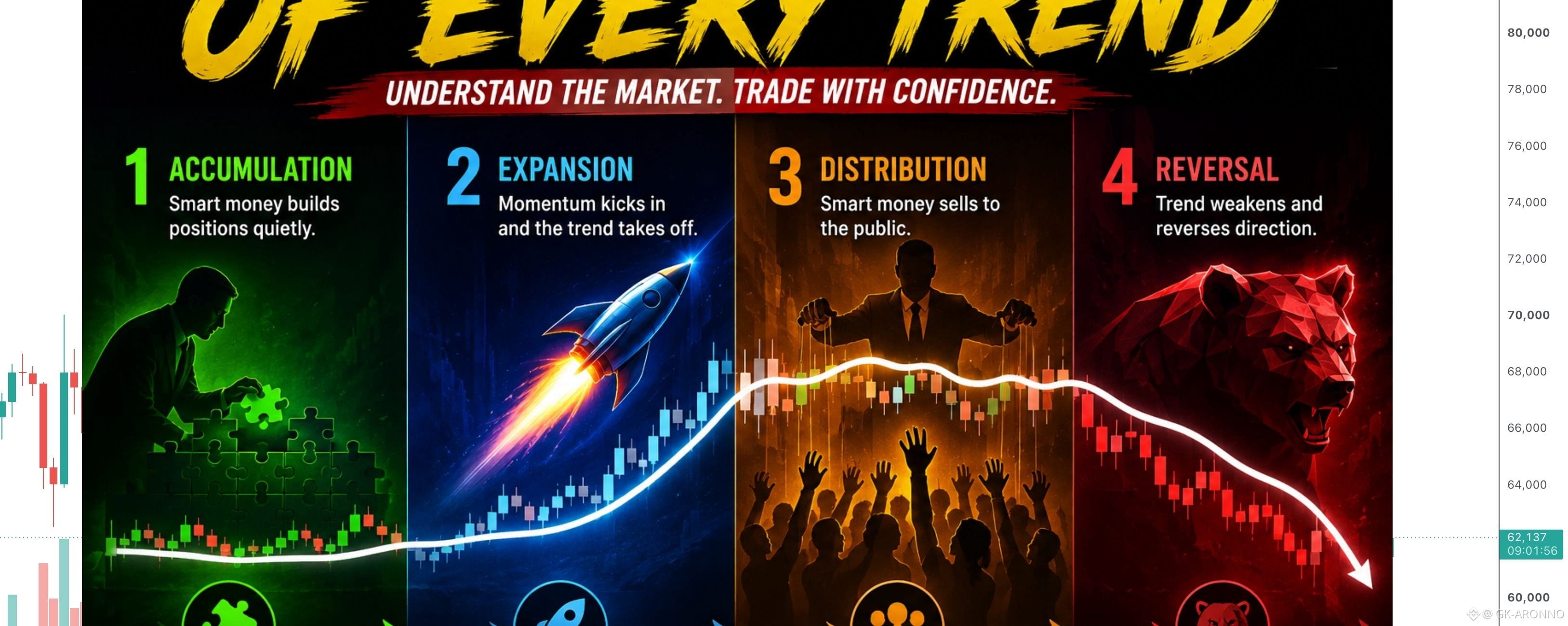

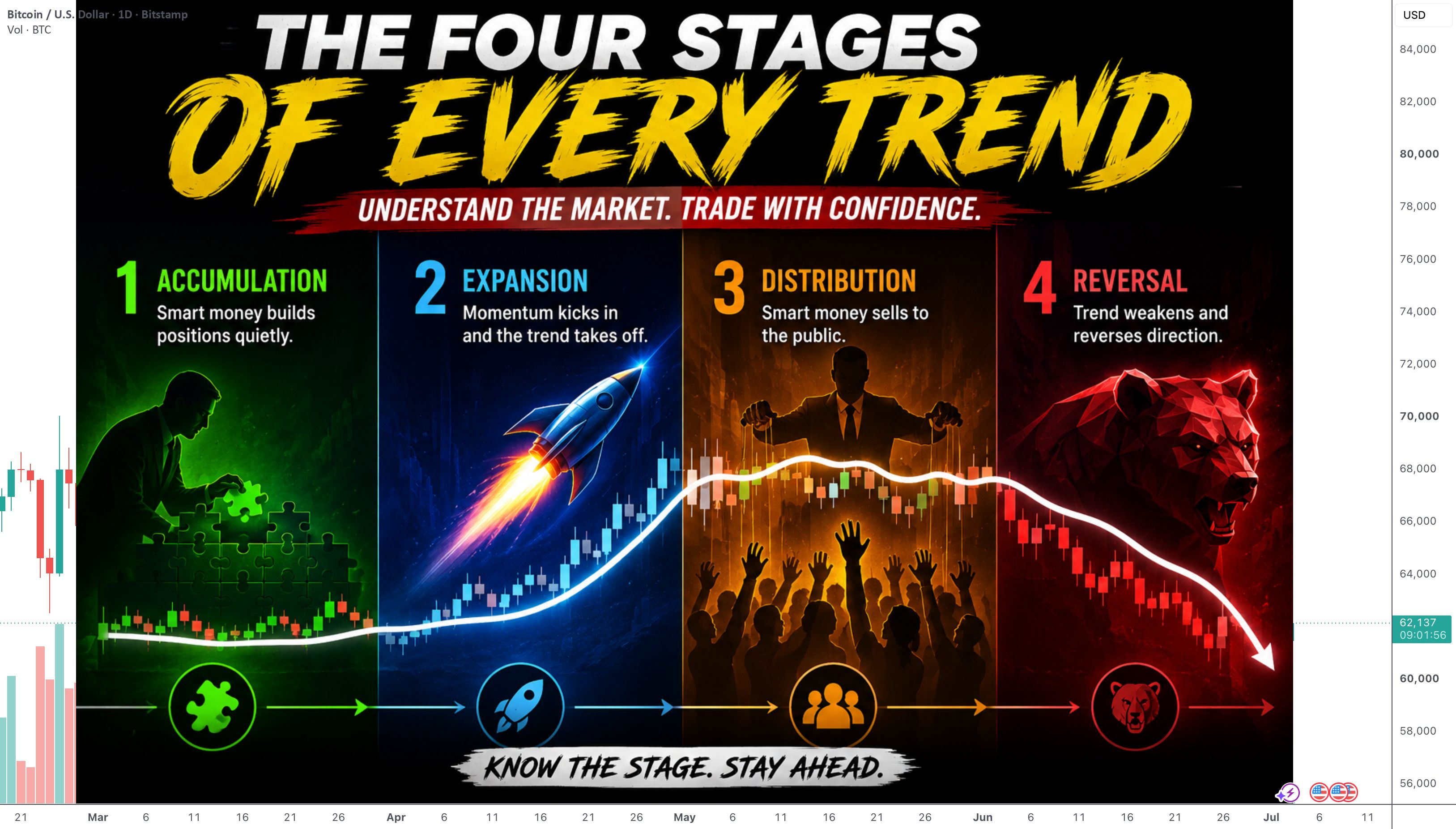
Every strong trend follows a story. While no two markets move exactly the same way; most sustained trends progress through four distinct stages. Learning to identify these stages can help traders avoid chasing moves, improve timing, and better understand what the market is trying to communicate.
Stage 1: Accumulation
This is where the foundation of a new trend is built. After a prolonged decline or a period of uncertainty; price begins to stabilize within a relatively narrow range. Volatility decreases, selling pressure fades, and patient buyers quietly start accumulating positions.
At this stage, market sentiment is usually neutral or even pessimistic. Most traders lose interest because price appears to be "going nowhere." However, this quiet phase often lays the groundwork for the next significant move.
Stage 2: Expansion
Once demand begins to outweigh supply; price breaks out of its range and momentum starts building. Higher highs, higher lows, increasing volume, and strong directional candles become more frequent.
This is where trend-following strategies tend to perform best. Instead of chasing every candle; experienced traders look for healthy pullbacks, confirmation, and proper risk management before entering positions.
Stage 3: Distribution
No trend lasts forever. As prices reach higher levels; early participants begin taking profits while new buyers continue entering the market. Price action becomes less decisive, volatility increases, and momentum gradually starts fading.
False breakouts become more common during this stage. Many traders mistake these moves for trend continuation; while experienced traders become more cautious and pay closer attention to signs of weakening momentum.
Stage 4: Reversal
Eventually; sellers gain control and the existing trend begins to break down. Market structure changes, support levels fail, and price starts forming lower highs and lower lows in an uptrend reversal—or higher highs and higher lows after a downtrend reversal.
Reversals rarely happen because of a single candle. They develop as buying or selling pressure shifts over time, making patience and confirmation essential before assuming a new trend has begun.
Key Takeaways:
• Every trend begins with accumulation—not excitement.
• Expansion is where momentum becomes visible and opportunities often improve.
• Distribution is a warning that the existing trend may be losing strength.
• Reversal confirms that market control has shifted from buyers to sellers—or vice versa.
Understanding these four stages won't help you predict every market move; but it can help you trade with greater context instead of reacting to every candle. Markets are constantly evolving, and recognizing where price sits within the broader trend can lead to better decisions and more disciplined execution.
Which stage do you think the current market is in? Share your analysis below and let's discuss it together.
