
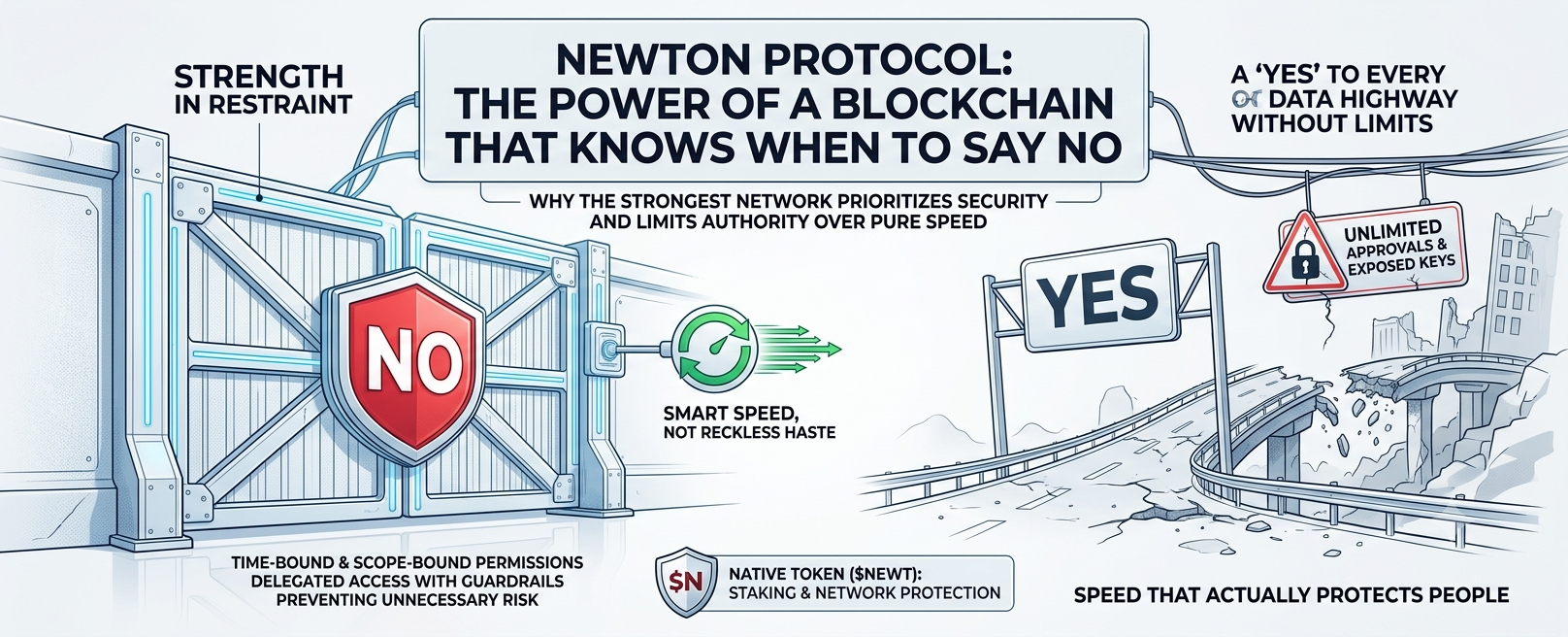
I've been thinking about how often crypto celebrates speed as if it's the answer to every problem. Every new chain seems to compete over TPS, faster execution, and lower latency. But I've been reading enough incident reports to realize that the biggest failures rarely happen because a network is too slow. They happen because someone approved too much, a private key was exposed, or a permission stayed active long after it should have expired.
That shift in perspective is why Newton Protocol stands out to me. As an SVM-based high-performance Layer 1, it delivers speed, but it also recognizes that performance without guardrails creates new risks instead of solving old ones. The conversation shouldn't stop at how fast a transaction settles. It should begin with whether that transaction should have been allowed in the first place.
I've been paying close attention to Newton Protocol Sessions because the idea feels practical. Delegation is enforced, time-bound, and scope-bound, so access is limited to exactly what is needed and only for as long as it is needed. That makes far more sense than leaving unlimited wallet approvals sitting in the background. Scoped delegation + fewer signatures is the next wave of on-chain UX.
The same philosophy appears throughout the architecture. Modular execution handles performance while a conservative settlement layer focuses on dependable finality. Each layer has a clear responsibility instead of trying to do everything at once. EVM compatibility is included simply to reduce tooling friction for developers, making migration easier without changing the protocol's security-first mindset.
The native token, $NEWT, serves as security fuel, while staking feels like accepting responsibility for protecting the network rather than simply earning rewards. At the same time, it's important to stay realistic. Bridge risks don't disappear just because the underlying chain is fast. Trust doesn't degrade politely—it snaps. Once permissions become too broad or keys are compromised, recovery is always harder than prevention.
I've been following the recent attention around Newton Protocol, and while price movements will always come and go, I think the more important conversation is about reducing predictable mistakes before they happen. A blockchain doesn't become trustworthy because it's the fastest. It becomes trustworthy because it knows when to limit authority.
In the end, I believe the strongest network isn't the one that says "yes" to every request as quickly as possible. It's the one that can confidently say "no" when the request creates unnecessary risk. That's the kind of speed that actually protects people.
