
Market felt weirdly quiet today. Not the good kind of quiet where you can actually breathe—more like that tense pause before everyone piles into the next narrative and things get stupid again. I was scrolling through my usual tabs, half-watching some DeFi yields, when I caught myself about to ape into something because “the chart looked right.” Classic. Then instead of refreshing prices for the hundredth time, I ended up clicking around on something else entirely. Out of curiosity, I checked Newton Protocol.
I wasn’t planning to write about this. I was just poking around because a friend mentioned it in passing last week, something about policies and automation. But then it clicked in this uncomfortable way.
People keep treating smarter decision-making in Web3 like it’s all about better signals, faster bots, or smarter AI that predicts the next move. We’re obsessed with the “what” and the “when”—the perfect trade, the optimal yield, the alpha that nobody else has. But what if we’ve been looking at it backwards? What if the real unlock isn’t making sharper calls, but building systems that stop you from making the dumb ones when you’re tired, emotional, or just human?
That’s the thing that hit me with Newton. It’s not another prediction tool. It feels more like an invisible layer that sits right before your transaction fires, checking against rules you actually set—spending limits, compliance stuff, risk parameters, whatever you decide—using real-world data and verifiable proofs. You define the guardrails once, and then you can actually delegate or automate without it feeling like you’re handing your keys to a stranger.
I thought automation in crypto was mostly about convenience or speed. You set a bot, cross your fingers, and hope it doesn’t drain you during a flash crash or a shady contract interaction. But here it’s different. The mechanism is surprisingly straightforward: you write or pick a policy, it gets evaluated before anything settles onchain, and you get a cryptographic receipt you (or anyone) can check. No after-the-fact regret. The transaction either aligns or it doesn’t go through. It’s like having a sober co-pilot who actually knows your rules and won’t let you text your ex at 2 a.m.—except the ex is a leveraged position you swore you wouldn’t touch again.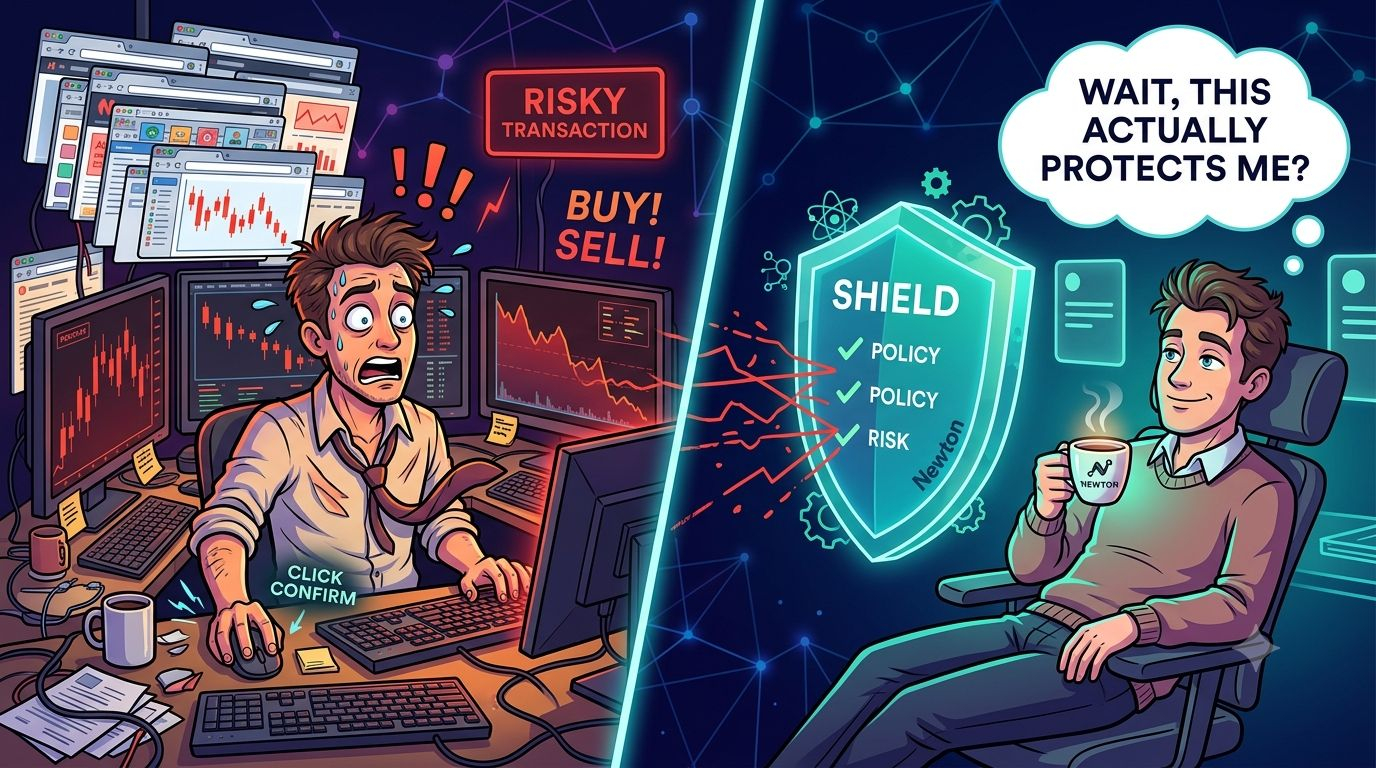
Here’s where it gets a bit uncomfortable, though. I’m not fully convinced this holds up under real pressure. What happens when the market goes completely off the rails and your policy feels too rigid? Or when the offchain data sources feeding these checks get gamed or delayed? There’s this tension between control and flexibility—too loose and it’s useless, too tight and you miss opportunities because you’re protecting yourself from yourself. Plus, in a space that loves permissionless everything, baking in authorization layers feels almost… responsible. Slightly square. Like admitting we’re not all perfectly rational agents who never fat-finger a zero.
I hesitated even typing that because it sounds like I’m criticizing it, but I’m not. That doubt is part of why it stuck with me. Most projects sell you upside with zero friction. This one quietly admits friction is where people lose money and tries to make the friction programmable and verifiable instead of painful and permanent.
It matters most when you’re scaling up or when you’re running strategies that need to keep running even if you’re asleep, on vacation, or just burned out staring at charts. DAOs managing treasuries, power users with positions across chains, institutions dipping their toes in without hiring a compliance army—those are the spots where constantly babysitting every move becomes impossible. You stop trying to outthink every variable and start trusting the system to enforce the boundaries you actually care aboutm
I still catch myself second-guessing. Earlier today I almost ignored my own position limits on a small swap because “this time feels different.” Old habits. But that’s the point, right? The protocol doesn’t replace your gut—it just makes sure your gut from last week (the clearer-headed version) still has a say when emotions or FOMO kick in.
Anyway, market still looks shaky. Volumes are low, narratives are recycling, and I’ll probably just watch how this plays out over the next few weeks. Might tweak a couple policies myself and see if it actually changes how trigger-happy I get. Or maybe I’ll just go touch grass for once. Who knows.
