
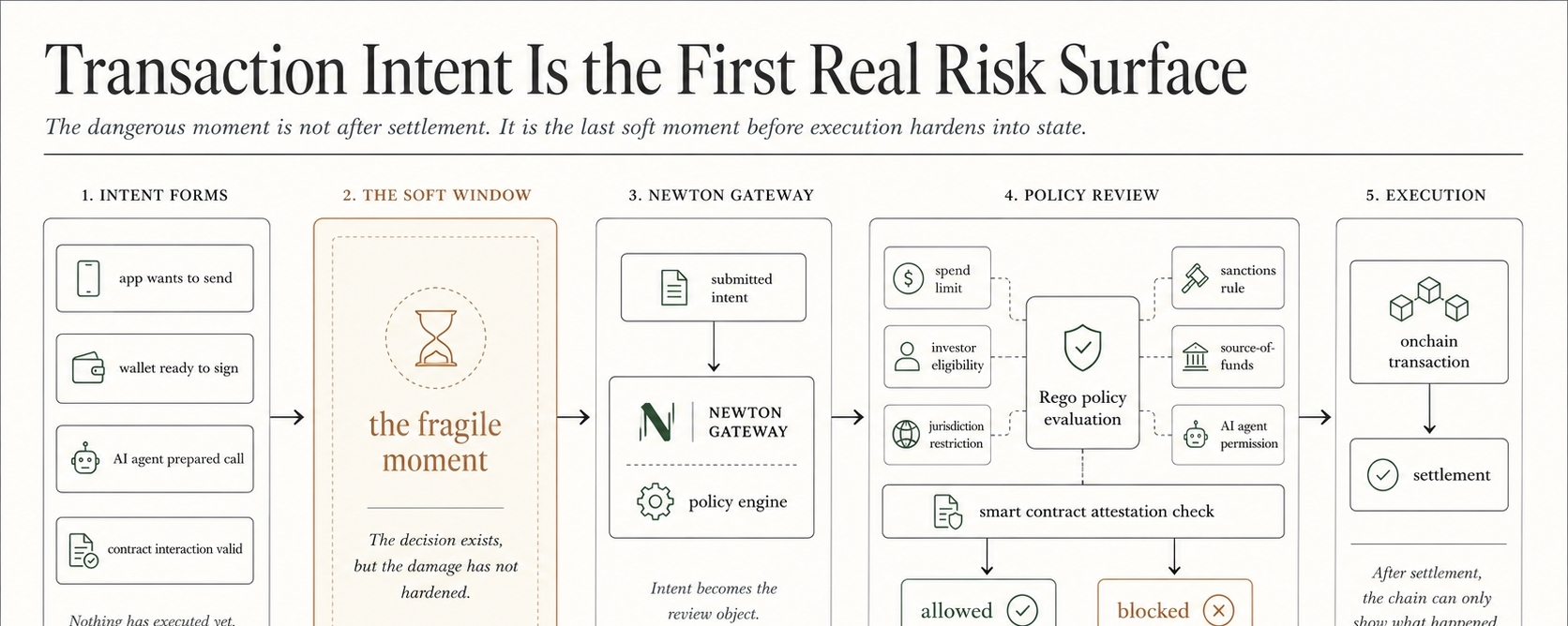
I opened the Newton( @NewtonProtocol ) Gateway path expecting to find the control point.
That was my first mistake.
The word Gateway does something to your head.
It makes the system feel like it has one door.
One place where the request enters.
One service that can say yes, no, delay, reshape, or push.
That is the easy read.
But Newton makes the Gateway stranger than that.
The Gateway sits close enough to the transaction path to look powerful, but not close enough to become truth.
It can receive.
It can route.
It can orchestrate.
But it cannot quietly become the operator.
That boundary matters.
A user sends an intent through JSON-RPC.
The Gateway sees the request.
NATS carries the message across the system.
Operator routing begins.
From outside, it starts to look like the backend decided.
A request entered.
A result came back.
A clean state appeared.
Everyone relaxes.
That is where most systems get blurry.
The service that moves the request starts to feel like the service that approved the request.
Newton cannot allow that blur.
If the Gateway could silently alter policy outcomes, the stack would collapse into trust in middleware.
If it could forge operator signatures, operator routing would become theater.
If it could attach data without a signer, ECDSA data attestations would become a label instead of evidence.
So the Gateway has to stay trapped inside its role.
Useful.
Necessary.
Close to everything.
But not sovereign.
It receives the outside call.
It coordinates the route.
It may be the first thing a developer touches in Newton.
But importance is not authority.
The Gateway can organize the path.
It cannot manufacture the proof that makes the path defensible.
Operator signatures still matter.
ECDSA data attestations still matter.
Force inclusion still matters.
The policy result still has to come from the evaluation path, not the place that handled traffic.
Force inclusion is the uncomfortable piece here.
It keeps the Gateway from becoming a quiet choke point.
If orchestration turns into withholding, the request needs a way back into view.
That does not make the Gateway weak.
It makes the Gateway bounded.
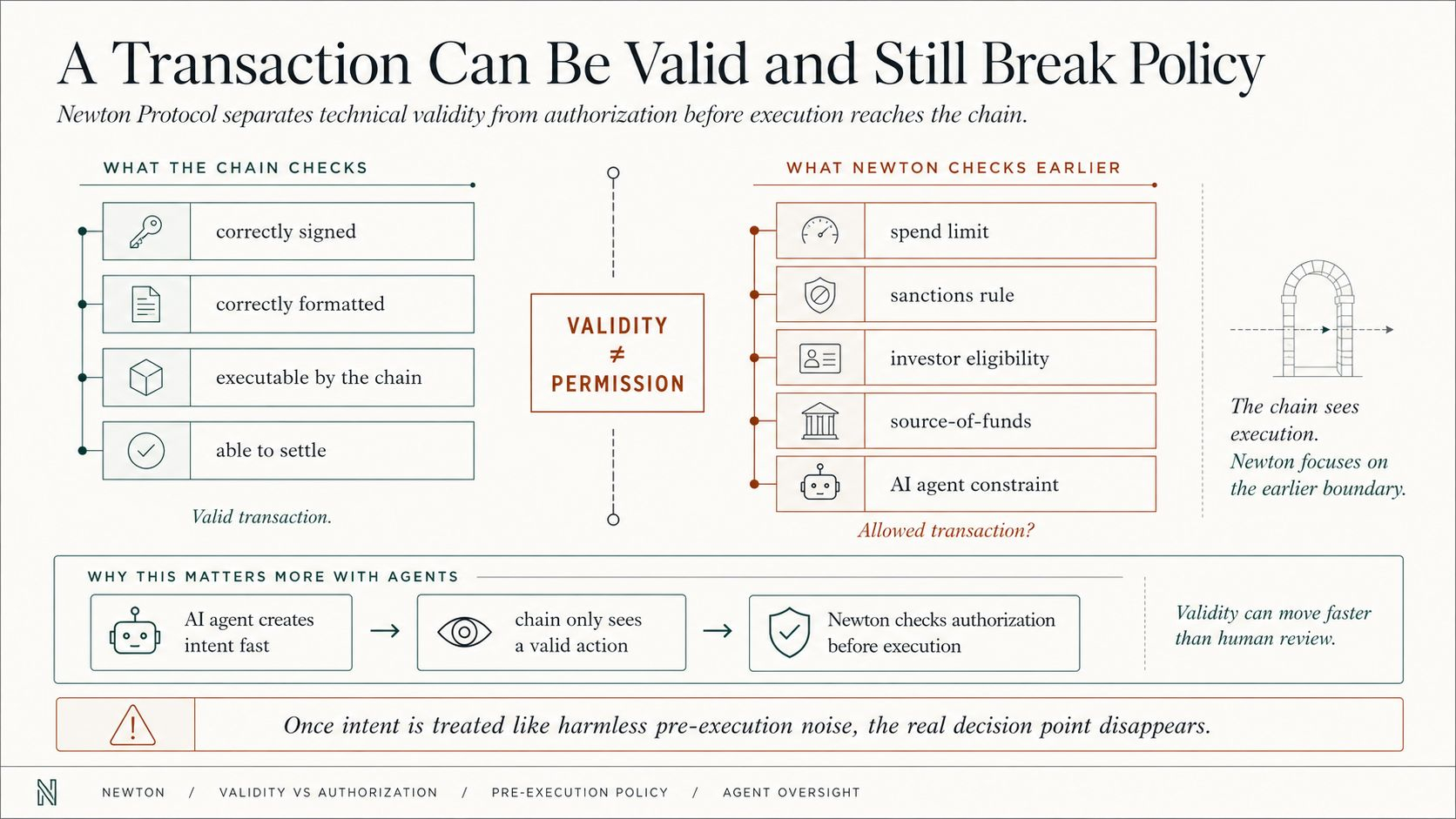
And bounded infrastructure is usually more trustworthy than powerful infrastructure pretending to be neutral.
The system does not remove coordination.
It removes the ability to confuse coordination with final authority.
A Gateway can make a transaction feel controlled because it stands near the entrance.
But Newton’s deeper question is harsher:
Who signed?
What policy was evaluated?
What data was attested?
Was the request routed, or was it quietly shaped?
That is the line.
The Newton's Gateway can carry the request.
It cannot become the reason the request is trusted.