
A shopping mall usually has two kinds of security. One stands at the entrance and decides whether someone is allowed to come in. The other is inside individual stores, watching what customers do after they have already entered. Neither is necessarily better. They are simply protecting different boundaries. I kept thinking about that because, in a strange way, it resembles the difference I see between Newton Protocol and Uniswap v4 Hooks.
At first glance, both seem to introduce programmable logic before a transaction completes. That similarity almost made me think they were solving the same problem. But once I stopped looking at the feature names and started following the execution flow, the resemblance began to fade.
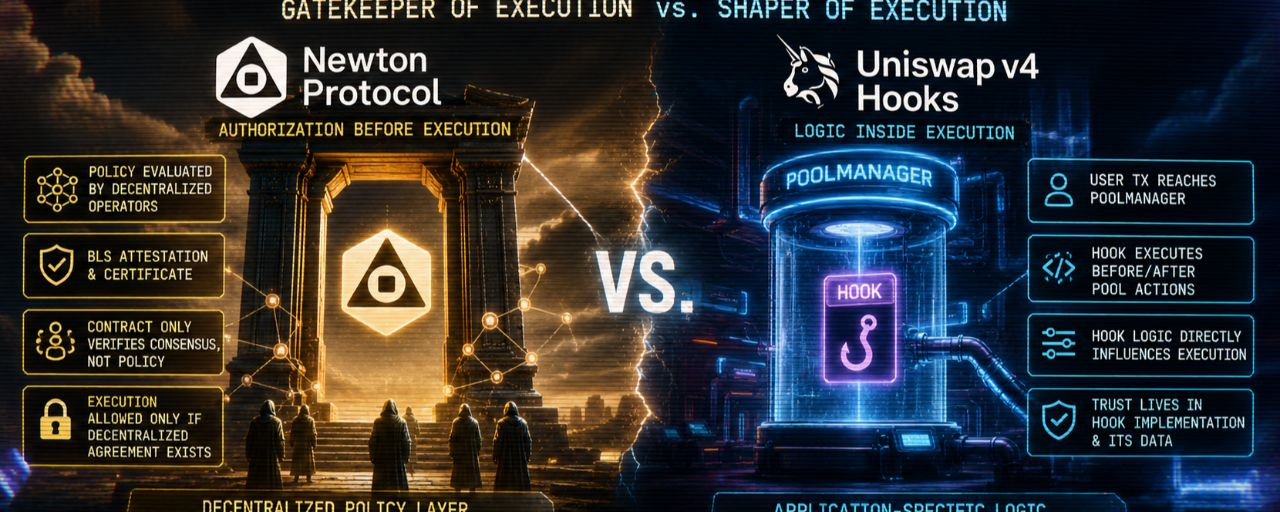
In Newton Protocol, the flow starts before the target contract is even allowed to execute. A caller submits an intent to the Gateway. The Gateway transforms that intent into a policy task and distributes it to AVS operators running on Ethereum. Every operator evaluates the same Rego policy, together with whatever runtime data the policy requests through its configured oracles. They independently reach an authorization result, aggregate their BLS signatures, and produce a certificate. Only after the PolicyClient verifies that certificate does the destination contract continue execution.
The thing I keep coming back to is that the contract itself never decides whether the policy is correct.
It only checks whether decentralized consensus has already agreed on the answer.
That feels like a very deliberate separation.
Then I looked at Uniswap v4 Hooks through the same lens.
A user submits a swap transaction directly to the PoolManager. Before or after certain pool actions, the Hook contract executes its own custom logic. Depending on how the Hook is written, it can modify fees, reject an operation, trigger additional accounting, or introduce entirely new pool behaviors. But the Hook executes inside the lifecycle of that particular liquidity pool.
Maybe I'm oversimplifying it, but I think the difference begins exactly there.
Newton inserts a policy layer before execution.
A Hook extends execution itself.
Those sound similar until I map them onto the flow.
With Newton, the Gateway creates the task.
Operators evaluate the policy.
Operators generate the BLS attestation.
The PolicyClient verifies the certificate.
Execution proceeds only if decentralized authorization exists.
With a Hook, the user transaction reaches the PoolManager.
The PoolManager calls the Hook contract.
The Hook evaluates whatever logic its developer implemented.
The Hook directly influences the pool's execution path.
There is no separate decentralized authorization layer sitting in front of that decision.
The responsibility lives inside the application.
I think I had been assuming both systems were examples of "programmable transaction filtering."
Now I'm not completely convinced.
One feels like infrastructure.
The other feels like application logic.
That distinction matters because it changes where trust is anchored.
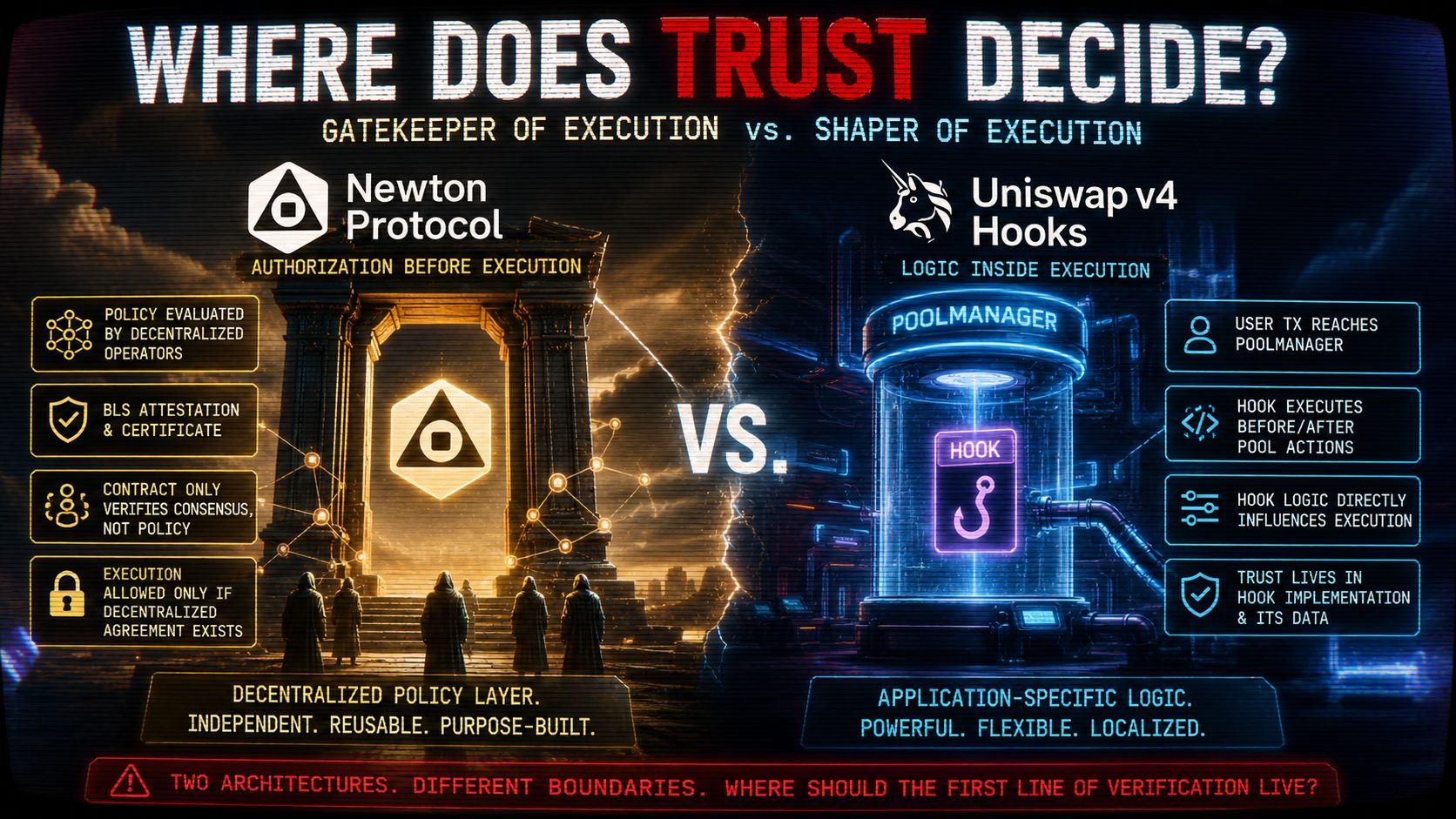
Inside Newton, the contract is trusting that the AVS operators all evaluated the same Rego policy correctly. The PolicyClient does not recompute every policy. It verifies the aggregated signature proving decentralized agreement. In other words, the output is trusted because multiple operators independently reached the same answer.
Inside a Hook, the PoolManager simply executes whatever code the Hook exposes. If the Hook fetches external information, applies custom pricing logic, or introduces access control, those guarantees come from the Hook implementation itself. There is no separate operator network reaching consensus over whether the Hook's decision was correct.
Maybe that's exactly how it should be.
After all, Uniswap Hooks were never designed to become a generalized authorization network.
They exist to let liquidity pools become programmable.
Mình có cảm giác là this is where I almost made a wrong comparison.
The Hook is specialized around one protocol.
Newton's policy layer is trying to remain independent from the application it protects.
That independence seems small at first, but it changes how reusable the authorization model becomes. The same policy evaluation flow can theoretically sit in front of a treasury contract, a wallet, an AI agent, or a DeFi protocol without rewriting the authorization mechanism itself. The protected contract changes. The authorization flow largely stays the same.
But then another question appeared.
Does that modularity introduce another layer that applications now have to trust?
Probably yes.
Because Newton deliberately separates policy evaluation from execution, applications become dependent on the correctness of the operator network, the Rego policies, the runtime oracle inputs, and the final BLS certificate. The execution contract verifies the certificate, but it does not independently verify every observation that produced it.
Maybe that is the unavoidable trade-off.
A Hook keeps responsibility local.
Newton distributes responsibility across multiple specialized components.
Neither architecture removes trust.
They distribute it differently.
The more I think about it, the less interested I become in comparing Hooks against PolicyClient contracts directly. They occupy different places in the transaction lifecycle. Hooks modify what happens once execution has already entered a specific protocol. Newton is trying to decide whether execution should even reach that protocol in the first place. Those are two different boundaries, and perhaps that is the real design choice each system is making.
I keep circling back to that idea because it feels like the comparison is less about programmable smart contracts and more about where an ecosystem chooses to place its first line of verification. Whether that boundary belongs inside every individual application, or whether it gradually becomes its own decentralized layer sitting in front of many different applications, is something I am still not completely sure the industry has settled on.
@NewtonProtocol #Newt $NEWT