
Sometimes the biggest technology stories begin with a simple question that most people are too busy to ask. We spend a lot of time talking about how intelligent AI has become, yet very little time asking who should trust it once it starts making decisions instead of simply giving suggestions. That question becomes even more important when those decisions involve digital assets, decentralized applications, and automated systems that move without human approval. Intelligence alone is impressive, but intelligence without accountability has always been difficult to accept.
For years, blockchain promised transparent systems where every action could be verified. At the same time, artificial intelligence evolved into something capable of analyzing enormous amounts of information and responding far faster than any individual could. Both technologies matured in parallel, but they rarely felt like they truly belonged together. One focused on certainty, while the other embraced probability. One relied on fixed rules, while the other constantly learned from changing patterns. The gap between those philosophies quietly became one of the industry's most overlooked challenges.
Developers naturally tried to connect the two worlds. Some projects stored AI results on-chain to improve transparency. Others relied on decentralized computing networks to reduce dependence on centralized cloud providers. A few experimented with automated strategies that reacted to market conditions. Each attempt solved a small part of the puzzle, but none fully answered the larger question of trust. Users could often see what happened, yet understanding why an AI reached a particular decision remained surprisingly difficult.
Another challenge appeared as automation became more ambitious. Traditional smart contracts perform exactly what they are programmed to do, but they cannot adapt when unexpected situations appear. AI can adapt, but adaptability also introduces uncertainty. If an autonomous system changes its behavior over time, how can users verify that those changes remain safe? The more capable AI became, the more obvious this tension started to feel.
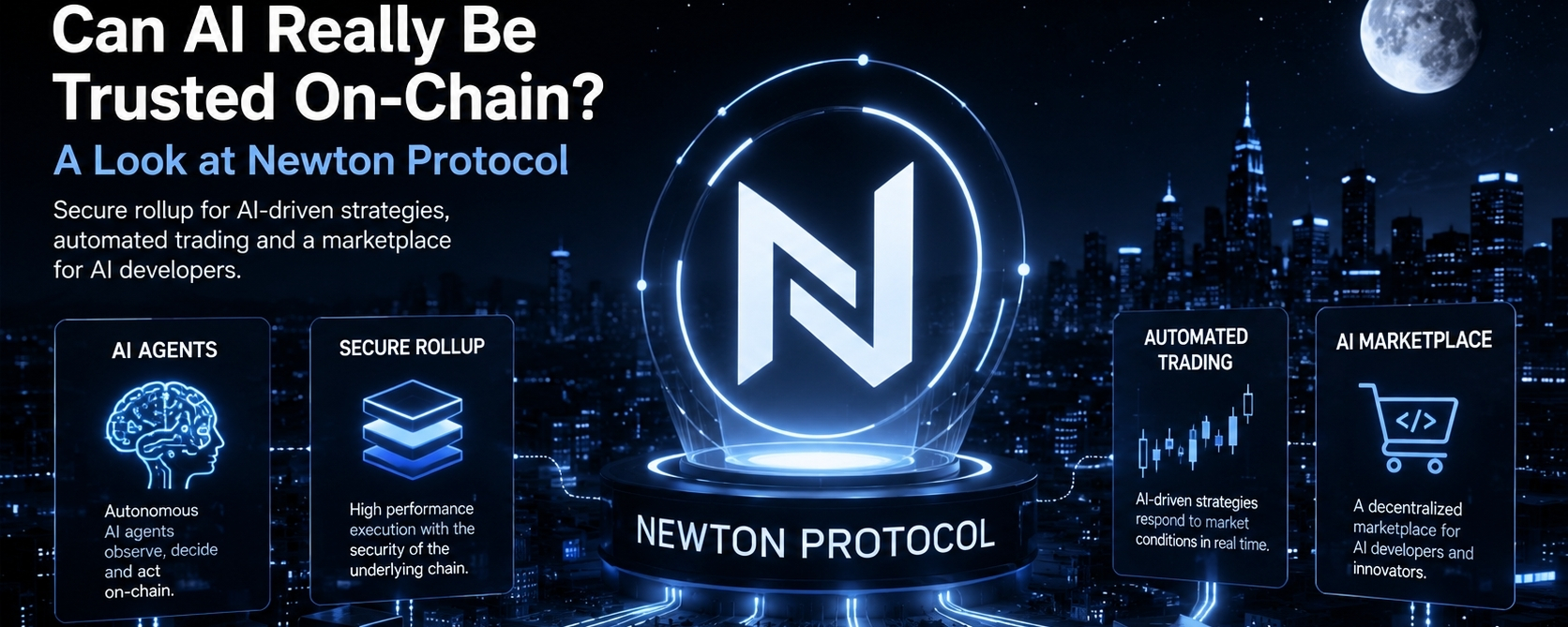
This is where Newton Protocol enters the conversation. Rather than presenting itself as another blockchain or another AI model, it explores the idea that intelligent systems may need infrastructure designed specifically for them. Instead of forcing AI into environments originally built for ordinary transactions, the project asks whether a specialized execution layer could make autonomous strategies easier to verify while still benefiting from blockchain security.
The idea behind its secure rollup architecture is relatively straightforward once the technical language is stripped away. AI requires significant computing power, and asking every blockchain validator to repeat every complex calculation would be inefficient. By separating heavy computation from final verification, the protocol attempts to keep intelligent automation practical without abandoning decentralized security. It is an engineering compromise rather than a perfect solution, and that balance is one of its more interesting design choices.
The project also pays attention to something that feels increasingly relevant as AI evolves: autonomous agents. These are not simple chatbots answering questions. They are systems designed to observe information, evaluate situations, make decisions within defined limits, and interact with decentralized applications with minimal human involvement. Supporting those agents requires much more than computing resources. It requires identity, permissions, verification, accountability, and clear rules about what those agents are actually allowed to do.
An equally interesting part of the ecosystem is its marketplace for AI developers. Instead of treating AI as something controlled by a handful of large organizations, the concept suggests an environment where developers can contribute intelligent strategies and reusable components. If that ecosystem grows responsibly, innovation could become more collaborative instead of remaining concentrated among a small number of dominant players. Of course, building such an ecosystem is much easier in theory than in practice.
Even with thoughtful architecture, important questions remain unanswered. Artificial intelligence is not static software. Models evolve, improve, and occasionally behave in unexpected ways. Blockchain systems, on the other hand, are usually designed for predictable execution. Combining these two very different worlds means accepting that some uncertainty will always exist. Technology can reduce risk, but it cannot completely eliminate it.
Security also deserves careful attention. Traditional blockchain security focuses on protecting transactions, cryptographic keys, and consensus mechanisms. AI introduces entirely different concerns, including manipulated data, adversarial inputs, unreliable models, and unexpected behavior from autonomous agents. A secure infrastructure can protect the environment, but protecting the intelligence operating inside that environment is a different challenge altogether.
Accessibility raises another important discussion. Advanced AI often depends on specialized hardware, expensive computing resources, and highly skilled developers. If participation becomes too technically demanding, ecosystems built around intelligent automation may gradually favor larger organizations while unintentionally leaving smaller teams behind. Decentralization is often discussed as a principle, but maintaining meaningful accessibility is much harder than simply describing it.
From a broader perspective, Newton Protocol reflects a noticeable shift across the blockchain industry. Increasingly, projects are no longer trying to make one blockchain perform every possible task. Instead, specialized infrastructure is emerging for specific workloads. Privacy networks, gaming chains, storage layers, and AI-focused rollups all point toward a future where blockchains cooperate rather than compete to handle every responsibility themselves.
Whether this approach ultimately succeeds depends on far more than engineering. Governance, transparency, interoperability, and responsible development may prove equally important. AI systems influence decisions that affect real users, which means technical excellence alone cannot guarantee public confidence. Trust usually grows slowly, especially when automation becomes increasingly independent.
Perhaps the most valuable contribution of Newton Protocol is not that it claims to have solved the relationship between blockchain and artificial intelligence, but that it encourages the industry to ask better questions. Instead of assuming smarter AI automatically creates better systems, it reminds us that intelligence, verification, security, and accountability must evolve together. As autonomous software becomes more involved in decentralized ecosystems, maybe the most important question is no longer how powerful these systems can become, but how much responsibility we should be willing to give them before we truly understand their decisions.
