
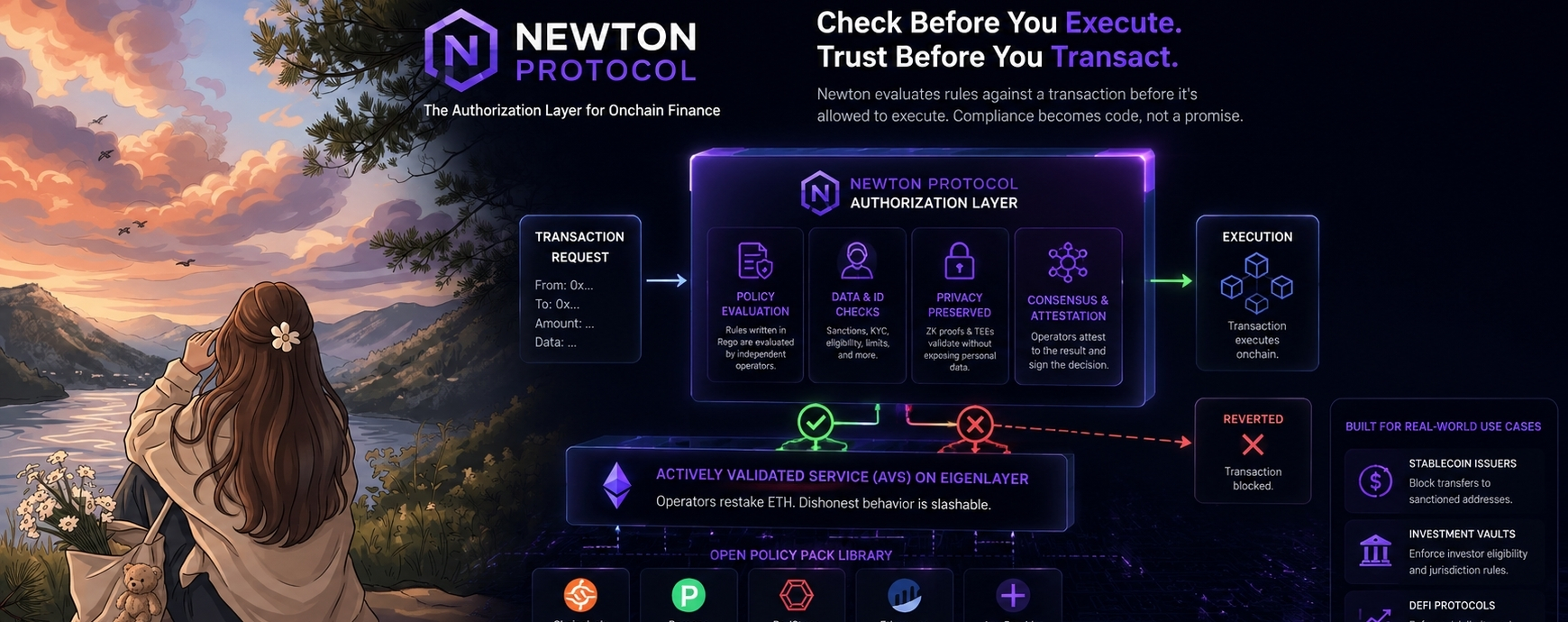
I almost scrolled past Newton Protocol the first time I saw it. Compliance infrastructure sounds like the least exciting corner of crypto you could spend an afternoon on. Then I actually read what problem it's trying to solve, and I changed my mind.
Here's the thing nobody frames clearly enough. A blockchain transaction settles instantly, but settlement was never the hard part of finance. In traditional markets, most of the work happens before the money moves: checking identity, checking sanctions lists, checking position limits, checking whether a counterparty is even allowed to do what they're trying to do. Crypto skipped straight to the settlement layer and left all of that pre-transaction logic sitting offchain, scattered across compliance teams, PDFs, and manual reviews that nobody can actually verify happened.
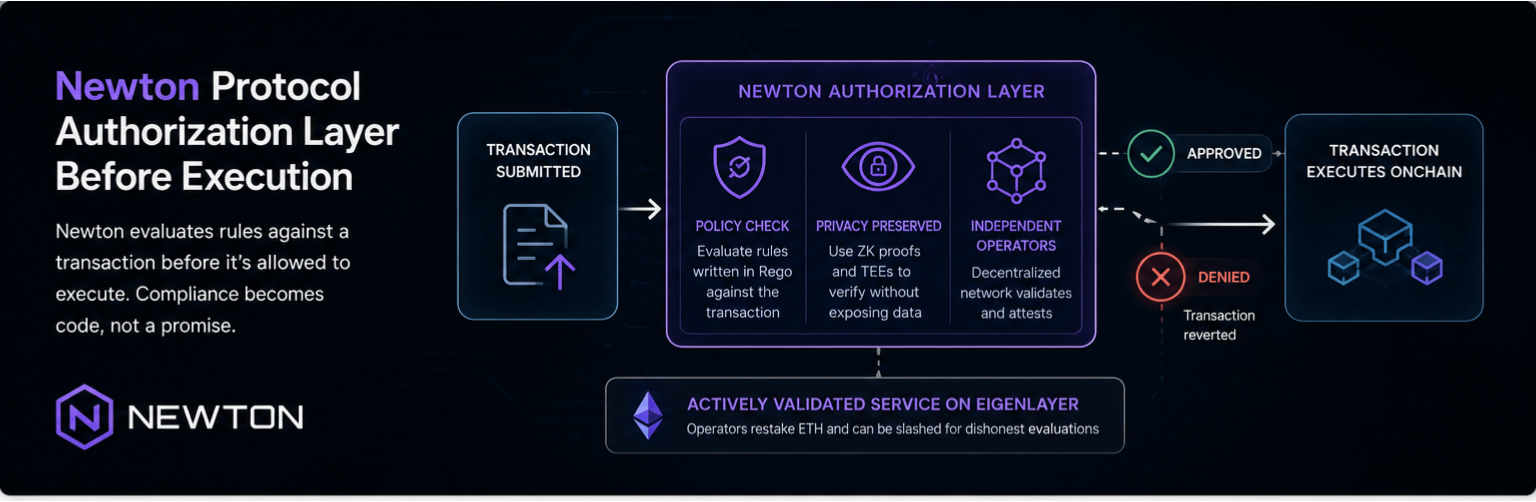
That gap is what Newton Protocol is built around. It's an authorization layer that sits in front of a transaction rather than after it. Instead of a protocol trusting that a curator or an operator followed the rules, Newton evaluates the rule against the transaction before it's allowed to execute at all. If a stablecoin issuer wants to block transfers to sanctioned addresses, or a vault wants to enforce investor eligibility, that logic runs as a policy check baked into the smart contract call itself, not as a promise written in a terms of service document.
What surprised me most is how deliberately Newton avoided just hardcoding rules into contracts, which is the obvious and lazy solution. Hardcoded logic means every regulatory update requires a redeploy, and redeploys are slow, expensive, and risky for anything holding real capital. Newton separates the policy from the contract entirely. Policies are written in Rego, the same declarative language used in traditional cloud infrastructure for access control, and they get evaluated by an independent network of operators rather than the protocol itself. That separation is the actual innovation here, not the compliance angle everyone focuses on.
The security model is where I slowed down and thought harder. Newton runs as an Actively Validated Service on EigenLayer, meaning the operators evaluating policies are backed by restaked ETH and can be slashed for dishonest evaluations. I don't think this gets discussed enough: Newton is essentially betting that Ethereum's economic security can be rented out to secure a compliance decision the same way it secures a rollup. That's a clever reuse of existing trust infrastructure, but it also means Newton inherits every open question about restaking concentration and operator centralization that the rest of the EigenLayer ecosystem is still working through.
The privacy design deserves more credit than it usually gets. A sanctions check or a jurisdiction filter normally requires exposing someone's identity data onchain, which defeats half the point of using a public ledger in the first place. Newton routes that through zero-knowledge proofs and trusted execution environments, so a policy can confirm "this wallet passed the check" without ever publishing who the wallet belongs to. For institutions that are legally required to screen counterparties but can't publish customer data publicly, that's not a nice-to-have, it's the entire reason they'd consider touching DeFi at all.
At first I assumed the open policy pack library, where any data provider or risk firm can publish a reusable compliance module, was just a developer convenience. The deeper I went, the more it looked like the actual moat. Chainalysis for sanctions, Persona for identity, RedStone for price divergence, Etherscan for gas conditions. None of these providers compete with each other and none of them need Newton's permission to publish a pack. That's a genuinely different incentive structure than most infrastructure plays, where the platform tries to own the data relationships instead of just routing around them.
The trade-off I keep coming back to is value capture. If policy evaluation becomes a commodity and the packs themselves are open source, what stops this from becoming invisible plumbing that institutions integrate once and never think about the token for again. NEWT captures fees, staking, and agent collateral, but that only matters if transaction volume through the authorization layer keeps growing faster than operators can be replaced by someone offering the same service cheaper. Mainnet beta going live on Base and Ethereum with real vault integrations is the first real test of whether usage translates into anything the token actually needs.
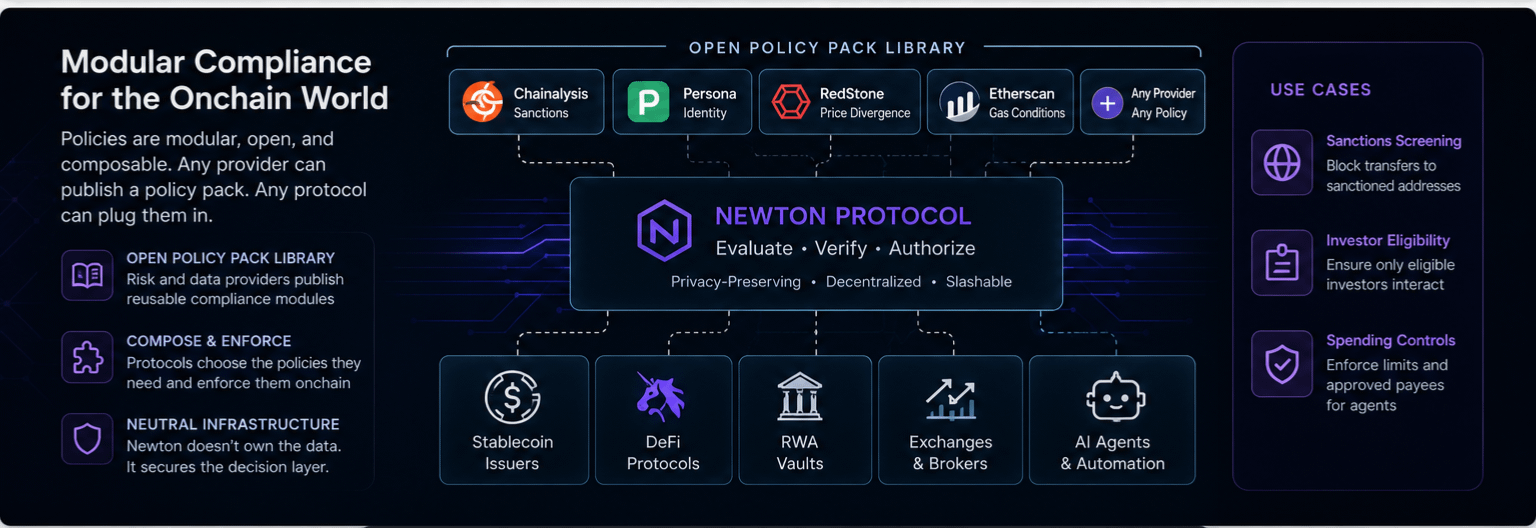
There's also a quieter risk in the AI agent framing. Newton is positioning itself as the guardrail layer for autonomous agents transacting onchain, enforcing spending caps and approved payees before an agent can act. That's a real problem worth solving, but it assumes the policies themselves are written correctly, and a badly configured policy is just a new kind of attack surface with extra steps.
I'm not fully sold on how "neutral" an authorization layer can stay once institutions, regulators, and token holders all want different rules enforced by the same neutral operator set. What part of this actually gets stress tested first: real institutional capital putting the compliance layer to work, or an AI agent finding the one edge case the policy writers didn't think of?