
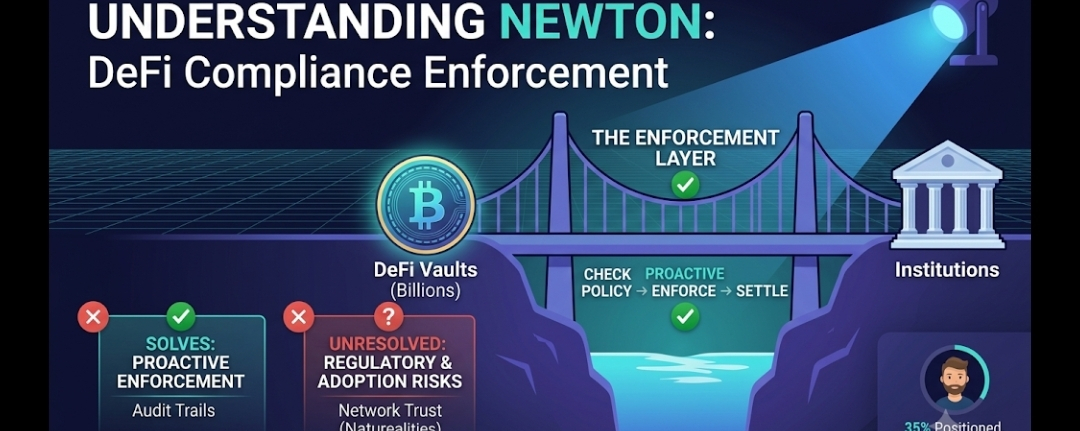
The Real Problem
I've been digging into DeFi compliance for 3 weeks now, and here's what I've learned:
The problem is real.
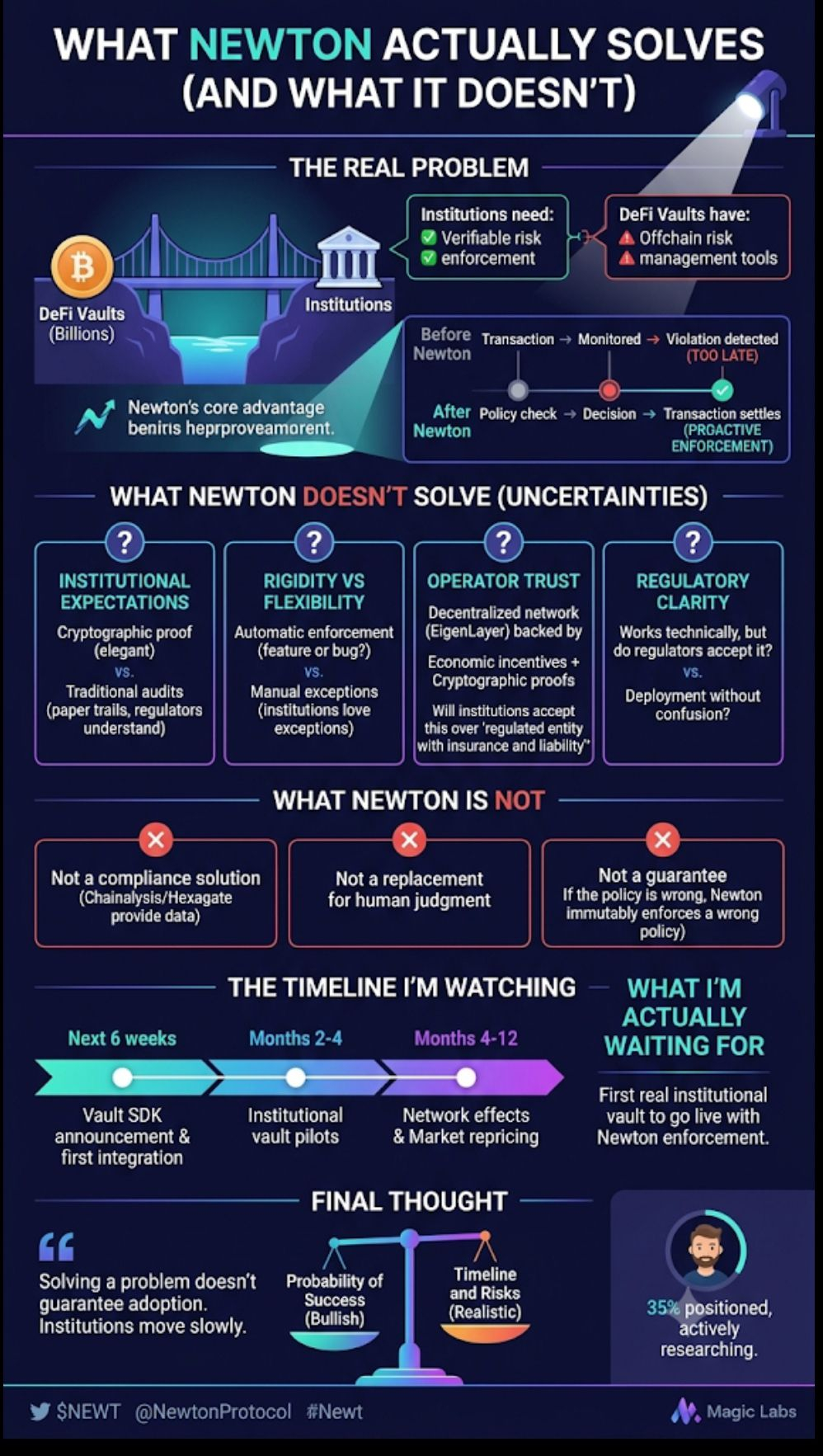
DeFi vaults hold billions. They're growing 10-50% monthly. Institutions want to deploy capital into them.
But there's a fundamental mismatch:
Institutions need: Verifiable risk enforcement
DeFi vaults have: Offchain risk management tools
When a vault says "we enforce a 5:1 leverage limit," institutions hear: "We hope we enforce it."
Because monitoring tools aren't enforcement. They're just alerts.
By the time a vault notices the violation, it's already happened.
---
## How Newton Changes This
Newton's insight is elegant: Check policy BEFORE settlement.
Instead of: Transaction happens → Monitored → Violation detected (too late)
Newton does: Policy check → Decision → Transaction settles
This is genuinely powerful.
For the first time, DeFi can offer institutional-grade policy enforcement.
---
## But Here's What I'm Uncertain About
Problem 1: Institutional expectations
Will institutions actually accept "cryptographic proof" of compliance?
Or do they want traditional audit trails? Paper trails? Things they can hand to regulators who understand them?
Cryptographic proofs are elegant. But they're also... weird to most compliance teams.
Problem 2: Rigidity vs Flexibility
Newton enforces policy automatically. No exceptions.
Institutions love exceptions. "This transaction is unique, approve it manually."
Newton says: "No. Policy is policy."
This rigidity is a feature for some institutions. But a bug for others.
Problem 3: Operator trust
Newton relies on a decentralized operator network (backed by EigenLayer staking).
Institutions ask: "How do I trust these operators?"
Answer: "Economic incentives + cryptographic proofs."
That's... okay. But not as good as "regulated entity with insurance and legal liability."
Problem 4: Regulatory clarity
Newton works. But do regulators accept it?
Can institutions actually deploy capital through Newton-secured vaults without creating regulatory confusion?
This is the real unknown.
---
## What Newton Is NOT
It's not a compliance solution. It's an enforcement layer.
Chainalysis, Hexagate, etc. still provide the data.
Newton just makes sure the data is enforced automatically.
It's not a replacement for human judgment. Someone still has to decide "what's the risk limit?"
Newton just enforces that decision onchain.
It's not a guarantee. If the policy is wrong, Newton enforces a wrong policy.
Credibly and immutably. But still wrong.
---
## My Honest Assessment
What Newton gets right:
- The architecture is sophisticated and well-designed
- The problem it solves is real
- Magic Labs has executed at scale before
- Cross-chain support is genuinely useful
What concerns me:
- Institutional adoption timeline is uncertain
- Regulatory acceptance is unproven
- Operator network needs to prove trustworthiness
- First movers will test this, not early adopters
My position:
I'm 35% positioned because I think Newton has a 60-70% chance of becoming important infrastructure.
But I'm not 100% confident because execution, regulation, and institutional preference are all variables I can't fully predict.
---
## The Timeline I'm Watching
Next 6 weeks: Vault SDK announcement and first vault integration
- If this happens cleanly → Confidence increases
- If there are delays → Confidence decreases
Months 2-4: Institutional vault pilots
- If pilots show demand → Adoption accelerates
- If pilots show resistance → Market stalls
Months 4-12: Network effects (if early adoption works)
- First movers attract capital
- Others rush to adopt
- Market reprices
---
## What I'm Actually Waiting For
Not: "Newton is interesting"
Not: "Magic Labs has credibility"
Not: "The architecture is solid"
I'm waiting for: The first real institutional vault to go live with Newton enforcement.
When I see a known institutional player actually deploying capital through a Newton-secured vault, I'll increase my position.
Until then? I'm watching closely. But not overcommitting.
---
## Final Thought
Newton solves a real problem for institutional DeFi.
But solving a problem doesn't guarantee adoption.
Institutions move slowly. They have regulatory constraints. They prefer proven approaches.
Newton is unproven.
Which is why early positioning makes sense, but overconfidence doesn't.
I'm bullish on Newton's probability of success.
But realistic about its timeline and risks.
That's why I'm 35% positioned, actively researching, and waiting for institutional vaults to validate the concept.