
I used to think giving users more control was always a good thing.
More transparency.
More visibility.
More say in how systems behave.
it sounds like a good idea at first
but when you actually watch how people use things
it feels different
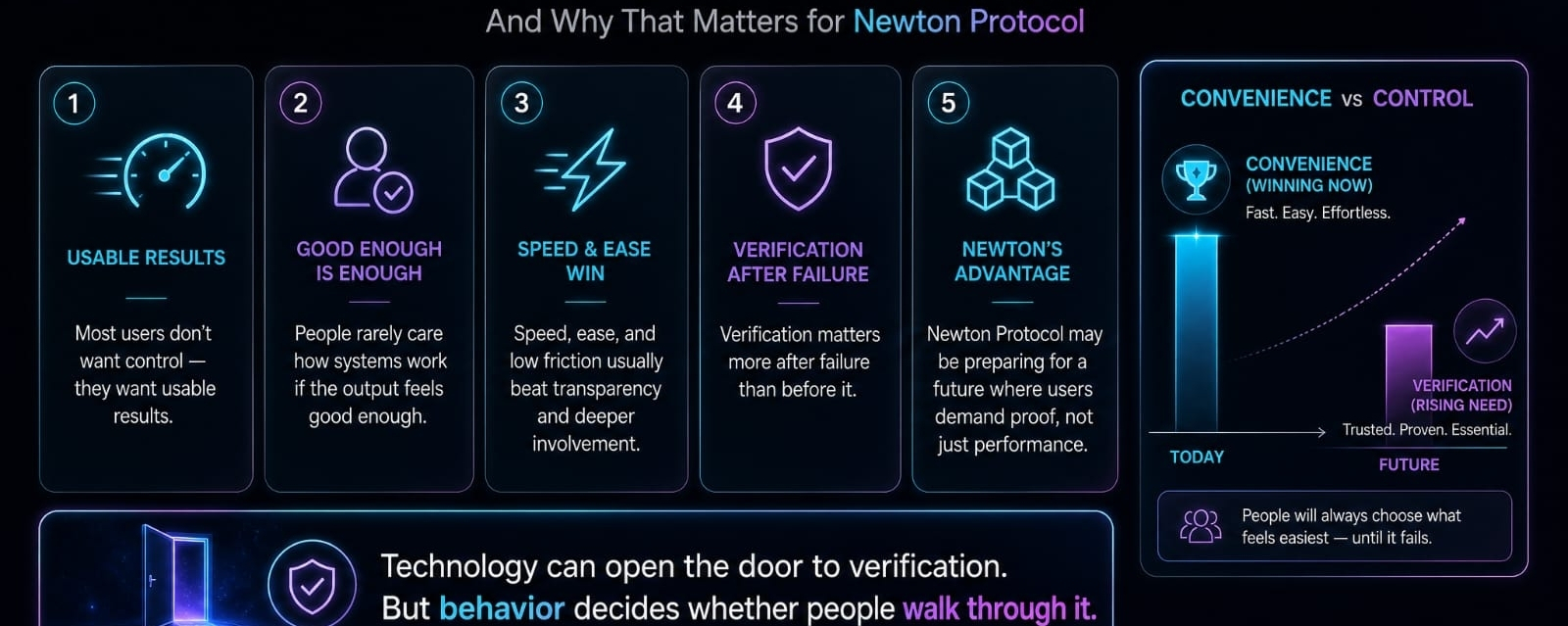
most people don’t really care about control
they just want the result
like when someone uses an AI tool
they don’t stop to think how it worked
they just check if the output is usable or not
if it is… they move on
if it’s not… they try something else They’re asking whether the result is good enough to trust and move on.
Speed matters.
Ease matters.
Friction doesn’t.
Control, on the other hand, often comes with effort.
You have to check things.
Understand things.
Sometimes even question things.
And most users avoid that unless they have a reason not to.
That’s where Newton Protocol becomes interesting.
It’s not just building infrastructure.
It’s building a system where decisions — especially AI-driven ones — can be verified instead of blindly accepted.
From a technical perspective, that’s powerful.
But from a behavioral perspective, it raises a bigger question:
Do people actually want that level of involvement?
Because giving users the ability to verify something is not the same as making them use it.
There’s a gap between “can” and “will.”
And that gap is where many systems struggle.
Right now, most users are comfortable operating in a world where things are mostly hidden, as long as the experience feels smooth.
They don’t check the logic.
They don’t verify outputs.
They trust by default — not because they’ve confirmed anything, but because nothing has gone wrong yet.
That “yet” is important.
Because behavior usually changes after failure, not before it.
People don’t suddenly become careful.
They become careful after they’ve been burned.
So maybe Newton Protocol isn’t just about improving infrastructure.
Maybe it’s positioning itself for a moment that hasn’t fully arrived yet —
a moment where users start demanding proof, not just results.
If that shift happens, systems that offer verification won’t feel like extra features.
They’ll feel necessary.
But until then, there’s a tension.
Between convenience and control.
Between smooth experience and deeper understanding.
And history shows that convenience usually wins… until it doesn’t.
That’s why I don’t think the biggest question here is whether Newton Protocol works.
It’s whether users will ever feel the need to actually use what it offers.
Because technology can open the door.
But behavior decides whether anyone walks through it.
So maybe the real question isn’t about decentralization or AI at all.
It’s much simpler:
when things are working fine…
why would anyone choose to look deeper?