
I used to think every serious blockchain upgrade was about one thing. Making transactions faster and cheaper. That was the metric everyone compared. Latency, throughput, fees. It all pointed in the same direction. Improve execution and everything else will follow.
But after spending time reading about @NewtonProtocol and its Mainnet Beta, that assumption started to feel incomplete. Not wrong. Just insufficient. Because speed only matters after you are sure the action itself should happen.

The idea that beta means unfinished also started to feel misleading. In most cases, beta suggests something is still being tested or is not fully reliable. Here, it feels different. The system is not unfinished. It is controlled. The environment is intentionally constrained so that execution can be observed, verified, and shaped before scaling. That is not a limitation. That is a design choice.
That shift in perspective led me to look deeper into how the system actually works.
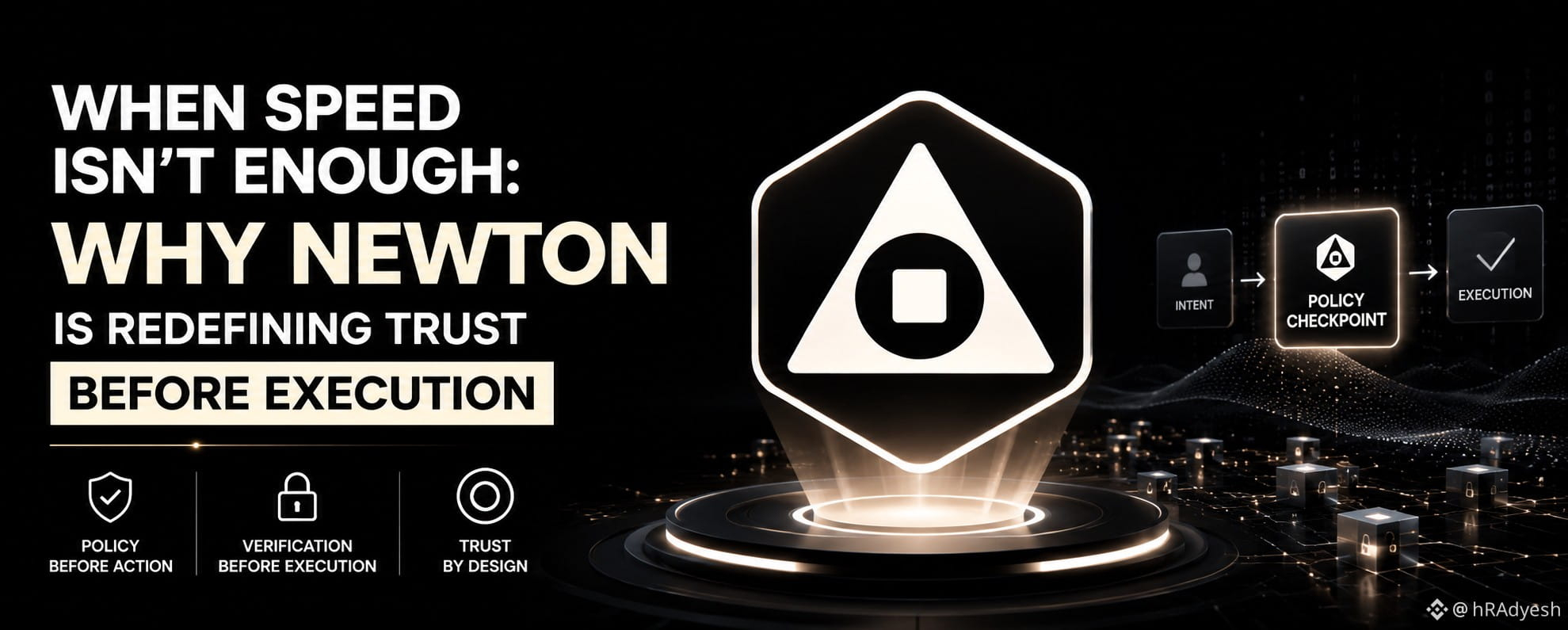
At a simple level, Newton introduces a policy layer before execution. Instead of a transaction moving directly from user intent to smart contract settlement, it passes through a checkpoint. This checkpoint evaluates whether the action meets predefined conditions. These conditions can include identity requirements, risk parameters, compliance rules, or strategy constraints.
The important detail is that this evaluation does not rely on blind trust. It uses a combination of offchain computation and onchain verification. Operators process the intent, evaluate it against the policy, and produce a signed result. These signatures are aggregated and verified before the transaction is allowed to proceed.
This means the system separates three things that are usually mixed together. Policy definition, execution logic, and verification. Each part has its own role. Each part can be inspected.
From the outside, the flow can look familiar. A vault still exists. A manager still signs. The intent still becomes execution. But the path is different. The instruction no longer goes directly to the contract. It is intercepted, checked, and only then allowed to continue.
That is where the design becomes intentional rather than cosmetic.
Most blockchain systems assume that once a transaction is valid, it should execute. Validity is defined by code. If the inputs match the rules, the system proceeds. But code does not understand context. It does not know if an action is risky, inappropriate, or simply poorly timed.
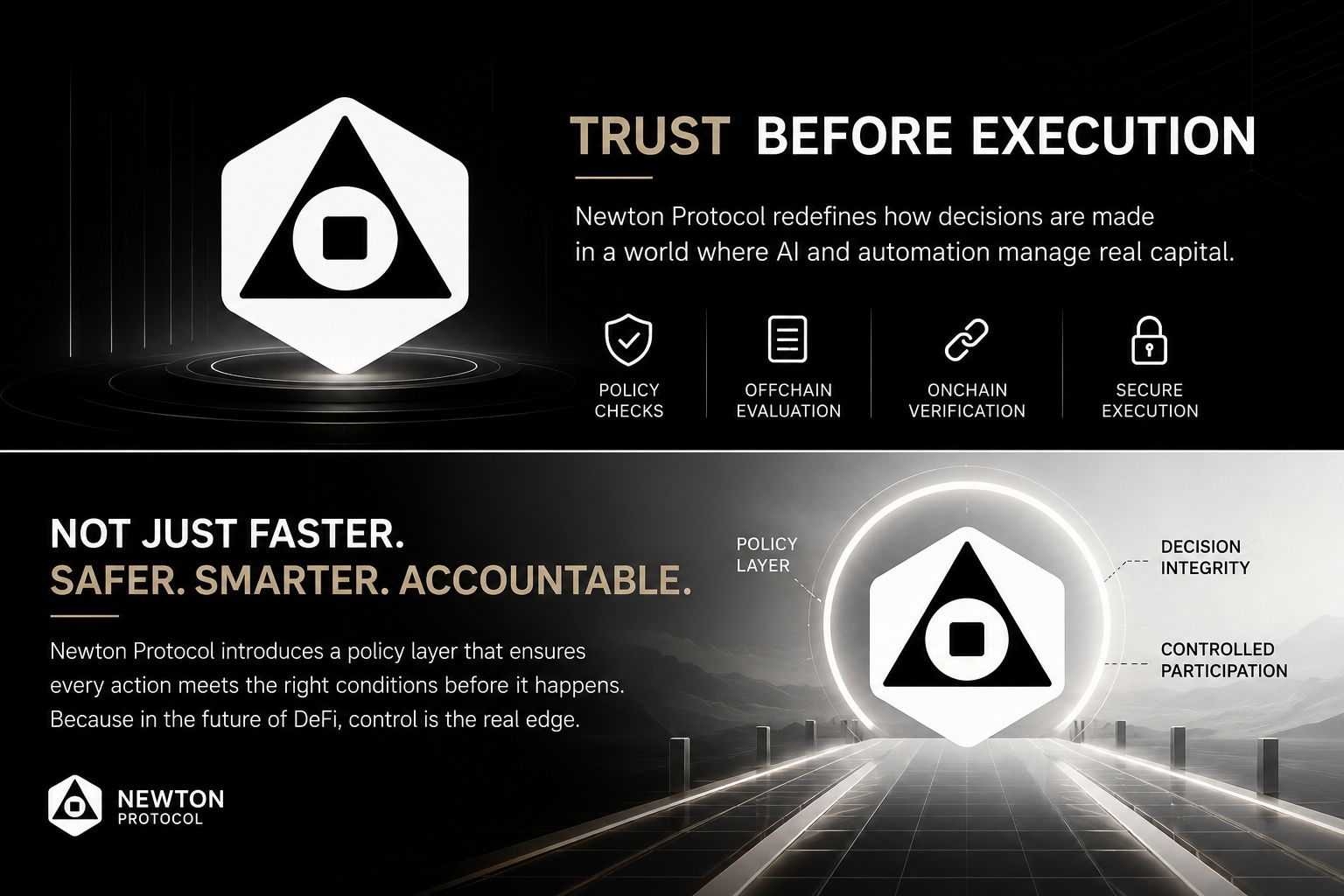
Newton is built around the idea that validity is not enough. Authorization matters. Context matters. And these factors need to be enforced before execution, not analyzed after.
This becomes more relevant as AI enters the picture.
Most discussions about AI in crypto focus on capability. Can it trade better. Can it optimize yield. Can it react faster than humans. These are useful questions, but they ignore a more difficult one. What happens when these systems control meaningful amounts of capital.
At that point, intelligence alone is not the bottleneck. Control is.
An AI agent that executes a flawed strategy at high speed does not create efficiency. It creates faster losses. Without constraints, automation amplifies mistakes instead of preventing them.
This is where Newton’s architecture starts to connect with a broader trend. It is not trying to build a better trader. It is trying to define the boundaries within which any trader, human or machine, can operate.
That distinction may seem subtle, but it changes where value sits. Instead of competing on execution, the system competes on decision integrity.
If this approach works, it could reshape how people think about infrastructure. The focus would shift from how fast transactions settle to how confidently they are approved. From raw throughput to controlled participation.
It also raises questions that are not easy to answer.
As more rules move onchain, who defines them. As policies become more complex, who verifies them. And as control increases, how do we ensure it does not turn into hidden centralization.
These are not technical questions alone. They are design and governance questions.
For now, what stands out is the direction. @NewtonProtocol is not trying to remove humans from the system. It is trying to reduce blind trust. It is not replacing execution. It is reframing it.
And that might be the more important shift.
If AI is going to manage capital, should we prioritize making it smarter or making it accountable.
If every transaction can be checked before execution, does speed still remain the primary metric.
And if policy becomes the gatekeeper, who ultimately controls the gate.
Not financial advice. DYOR.
