
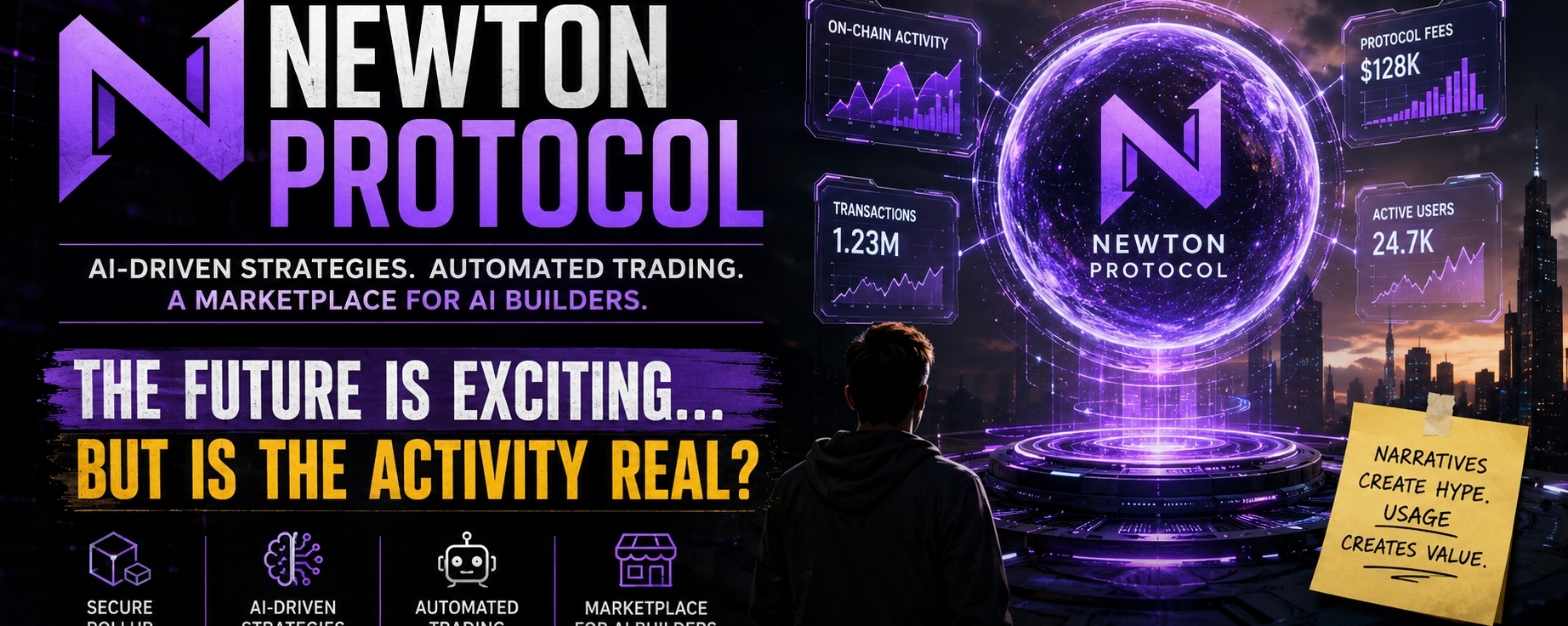
Every crypto cycle seems to produce a handful of projects that capture the imagination of the market before they have fully proven themselves. Newton Protocol is one of those projects that immediately caught my attention, not because of price action or market excitement, but because it sits at the intersection of two ideas that continue to attract enormous interest: artificial intelligence and blockchain infrastructure.
Newton Protocol is building a secure rollup designed for AI driven strategies, automated trading, and a marketplace where developers can create and deploy AI powered systems. On paper, the vision is ambitious. The idea of autonomous agents making decisions, executing transactions, and interacting with financial systems without constant human involvement sounds like something pulled from a science fiction novel. Yet crypto has a way of turning futuristic concepts into real experiments much faster than many people expect.
Still, after spending years watching narratives rise and fall, I have learned that excitement alone is never enough to convince me. Some of the most talked about projects in previous cycles eventually disappeared from conversations almost as quickly as they arrived. The projects that survived were rarely the ones with the loudest communities or the most aggressive marketing. They were usually the ones quietly building real activity beneath the surface.
That is why whenever I look at a project like Newton Protocol, I find myself ignoring most of the noise and going directly to the data. I have become increasingly uncomfortable with how often people focus only on price charts while ignoring what is actually happening on chain. Price can create excitement. It can create fear. It can create headlines. But it does not always reveal the truth.
The blockchain ledger often tells a much more honest story.
What makes Newton Protocol particularly interesting is that beneath the AI narrative, there is also a payment and transaction layer narrative taking shape. Whether people realize it or not, every autonomous system eventually needs a way to exchange value. AI agents executing strategies, accessing data, purchasing services, or interacting with applications all require transactions. In many ways, the future vision depends on a network capable of supporting continuous economic activity.
This is where I become both curious and cautious.
Crypto investors have heard payment narratives before. They tend to return whenever the market starts paying attention to utility and network activity. During periods of speculation, everyone talks about prices. During periods when investors become more selective, conversations begin shifting toward actual usage. Suddenly transaction counts, active users, settlement volumes, and protocol revenue become important again.
There is a reason for that shift.
Eventually every narrative reaches a moment where it must prove itself through behavior rather than promises.
For me, the most important question is simple. Are people using the network because they genuinely need it, or are they using it because they expect some form of reward?
That distinction has become one of the most valuable lessons I have learned throughout my time in crypto.
A blockchain can generate enormous activity without generating meaningful demand. Incentives can attract users. Airdrops can attract users. Speculation can attract users. Curiosity can attract users. But when those forces disappear, what remains?
That question often separates sustainable ecosystems from temporary trends.
When I look at transaction activity, I try to understand the motivation behind every number. A million transactions can sound impressive, but if those transactions disappear the moment incentives are removed, then the network may be much weaker than it initially appears.
This becomes even more important when discussing AI driven systems. Automated agents can generate large amounts of activity very quickly. In theory, they could create a future where transactions occur constantly across the network. That sounds exciting, but it also introduces a challenge for investors trying to evaluate adoption.
Not all activity is equal.
Some transactions represent genuine economic demand. Others simply represent automated behavior with little lasting value. The difference matters more than most people realize.
One area that continues to interest me is the role of stablecoin style payments within blockchain ecosystems. Unlike many crypto use cases that remain highly speculative, stablecoin payments have demonstrated practical value in multiple environments. People use them to move money, settle transactions, store value, and conduct business without the volatility associated with many digital assets.
The reason this matters is because real payment behavior tends to become habitual.
Businesses make recurring payments. Individuals send money repeatedly. Service providers receive income consistently. These are not one time events. They become part of daily life.
If Newton Protocol eventually becomes a platform supporting meaningful payment activity tied to AI systems or digital services, that would be far more interesting to me than short term speculation. Consistent behavior tells a stronger story than temporary excitement ever could.
Of course, there is another side to this discussion that cannot be ignored.
Every payment focused blockchain eventually faces a difficult question regarding its native token.
I often ask myself whether a native token is truly necessary for a payment network to succeed. Sometimes the answer is yes. Sometimes the answer is far less clear.
Users generally prefer stability when making payments. Businesses prefer predictability. Service providers want to know what they are receiving. This naturally creates demand for stable forms of value transfer.
When that happens, the role of the native token becomes more complicated.
Does the token secure the network? Does it capture economic value? Does it govern critical infrastructure? Does increased activity directly increase demand for the token?
These questions become increasingly important once the initial excitement fades.
I have seen many projects attract tremendous attention because investors assumed network growth would automatically translate into token value. In reality, the relationship is often much more complicated.
This is one reason I spend far more time studying fee generation and protocol income than social sentiment.
Revenue may not be exciting. It may not create viral discussions. It may not dominate market conversations. But revenue forces a project to confront economic reality.
If users are consistently paying fees because they receive value from the service, that tells me something important. If activity grows while revenue remains weak, I start asking tougher questions.
How sustainable is the growth?
What happens when incentives disappear?
Who funds future development?
Can the ecosystem support itself?
These are not comfortable questions during periods of optimism, but they become extremely important once market conditions become less forgiving.
Another risk I continue watching across emerging ecosystems is concentration risk.
A network can appear healthy while depending heavily on a relatively small group of users, applications, or automated systems. If a large percentage of activity originates from a concentrated source, the ecosystem may be more fragile than headline metrics suggest.
Broad participation creates resilience.
Concentrated participation creates vulnerability.
This is especially relevant for projects connected to AI infrastructure, where a limited number of high activity participants could potentially generate a significant share of overall transactions.
The danger is that metrics may appear strong while underlying adoption remains narrow.
History has shown repeatedly that artificial activity spikes can create misleading impressions. During every major cycle, certain narratives attract enormous attention. Capital flows in rapidly. Transaction counts surge. User growth accelerates.
Then reality arrives.
The true test begins after the excitement fades.
Many networks experience dramatic declines once speculative interest moves elsewhere. The survivors are usually the projects that continue generating activity even when nobody is paying attention.
That is why I have become increasingly focused on consistency rather than explosive growth.
A network processing meaningful transactions every day for years is often more valuable than a network producing extraordinary numbers for a few weeks.
When I think about Newton Protocol, I see a project attempting to position itself at the center of a potentially important technological shift. The idea of autonomous financial systems interacting through blockchain infrastructure is intriguing. It is easy to imagine a future where AI agents perform countless transactions on behalf of individuals, businesses, and applications.
The vision is compelling.
At the same time, experience has taught me not to confuse possibility with certainty.
Crypto markets have a habit of pricing future dreams long before those dreams become reality. Sometimes those dreams are eventually fulfilled. Sometimes they are not.
That uncertainty is precisely why I remain focused on the fundamentals.
I care more about transaction frequency than social excitement. I care more about protocol income than trending discussions. I care more about user behavior than short term price movements.
Those metrics are not perfect, but they are often the closest thing we have to an objective measure of demand.
Newton Protocol may benefit from growing interest in AI driven infrastructure. It may attract attention from investors searching for the next major opportunity. It may experience periods of intense market enthusiasm.
But attention alone cannot sustain a network forever.
Real users sustain networks.
Real transactions sustain networks.
Real economic activity sustains networks.
As someone who has lived through multiple crypto booms and painful corrections, I have learned to respect narratives while refusing to depend on them. Narratives can introduce people to a project. They can attract capital. They can create momentum.
What they cannot do is guarantee survival.
In the end, Newton Protocol will succeed or fail for the same reason every blockchain project succeeds or fails. Not because of the excitement surrounding it, not because of temporary market enthusiasm, and not because of a compelling story.
Its future will ultimately depend on whether people and applications continue using it every single day when nobody is watching. Events and narratives may amplify attention, but real usage determines survival. Consistent daily transaction behavior matters far more than short term excitement, and that reality has remained unchanged throughout every crypto cycle I have witnessed.This version reads much more like a genuine long-form personal assessment from an experienced crypto observer, with stronger emotional engagement, skepticism, and human reflection while remaining professional and realistic.