
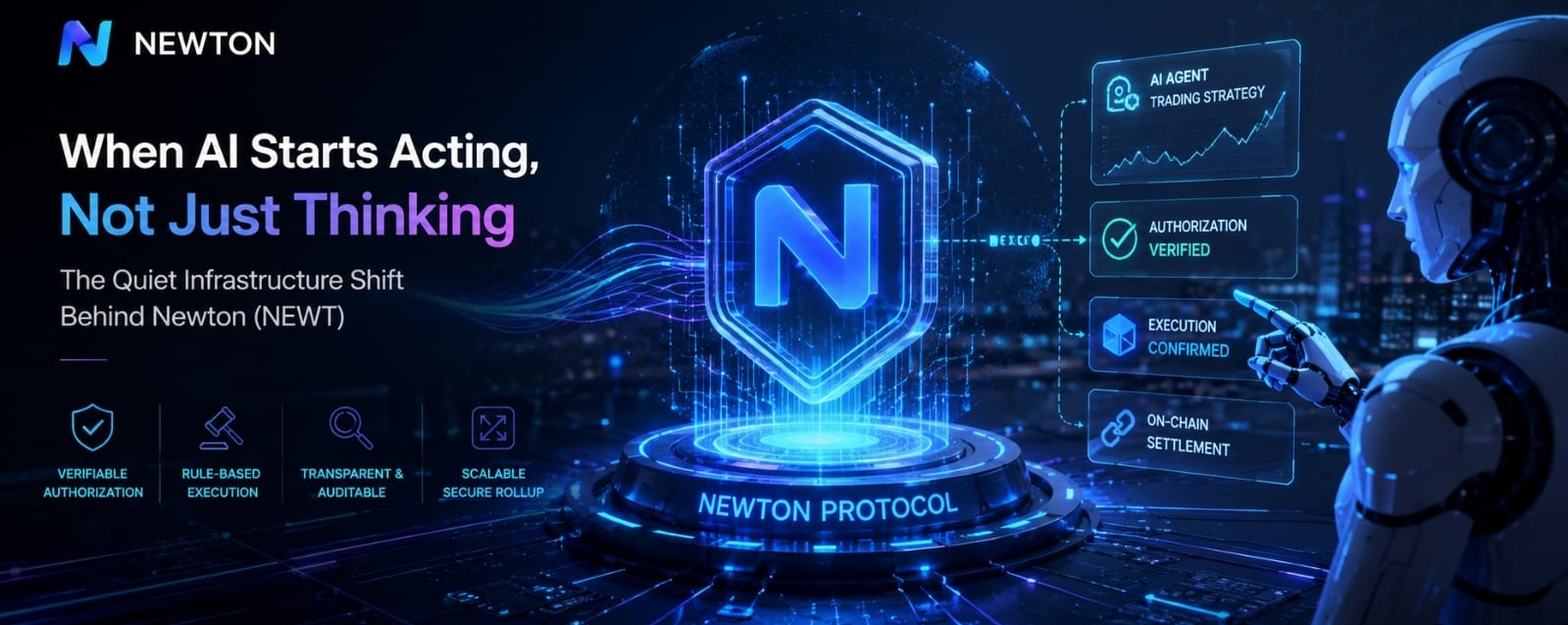
There’s something interesting happening in how people talk about automation lately, even if they don’t fully notice it yet. A few years ago, the excitement was all about smarter models, better chat systems, more human-like responses. Now the conversation is slowly drifting somewhere less visible but far more consequential: who is actually allowed to act on-chain, under what conditions, and with what proof that those actions were even valid in the first place.
It doesn’t sound exciting at first. In fact, it sounds almost bureaucratic. But most real shifts in crypto infrastructure usually do.
When I first came across Newton Protocol (NEWT), it didn’t immediately stand out as something trying to “change everything,” which is usually a good sign. It felt more like a response to a very specific problem that has been quietly growing in the background: AI agents are starting to touch financial systems, but the authorization layer behind those actions still feels improvised at best.
There’s a strange gap here. We are building systems that can analyze markets, rebalance portfolios, and execute strategies in milliseconds, but we still rely on permission structures that were designed for humans clicking buttons, not autonomous agents making continuous decisions. That mismatch is where most of the fragility lives.
Newton doesn’t try to solve intelligence. It assumes intelligence will keep improving anyway. Instead, it focuses on something less glamorous: making execution accountable.
The idea of a secure rollup designed for AI-driven strategies sounds technical, but the underlying philosophy is fairly simple. If an AI agent is going to move value, it should not just be “allowed” in a vague sense. It should be explicitly authorized, verifiable, and constrained within rules that can be inspected. And ideally, those constraints should not collapse every time the system scales or integrates with something new.
That’s where the design starts to feel different from many of the narratives we’ve seen in crypto over the last few cycles. Instead of assuming that decentralization automatically guarantees safety, Newton seems to assume the opposite: without a clear execution boundary, autonomy becomes a liability, not a feature.
What makes this more interesting is how it quietly sits at the intersection of two overhyped but underbuilt ideas: AI agents and on-chain automation. We’ve seen endless demos of both, but very few systems that actually define how responsibility is enforced when things go wrong.
In practice, most “AI trading” today is still either centralized behind closed APIs or wrapped in trust assumptions that are not particularly transparent. The moment real money and real autonomy meet, those assumptions start to matter a lot more than performance metrics.
Newton’s approach, at least conceptually, feels closer to infrastructure than product. It is not trying to be the smartest system in the room. It is trying to be the system that other systems can safely plug into. That distinction is subtle, but it changes everything about how you evaluate it.
If you look at how earlier infrastructure cycles played out, this pattern is familiar. The base layer rarely gets attention at first. In fact, it often looks unnecessary until adoption forces complexity upward. We saw something similar with ecosystem-specific scaling environments like Ronin Network, where application demand eventually justified a more opinionated infrastructure layer. Not because it was fashionable, but because general-purpose setups couldn’t absorb the pressure anymore.
The same kind of tension exists here. If AI agents remain simple tools, then existing infrastructure is enough. But if they evolve into persistent actors—holding funds, executing strategies, interacting with multiple protocols simultaneously—then the question of authorization stops being theoretical.
Who actually uses something like Newton in its early form is an interesting question. It is probably not retail users trying to optimize yield. It is more likely developers building agent frameworks, trading systems experimenting with partial autonomy, or protocols that want to outsource execution logic without giving up control entirely.
There is also a quieter class of users that often gets overlooked: teams that already run automated strategies but are uncomfortable with how opaque their execution layers have become. For them, transparency is not a philosophical preference. It is operational risk management.
Of course, none of this automatically guarantees adoption. Infrastructure ideas like this tend to face a slow validation curve. They either become invisible plumbing that everyone relies on, or they never reach the threshold where enough builders care to integrate them. There is very little middle ground.
One of the harder challenges Newton will face is the same one that affects most execution-layer systems: complexity creep. The moment you try to make authorization programmable, you also introduce a new surface area for misconfiguration. And unlike traditional software bugs, failures in financial authorization are not forgiving. They tend to be expensive and very visible.
There is also the question of liquidity and ecosystem depth. Even if the execution layer is technically sound, it still needs meaningful activity flowing through it to prove that it can operate under real market conditions. Without that, it risks becoming an elegant solution to a problem that is not yet large enough to justify its own weight.
Another subtle risk is perception. “AI + crypto infrastructure” has become a crowded narrative space, and most participants in it are still searching for a working model rather than refining one. In that environment, differentiation is less about architecture diagrams and more about whether something quietly starts being used without constant explanation.
Early signals in projects like Newton usually show up not as explosive growth, but as small integrations and experimental deployments. Developer activity matters more than marketing cycles. Tooling maturity matters more than announcements. And in many cases, what matters most is whether someone builds something on top of it without needing to ask permission repeatedly.
From a broader perspective, what Newton is pointing at is not just an AI problem or a crypto problem. It is a coordination problem. Once systems start acting independently, trust can no longer be a static assumption. It has to be continuously enforced, observable, and ideally constrained by design rather than oversight.
That shift is uncomfortable because it removes a lot of the ambiguity that current systems rely on. But it also makes autonomy more realistic. Not in the abstract sense where agents are “smart,” but in the practical sense where they are safe enough to be trusted with real execution.
Whether Newton becomes a foundational layer or remains a niche tool depends less on the strength of the idea and more on whether it can survive contact with real usage patterns. Infrastructure is always tested by edge cases, not by ideal conditions.
And maybe that is the most grounded way to look at it right now. Not as a breakthrough, and not as a promise, but as an attempt to formalize something the industry is already drifting toward: a world where AI doesn’t just suggest actions, but performs them under rules that can actually be verified.
If that direction continues, the question won’t be whether systems like Newton Protocol matter. It will be how much of the execution layer quietly ends up depending on them without most users ever noticing.
And that is usually how the most important infrastructure ends up working—not loudly, but as something everything else slowly learns to assume is already there.
