
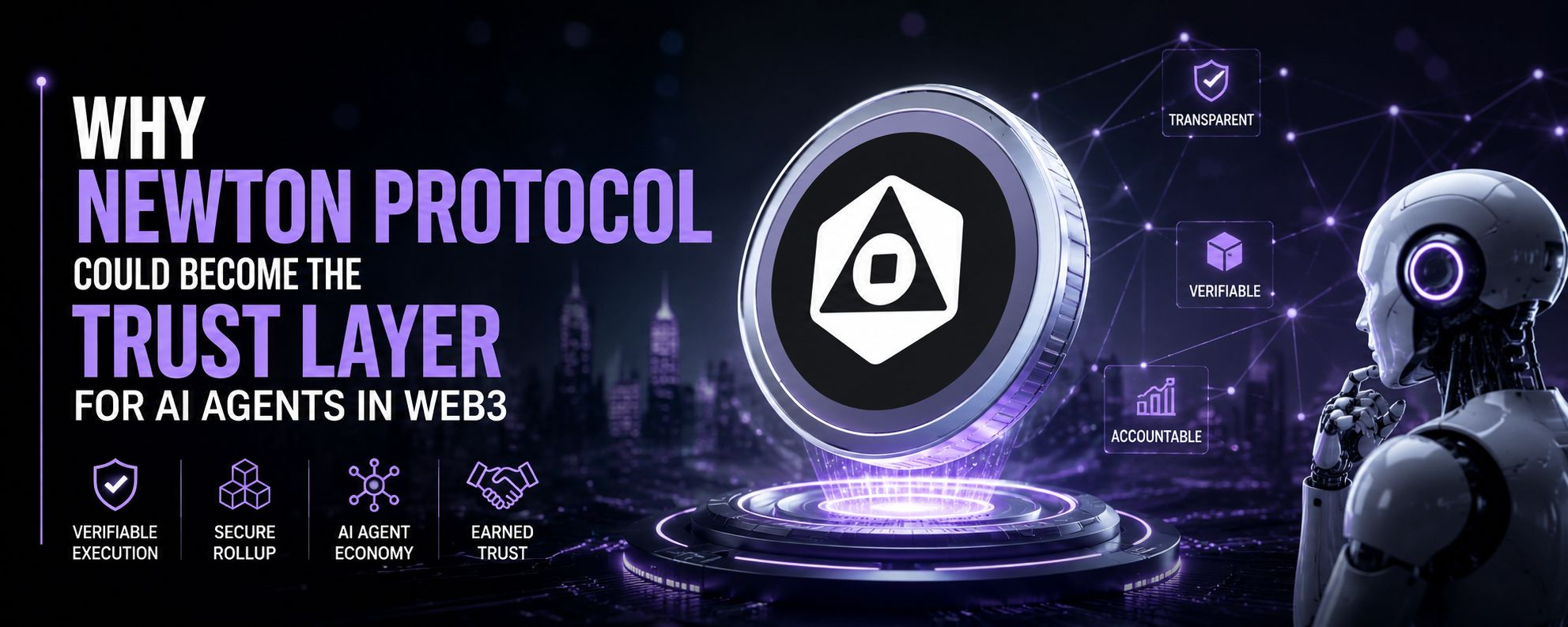
When I first looked at Newton Protocol, I thought it was just another project trying to connect artificial intelligence with blockchain. There are plenty of those already. But the more time I spent understanding what it is actually trying to solve, the more I realized the interesting part isn't AI itself. It's trust. And in a world where AI agents are beginning to make decisions, move assets, and interact with decentralized applications on our behalf, trust may quietly become the most valuable infrastructure of all.
That question feels especially relevant today because AI is no longer just generating text or images. AI agents are gradually becoming active participants in digital economies. They can monitor markets around the clock, execute trades, manage DeFi strategies, rebalance portfolios, and even negotiate with other software. The capability is growing faster than the systems designed to verify their actions.
That gap is where Newton Protocol is positioning itself.
On the surface, Newton Protocol is building infrastructure for AI-driven strategies and autonomous financial applications. Underneath, the project is attempting something much more difficult. It wants every meaningful action performed by an AI agent to be verifiable rather than simply trusted. That distinction matters because blockchain has never really been about removing trust. It has been about replacing blind trust with transparent verification.
Understanding that helps explain why Newton is designed around a secure rollup architecture rather than treating AI as just another application layer. A rollup can process activity efficiently while anchoring security to an underlying blockchain. That means AI agents are not only executing tasks faster, but their actions can also leave an auditable history. If an agent changes a trading strategy, reallocates funds, or interacts with a protocol, those actions can potentially be verified instead of remaining hidden inside a black-box model.
That changes the conversation.
Today, most AI systems operate behind closed doors. Users see the output but rarely understand the reasoning or verify the process. In traditional software, that may be acceptable. In decentralized finance, where billions of dollars move through smart contracts, it becomes a much bigger problem.
According to industry estimates, decentralized finance continues to secure well over $100 billion in total value locked across blockchain ecosystems. That number represents far more than capital. It represents trust placed in code rather than institutions. If even a small percentage of those assets eventually come under AI-assisted management, the demand for transparent verification grows alongside it.
Newton appears to recognize that before the market fully demands it.
Another interesting layer is its marketplace for AI developers. At first glance, it sounds like a distribution platform where developers can publish AI models. But underneath, it creates incentives that look surprisingly similar to what decentralized finance achieved for liquidity providers.
Instead of only rewarding infrastructure operators, Newton could reward developers whose AI agents consistently perform well under transparent conditions. Reputation becomes measurable rather than marketing driven. Developers earn credibility through performance records that users can inspect instead of simply believing promotional claims.
That sounds simple until you consider how different it is from today's AI ecosystem.
Most AI products ask users to trust the company building the model. Newton is exploring whether users can instead trust cryptographic evidence surrounding the model's actions. Those are very different foundations.
Of course, this raises another question. Can AI decisions really be verified?
The answer is both yes and no.
The reasoning inside a large language model remains incredibly difficult to inspect. That challenge has not disappeared. What blockchain can verify is everything surrounding the decision. Which model executed the task. Which permissions it had. Which wallet signed the transaction. Which data source was referenced. Which outcome followed.
Think of it like watching a professional chess match. You may never know every thought inside a player's mind, but every move on the board is visible. That transparency allows others to judge whether the strategy makes sense. Newton seems to be applying a similar philosophy to AI agents.
That approach also reduces another growing concern. Autonomous agents with unrestricted wallet access create obvious security risks. If an AI agent is compromised, manipulated, or simply makes poor decisions, the financial consequences can escalate quickly.
By introducing programmable permissions and verifiable execution layers, projects like Newton are trying to narrow the damage that mistakes can cause. It doesn't eliminate risk. Nothing in crypto does. But it changes risk from something invisible into something observable.
There is also a broader market context that makes this timing interesting.
AI-related crypto projects have attracted increasing attention throughout 2025 and 2026 as investors look beyond simple chatbot narratives. Capital is gradually shifting toward infrastructure rather than speculation alone. Markets tend to mature this way. The first wave celebrates possibility. The second begins asking harder questions about reliability, scalability, and accountability.
Newton enters the conversation during that second phase.
That doesn't guarantee adoption.
Building infrastructure is often less exciting than launching consumer applications. Users usually notice wallets, exchanges, and trading platforms long before they appreciate the protocols quietly securing them. The trust layer often becomes visible only after something fails.
Meanwhile, competition is becoming stronger. Multiple blockchain ecosystems are exploring decentralized AI, confidential computing, zero-knowledge proofs, and agent coordination frameworks. Newton is not alone in recognizing this opportunity. The challenge will be execution, developer adoption, and whether enough AI builders decide that transparent infrastructure is worth integrating.
Early signs suggest the demand exists.
Enterprises are increasingly experimenting with AI agents for financial operations. Individual crypto users are exploring automated portfolio management. Developers continue searching for ways to prove their systems behave as intended. Those trends are moving independently today, but they naturally converge around one shared requirement. Verifiable trust.
That may ultimately become Newton Protocol's biggest advantage if this holds.
People often assume AI's future depends entirely on smarter models. I'm not convinced that's the whole story. Smarter intelligence without stronger verification simply creates larger black boxes. The next stage of AI may depend less on generating better answers and more on proving why those answers deserve confidence.
Blockchain has always been strongest when solving coordination problems between strangers. AI introduces a new version of that same challenge. Except now, the stranger isn't another person. It's software acting with increasing autonomy.
That subtle shift changes everything.
When we look back at this stage of Web3, we may remember it less as the moment AI entered crypto and more as the moment crypto began teaching AI how to earn trust instead of asking for it. If Newton Protocol succeeds, its biggest contribution may not be smarter agentst all. It may be making trust something that can finally be verified instead of assumed.