
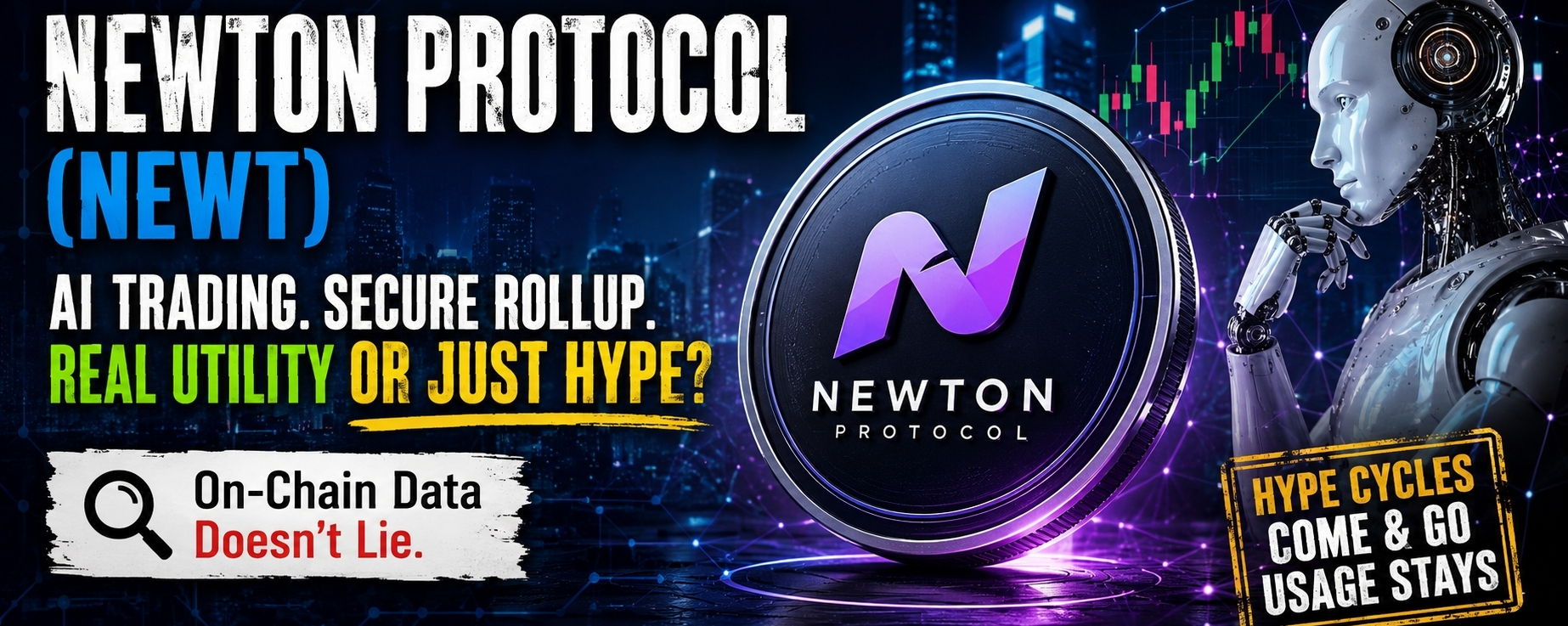
Every crypto cycle seems to produce a new story that captures people's imagination. Sometimes it is decentralized finance. Sometimes it is gaming. Sometimes it is digital collectibles. Today, artificial intelligence is attracting a huge amount of attention, and projects connected to AI are finding themselves at the center of conversations across the market. Newton Protocol (NEWT) is one of the projects that has emerged from this growing trend, presenting a vision built around a secure rollup designed for AI driven strategies, automated trading, and a marketplace where developers can build and deploy intelligent applications.
At first glance, the idea sounds compelling. Artificial intelligence is advancing rapidly, and blockchain networks continue searching for practical use cases that can attract long term users. Bringing these two worlds together naturally creates excitement. Yet after spending years observing crypto markets through multiple booms and painful corrections, I have become cautious whenever a narrative becomes too popular too quickly.
The older I get in this industry, the less interested I become in promises and the more interested I become in evidence.
Whenever I evaluate a project, I find myself looking past the headlines and focusing on the blockchain itself. What are users actually doing? Are transactions increasing because people genuinely need the network, or because they are chasing rewards and speculation? Is there real economic activity taking place, or are we simply watching another wave of attention searching for a place to land?
These questions matter because I have seen this movie before.
In every cycle, investors become convinced that a particular theme will change everything. Prices move higher. Excitement spreads rapidly. Optimism becomes difficult to avoid. Then reality begins asking difficult questions. Where are the users? Where is the revenue? Where is the demand that survives after the excitement fades?
This is why I find the payment focused blockchain narrative particularly interesting whenever it begins resurfacing. Payment narratives tend to return whenever market participants start looking for activity that can be measured rather than stories that can only be imagined. Eventually people want proof. They want to see transactions, usage, fees, and economic behavior.
That shift in attention usually happens for a reason.
Payments remain one of the few blockchain use cases that ordinary people can immediately understand. Most individuals do not spend their day interacting with complex decentralized applications. They do, however, understand the importance of moving money efficiently. They understand sending value to another person. They understand receiving payments without unnecessary friction.
This is one reason stablecoin based payments continue attracting attention. Their value extends beyond crypto native users. They solve practical problems that exist in the real world. Whether someone is a trader, a freelancer, a business owner, or simply an individual moving funds across borders, the usefulness is easy to recognize.
When I think about Newton Protocol, I cannot help asking how much of its future success will depend on creating similar forms of practical demand.
The concept of AI powered activity sounds exciting, but excitement alone is not enough. A network ultimately survives because users continue returning to it. The reason they return matters more than the number of transactions they generate.
One lesson I have learned repeatedly is that not all activity deserves equal weight.
A blockchain can process enormous transaction volumes and still struggle to create sustainable value. Automated systems can generate thousands of interactions every minute. Algorithms can execute trades continuously. Wallet numbers can increase rapidly. Yet if that activity exists primarily because participants expect rewards, then the foundation may be weaker than it appears.
This distinction between activity and demand is something I believe many investors overlook.
Activity can be purchased.
Demand usually has to be earned.
Whenever I review on chain data, I pay close attention to transaction fees, protocol income, transaction frequency, and user behavior. These metrics rarely generate the same excitement as price charts, but they often reveal the truth much sooner.
A user who returns every day because a service provides value tells me something important.
A user who disappears the moment incentives decline tells me something important too.
That difference may determine whether a network survives beyond a single narrative cycle.
One of the reasons I remain skeptical during periods of intense enthusiasm is because I have seen how quickly numbers can become misleading. A sudden spike in activity often creates the appearance of momentum. Investors rush to interpret the data as evidence of adoption. Yet several months later, transaction counts begin falling, active users decline, and attention shifts elsewhere.
The blockchain industry has experienced this pattern repeatedly.
What makes these situations difficult is that the activity itself is not necessarily fake. The transactions are real. The users are real. The challenge is determining whether the behavior will continue once external motivations disappear.
For Newton Protocol, this may become one of the most important questions going forward.
If AI driven applications genuinely create value for users, then transaction activity may become increasingly sustainable. Developers may continue building. Users may continue engaging. Businesses may eventually find practical reasons to participate.
However, if much of the activity depends on temporary enthusiasm surrounding artificial intelligence as a market narrative, then long term sustainability becomes less certain.
This uncertainty is not criticism. It is simply reality.
Every emerging network faces similar challenges.
Another aspect that deserves attention is protocol revenue. I often find myself surprised by how little discussion takes place around revenue generation compared to token prices. Investors spend countless hours discussing market movements while paying very little attention to whether a protocol is actually generating meaningful income.
For me, revenue matters because it reflects economic value creation.
If users are consistently willing to pay transaction fees, that suggests the network is providing something useful. If transaction volume rises while revenue remains weak, then I become more cautious. Growth without economic strength can create an illusion of progress.
The role of the native token also deserves careful examination.
Many blockchain ecosystems assume their native asset will naturally benefit from network growth. Sometimes that assumption proves correct. Other times the relationship becomes much more complicated.
If payment activity increasingly relies on stable assets, what exactly is the role of the native token? Does it secure the network? Does it capture value from economic activity? Does it provide utility that users genuinely need?
These are not comfortable questions, but they are necessary ones.
I have watched too many investors assume that network growth automatically translates into sustainable token demand. The reality is often more nuanced.
There is also the issue of concentration risk.
Many blockchain networks eventually discover that a relatively small group of participants accounts for a significant percentage of total activity. When that happens, growth becomes more fragile than headline numbers suggest. If a handful of large users reduce their activity, network metrics can change dramatically.
Artificial activity spikes create similar concerns.
A sudden increase in transactions may look impressive, but sustainable adoption usually develops gradually. Real usage often appears boring from the outside. People use a network repeatedly because it solves a problem. They do not necessarily create dramatic spikes in activity. Instead, they build consistent patterns over time.
Ironically, those boring patterns are often the strongest signals.
As someone who has lived through multiple crypto cycles, I have become increasingly comfortable with boring signals. Consistent fee generation. Stable user growth. Reliable transaction behavior. Gradual increases in protocol income.
These indicators rarely generate excitement, but they often survive long after narratives fade.
That brings me back to Newton Protocol.
The project is attempting to position itself at the intersection of two powerful trends. Artificial intelligence continues expanding rapidly, and blockchain infrastructure continues searching for meaningful adoption. The opportunity is real. The vision is ambitious.
At the same time, ambition alone does not guarantee sustainability.
What matters is whether users ultimately find enough value to return day after day, month after month, regardless of market sentiment.
I sometimes feel uncomfortable watching investors focus exclusively on price action. Price can tell an interesting story, but it rarely tells the complete story. Attention can be exciting, but attention is temporary. Narratives can attract capital, but capital eventually looks for results.
That is why I continue returning to on chain data.
The ledger has no interest in promoting a narrative. It simply records behavior. It shows who is using a network, how often they return, what fees they are paying, and whether economic activity is becoming stronger or weaker.
Those signals are rarely perfect, but they are usually more reliable than speculation.
In the end, my view of Newton Protocol remains one of cautious curiosity. The project operates within a sector that could become increasingly important as artificial intelligence evolves. There are legitimate reasons to watch its development closely. There are also legitimate reasons to remain careful and avoid making assumptions too early.
History has taught me that attention and survival are not the same thing.
Events, partnerships, market excitement, and emerging narratives can all amplify awareness. They can bring new eyes to a project and create periods of remarkable interest. What ultimately determines survival, however, is something much simpler.
Real usage.
If people continue showing up every day because the network provides genuine value, the foundation becomes stronger. If activity fades once excitement disappears, the weaknesses eventually become visible.
That is why I believe consistent daily transaction behavior matters far more than short term enthusiasm. Narratives may capture attention, but only real demand earns longevity. In the long run, transaction fees, protocol income, user retention, and authentic user behavior remain the clearest signals of whether a network is building something durable or simply experiencing another moment in the spotlight.If you want it to feel even more like a veteran investor's personal journal with stronger emotional hooks and a deeper storytelling style, I can make it sound even less AI-written and more like a published crypto opinion piece.
#BOKWarnsSingleStockLeveragedETFRisks
#IRENFalls10%After$700MCoCEOStockAward
#EthicalHackersFindAptosFlawRisking$70B #StablecoinMarketCapFalls$10BTo$300B