
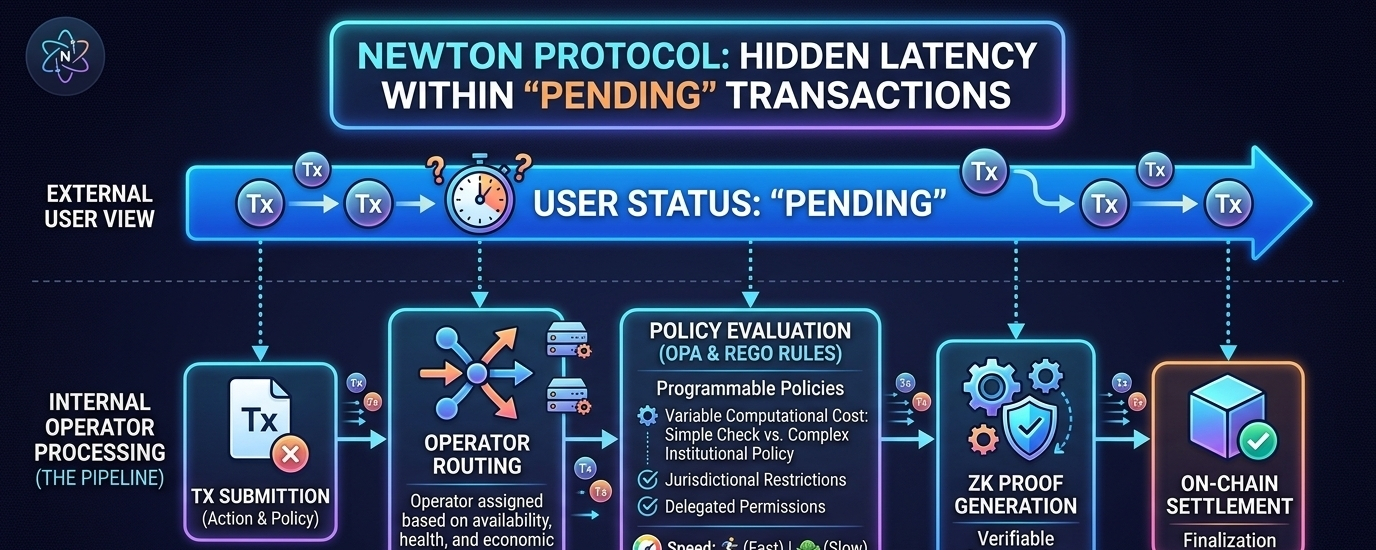
Over the weekend, I spent some time testing Newton Protocol's pre-transaction enforcement flow. One transaction caught my attention—not because it failed, but because it lingered in a pending state noticeably longer than expected before finally settling on-chain.
My first assumption was simple: operator congestion.
Newton's architecture depends on operators handling policy enforcement before transactions are finalized, so a temporary backlog seemed like the most reasonable explanation. Distributed systems experience uneven workloads all the time, and brief delays are hardly unusual.
But that explanation became less convincing a few moments later.
While my transaction was still waiting, I noticed the same operator appeared to process another transaction almost immediately. That observation didn't prove anything on its own, but it introduced doubt. If the operator was capable of accepting and completing other work, then perhaps raw network load wasn't the entire story.
That small observation led me to think less about one delayed transaction and more about the architecture behind Newton's execution pipeline.
From the outside, every unfinished transaction simply appears as "pending."
Internally, however, that single label may represent several completely different stages of execution.
The first stage is straightforward.
A transaction is submitted with its intended action and associated policy requirements. Rather than moving directly toward settlement, Newton routes the request toward an available operator responsible for policy enforcement.
Availability, however, should not be confused with responsiveness.
An operator may be online, properly synchronized, actively participating in the network, and secured through EigenLayer's economic guarantees while still not producing the fastest response for a particular request. Operational health and execution speed are related concepts, but they are not identical.
Once an operator receives the transaction, policy evaluation begins.
This is where Newton differentiates itself from conventional execution environments.
Instead of validating only signatures and balances, the protocol evaluates programmable policies using OPA and Rego rules. Those rules can express far richer conditions than traditional smart contract permission checks.
Some policies may be extremely lightweight.
Others may involve significantly more logic, including jurisdictional restrictions, institutional compliance requirements, delegated permissions, execution constraints, or combinations of multiple policy layers.
Not every policy requires the same computational effort.
Even if two transactions arrive at nearly the same time, their evaluation costs may differ substantially.
After policy evaluation, the resulting decision still requires cryptographic verification.
Newton incorporates zero-knowledge proofs to demonstrate that policy enforcement occurred correctly without revealing unnecessary information. Proof generation and verification add another important security layer, but they also introduce additional computational work before settlement can proceed.
Only after these stages complete does the transaction finally reach on-chain settlement.
Viewed this way, the familiar "pending" status hides an entire sequence of independent operations:
Transaction submission.
Operator routing.
OPA/Rego policy evaluation.
Zero-knowledge proof verification.
On-chain settlement.
Any one of these stages can contribute latency, yet externally they often appear indistinguishable.
That distinction matters because users naturally search for a single explanation whenever a delay occurs.
In reality, multiple infrastructure components may each contribute a few hundred milliseconds—or occasionally much longer—without exposing where time is actually being spent.
This also changes how I think about operators.
In many decentralized systems, discussions focus primarily on uptime.
Either an operator is available or it isn't.
Newton introduces a more nuanced question.
How quickly can an operator evaluate different categories of policy?
Availability measures participation.
Responsiveness measures execution speed.
Trust comes from economic security and verifiable computation.
These qualities overlap but remain distinct operational characteristics.
An operator secured through EigenLayer may satisfy every security assumption while still taking longer to evaluate certain requests than another equally trustworthy operator.
That naturally raises questions about incentives.
I do not present this as an explanation for the delay I observed, only as one possible hypothesis worth considering.
If policy evaluations vary significantly in computational complexity, operators may experience different resource costs depending on the work assigned to them.
A simple permission check might complete almost instantly.
An institutional compliance policy involving multiple conditional evaluations could consume noticeably more CPU time or memory before producing a valid result.
If operators process heterogeneous workloads, could response times naturally diverge?
Could some requests remain in queues longer simply because they require more expensive evaluation?
Equally, there are many alternative explanations that have nothing to do with operator incentives.
Routing algorithms could distribute requests unevenly.
Queue position alone might determine completion order.
Internal batching strategies could delay otherwise simple transactions.
Zero-knowledge proof generation could temporarily dominate execution time.
Network synchronization or validator scheduling might contribute additional delay before settlement.
Without visibility into the pipeline, distinguishing among these possibilities becomes extremely difficult.
That lack of observability is perhaps the most interesting architectural challenge.
As protocols mature toward institutional adoption, predictable latency becomes almost as important as decentralization itself.
Institutions generally tolerate small delays.
They struggle much more with inconsistent delays whose causes cannot be identified.
Newton's programmable policy engine is one of its strongest architectural ideas because it enables sophisticated automated decision-making before transactions reach the blockchain.
At the same time, greater flexibility inevitably introduces greater execution variability.
The interesting question is how the protocol manages that variability under sustained demand.
Imagine an environment where thousands of concurrent transactions carry very different policy requirements.
Some request simple authorization checks.
Others involve jurisdiction-specific compliance logic, delegated permissions, enterprise governance rules, or more computationally intensive policy evaluations.
How does routing remain fair?
How does latency remain predictable?
Could computationally expensive policy evaluations gradually become deprioritized simply because they consume more operator resources?
Or does Newton incorporate scheduling mechanisms specifically designed to prevent that outcome?
These are not criticisms of the protocol.
Rather, they are the kinds of infrastructure questions that naturally emerge as programmable execution environments become more sophisticated.
Security is measurable.
Decentralization is increasingly measurable.
Latency transparency may become equally important as AI-native transaction systems evolve.
The brief delay I observed during my weekend testing does not establish any systemic issue, nor does it demonstrate a flaw in Newton's architecture. It simply highlighted how much complexity exists behind a status indicator that says only one word: "pending."
As builders continue pushing policy-aware execution toward production scale, greater transparency into execution behavior could become just as valuable as stronger cryptographic guarantees.
One question continues to stay with me:
Does Newton publish per-operator latency metrics broken down by policy type, or is that information intentionally hidden from users?
