
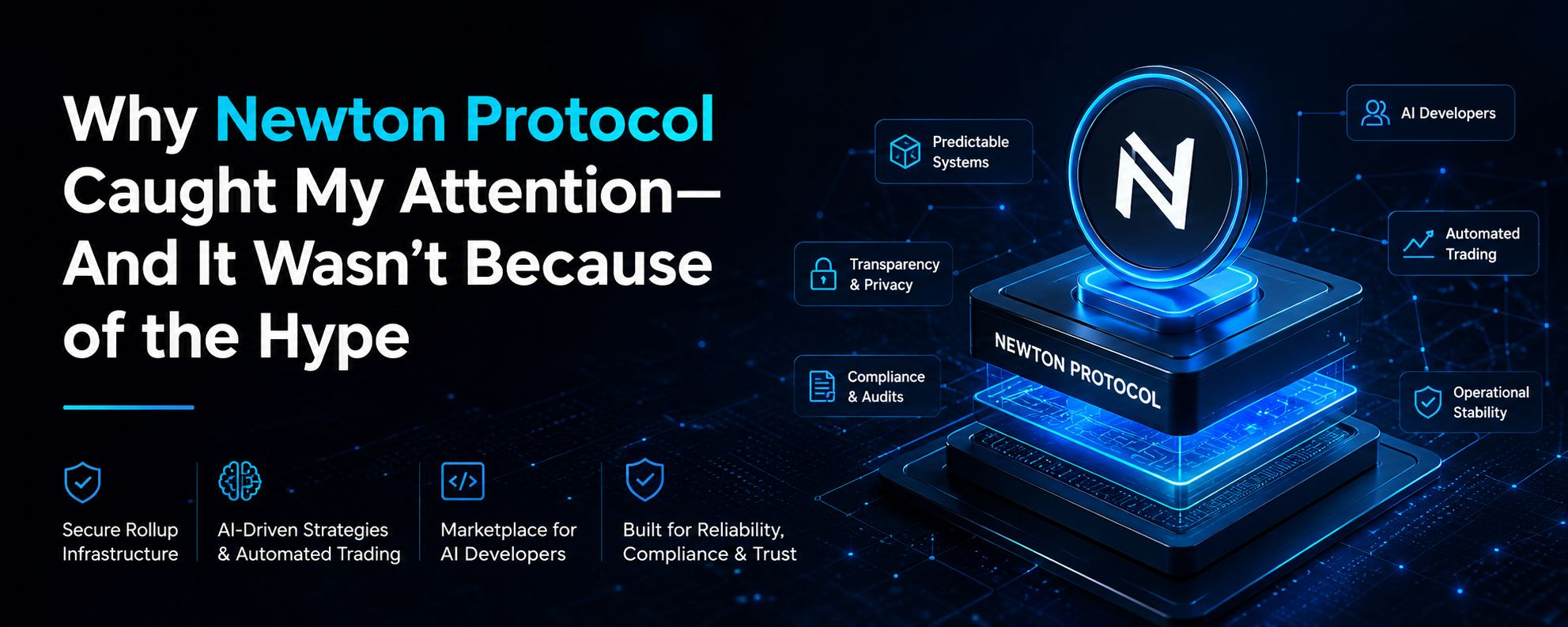
I have spent some time reading about Newton Protocol NEWT. I wasn't looking for another project making bold promises or trying to predict where the market might go. Instead, I wanted to understand how the protocol is designed and why those design choices matter in practice.
The more I read, the more I realized that what interested me wasn't the AI angle alone. It was the attention given to the less visible parts of building technology things like structure, reliability, predictable behavior, and creating an environment where AI-driven strategies, automated trading, and AI developers can operate in an organized way.
Those topics don't usually attract much attention, but they are often the foundation of systems that people are actually willing to rely on.
One thing I found interesting is that Newton Protocol focuses on establishing a secure rollup. That may not sound exciting at first, but infrastructure decisions usually shape everything built on top of them. If the foundation is unreliable, even the most advanced applications eventually run into problems.
As I continued reading, I noticed that the protocol doesn't simply talk about automation. Instead, it describes an environment where AI-driven strategies and automated trading can exist within a structured framework. To me, that feels like a practical way to think about automation. Technology becomes much more useful when its behavior is understandable and consistent rather than unpredictable.
Predictability isn't something people usually celebrate, yet I think it matters far more than many realize. Engineers maintaining systems, operators responding to incidents, and organizations working under regulatory expectations all benefit from software that behaves consistently. When systems are easier to understand, they are also easier to monitor, maintain, and trust.
Another part that stood out to me is the marketplace for AI developers. I see this as more than just a place for developers to publish work. It reflects the idea that software development works better when people have a structured environment instead of disconnected tools and isolated workflows.
I also think a lot about developer experience because it often determines how software evolves over time. Good APIs, practical tooling, sensible defaults, and clear interfaces rarely make headlines, but they reduce unnecessary complexity. Small improvements in these areas can make everyday development smoother and reduce the likelihood of mistakes.
The same is true for operational stability. In my experience, stability isn't only about keeping systems online. It's about making sure people understand what the system is doing, can monitor it effectively, and can respond with confidence when something unexpected happens. Reliable operations are usually built on consistency rather than constant intervention.
Compliance and audits are another area that often gets overlooked in public discussions. They may not sound exciting, but they are part of how organizations evaluate whether technology is suitable for real-world use. Systems that can withstand review generally rely on disciplined processes, repeatable behavior, and clear operational practices instead of depending on individual judgment alone.
Reading about Newton Protocol made me think about how much trust depends on these ordinary engineering details. Trust is rarely created through ambitious statements. It usually grows over time as systems continue to behave in predictable and understandable ways.
I also appreciate that discussions around the protocol acknowledge both privacy and transparency without presenting either as a simple answer to every problem. In practice, infrastructure often has to balance different operational needs, and thoughtful design usually recognizes those trade-offs.
Perhaps the biggest takeaway for me is that the most valuable engineering decisions are often the quiet ones. Monitoring, predictable defaults, practical tooling, maintainable APIs, and operational consistency may never become popular talking points, but they often determine whether infrastructure remains dependable over the long term.
After spending time learning about Newton Protocol, I came away with an appreciation for its design philosophy rather than any single feature. I like that the conversation seems to center on building infrastructure capable of supporting AI-driven strategies, automated trading, and developers within a structured environment instead of relying on exaggerated claims.
In the end, I think the projects that deserve attention are often the ones focused on solving practical problems. Reliable infrastructure, thoughtful developer experience, operational discipline, and predictable systems may not generate excitement overnight, but they are the qualities that help technology earn confidence over time.
That is what stayed with me as I learned more about Newton Protocol.
