
When people talk about new blockchains, the conversation usually starts with speed, throughput charts, or some clever cryptographic trick. Plasma doesn’t enter the room that way. It feels more like it slips in late, listens for a while, and then asks an uncomfortable question:
Why is moving stablecoins still harder than it needs to be?
That question explains almost everything about Plasma.
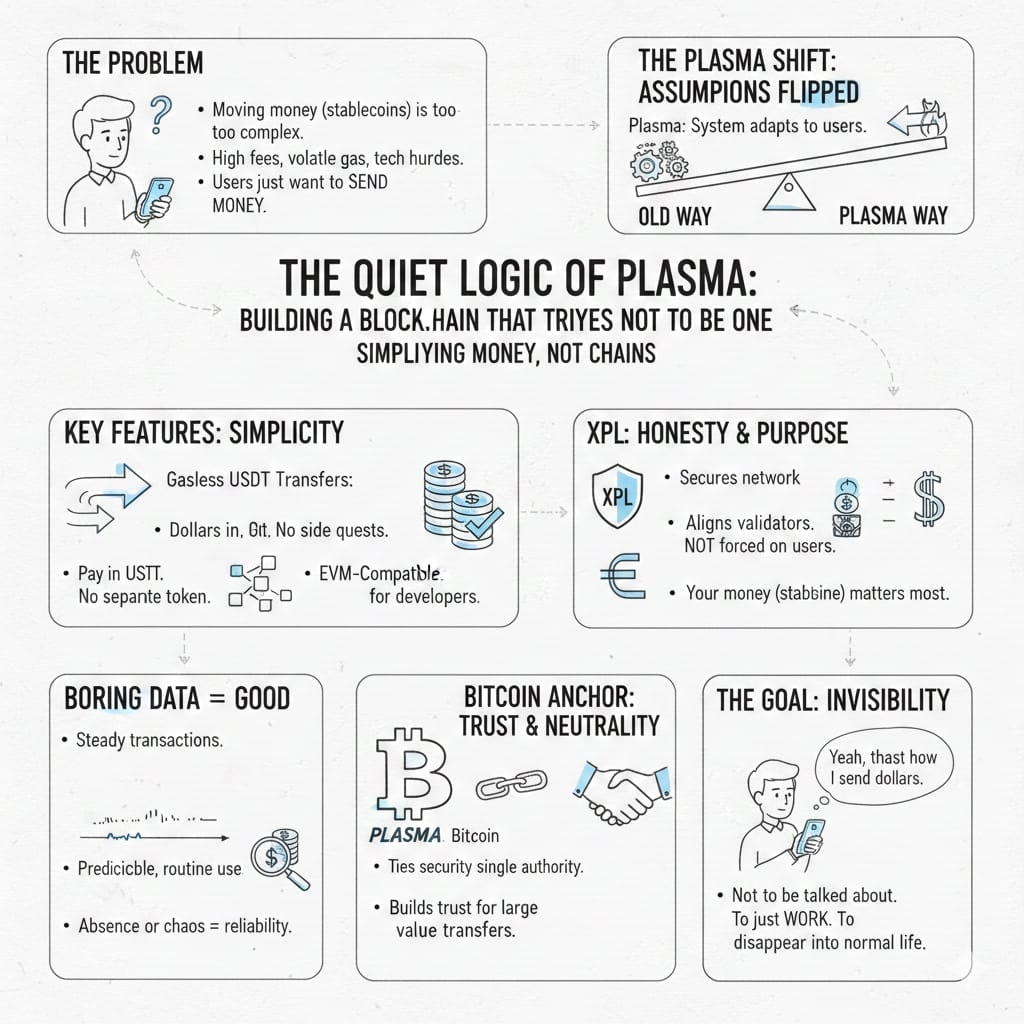
Plasma begins from a very human assumption: most people don’t want to “use a blockchain.” They want to send money. Especially stablecoins. For millions of users, USDT isn’t a trading tool or a DeFi toy—it’s salary, savings, remittance, or protection against inflation. When money plays that role, every extra step becomes friction, and every surprise fee feels like a bug.
A Chain That Assumes You Don’t Care About Chains
Most networks assume users are willing to learn the rules of the system: buy a volatile gas token, understand fee markets, watch prices fluctuate just so a transaction doesn’t fail. Plasma flips that assumption on its head. It treats that entire mental burden as unnecessary.
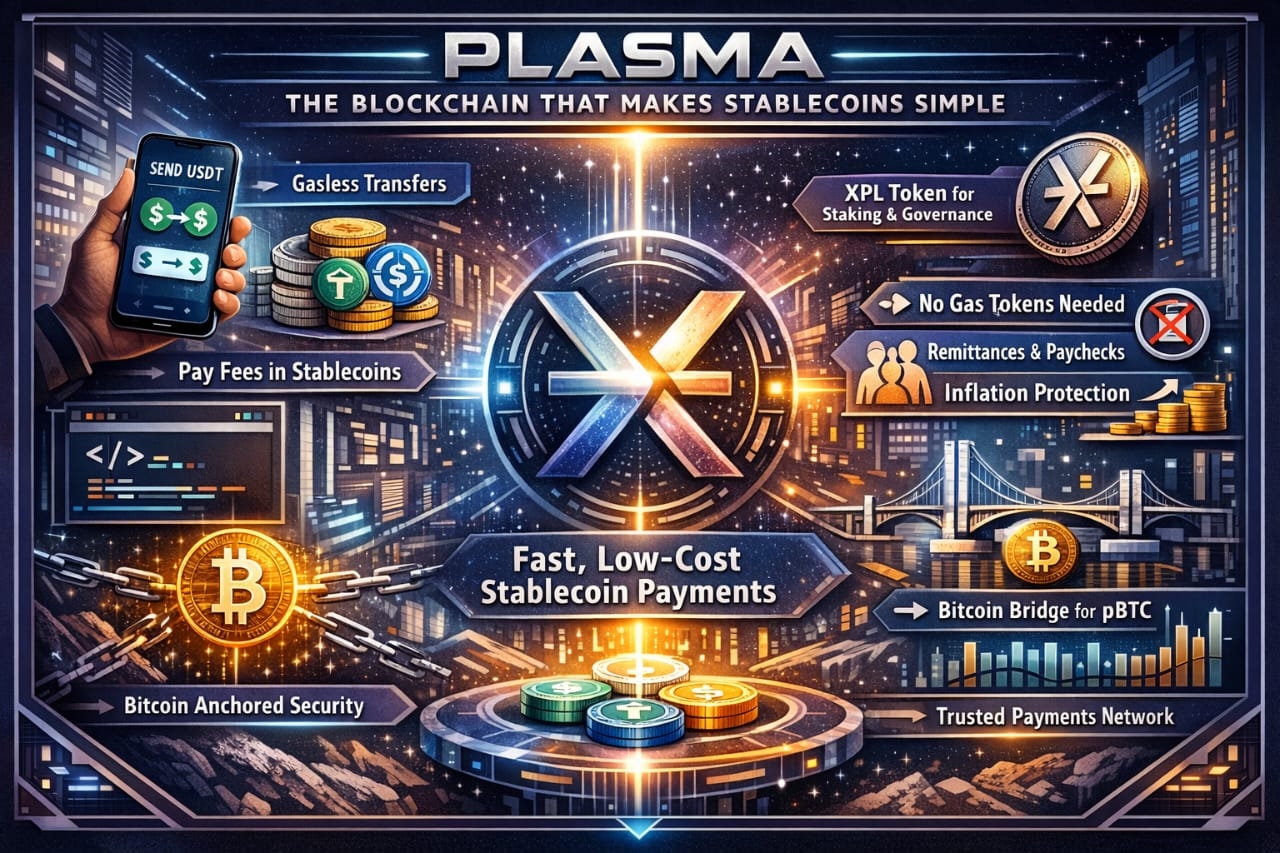
Gasless USDT transfers aren’t framed as a marketing gimmick. They’re an admission that the current model is backwards. If someone is sending digital dollars, the system should respect that mental model. Dollars in, dollars out—no side quests required.
Importantly, Plasma doesn’t promise that everything is free. That would be unrealistic. Instead, it draws a clear line: simple person-to-person transfers of stable value should not punish users with setup friction. That’s how payment systems think. Banks don’t ask you to buy a separate currency before moving your own money. Plasma is quietly aligning blockchain behavior with that reality.
Letting People Pay Fees the Way They Think
Once you move beyond basic transfers, Plasma continues to meet users where they are. Fees can be paid in stablecoins. That sounds like a small design choice until you consider the impact. No tracking another token. No worrying about volatility just to interact with an app. No explaining “gas” to someone who only wants the product to work.
Behind the scenes, the chain handles the complexity. Up front, the user sees a familiar unit of account. That separation—complexity inside, simplicity outside—is how mature financial infrastructure usually evolves.
A Rare Honesty About Its Own Token
One of the more refreshing aspects of Plasma is how it treats its native token, XPL. It exists, it matters, and it has a clear job: securing the network, aligning validators, and supporting the system’s long-term health.
What it doesn’t do is force itself into every user interaction. Plasma doesn’t pretend the token is what people actually want to hold day-to-day. The message is subtle but important: the network’s token secures the rails; your stablecoin is what you actually care about. That separation feels unusually grown-up in a space that often blurs utility and speculation.
Boring Data Is a Feature, Not a Bug
If you look at Plasma’s on-chain behavior, it doesn’t scream excitement. You don’t see wild spikes driven by speculative farming or novelty apps. Instead, you see something quieter: steady transactions, lots of stablecoin activity, and usage patterns that look repetitive and routine.
For payments infrastructure, that’s exactly the point. Financial rails don’t need to be exciting. They need to be predictable. The absence of chaos is a signal, not a weakness.
Choosing Familiar Tools on Purpose
Plasma’s decision to remain EVM-compatible isn’t about chasing developers—it’s about not asking them to relearn the world. New languages and novel execution models sound impressive, but they often slow adoption to a crawl. Plasma’s innovation isn’t in reinventing how smart contracts are written. It’s in redefining what the base layer should absorb so builders don’t have to.
The unspoken promise to developers is simple: build normally; we’ll make the money part less painful.
Why Bitcoin Matters Here—Even Emotionally
The Bitcoin-anchoring narrative isn’t just a technical choice. It’s symbolic. Bitcoin represents neutrality in crypto’s collective imagination—no issuer, no company, no country in control. By tying its security story to Bitcoin, Plasma signals that stablecoin settlement shouldn’t feel like it sits under any single authority’s thumb.
For institutions and individuals moving meaningful amounts of money, that sense of neutrality matters. It builds trust in a way raw performance metrics never quite do.
What Plasma Is Actually Trying to Become
Plasma doesn’t feel like an experiment chasing headlines. It feels like an attempt to rebuild the dull parts of finance correctly: settlement, transfers, fees, predictability. Those systems are invisible when they work and painfully obvious when they don’t.
If Plasma succeeds, it won’t be because people love talking about Plasma. It will be because people stop noticing it entirely.
They’ll just say, “Yeah, that’s how I send dollars.”
And in a space obsessed with attention, building something that disappears into normal life might be the most ambitious goal of all.