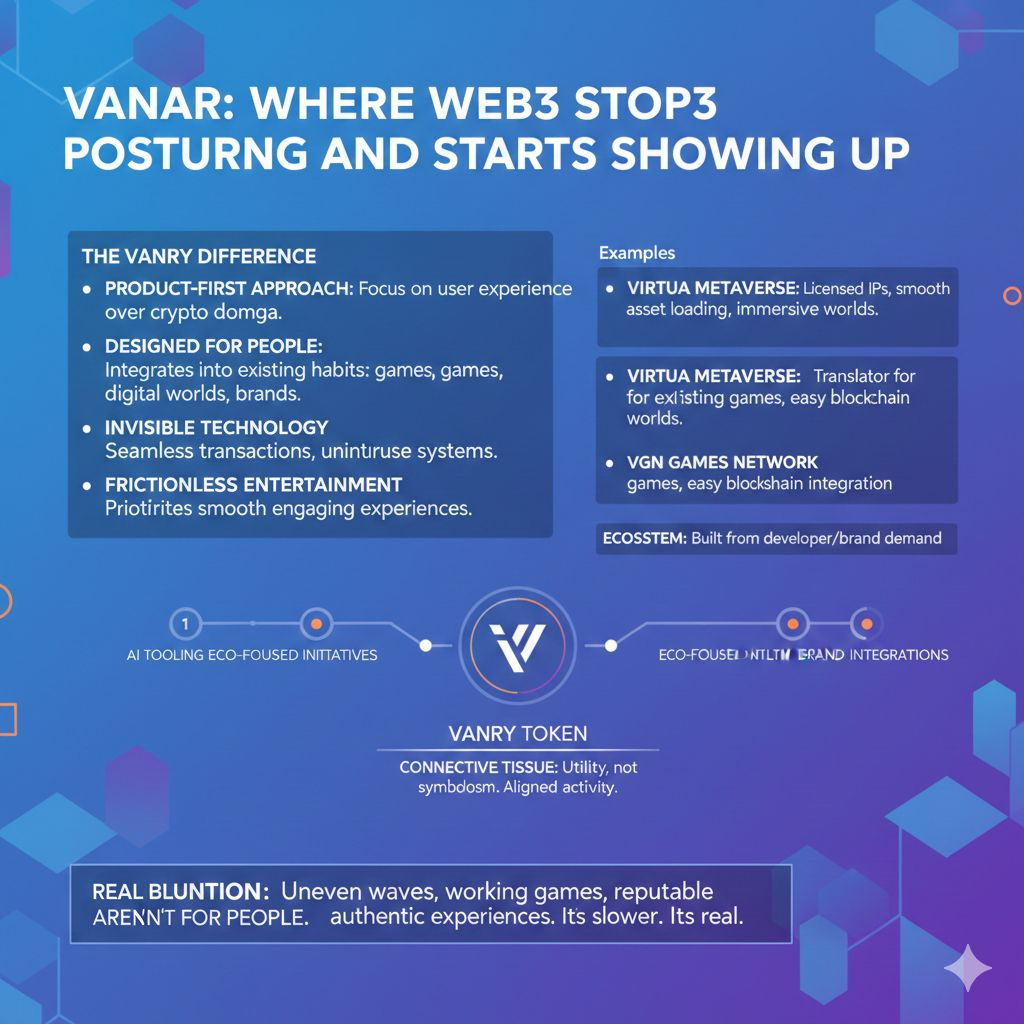
Vanar doesn’t talk like a blockchain trying to impress other blockchains. It behaves more like a product team that got tired of watching good ideas bounce off real people.That difference matters.
Most Layer 1s still assume users will adapt to crypto. Wallets first, explanations later. Vanar flips that instinct. The chain is designed around how people already spend time: games, digital worlds, branded experiences, things that don’t require a crash course just to participate. If you’ve ever watched someone close an app the moment a seed phrase appears, you understand the design pressure here.
The team’s background leaks into the product in small ways. Not in marketing slogans, but in choices. Systems that don’t interrupt play. Transactions that stay invisible unless you actually need to see them. Infrastructure that doesn’t insist on being the star of the show. In entertainment, friction kills faster than bugs. Vanar seems built by people who learned that lesson the hard way.
Virtua Metaverse is a good example. It doesn’t feel like a tech demo pretending to be a world. It feels like a place designed to host licensed IP without breaking immersion every five minutes. I noticed once—small thing—that asset loading stayed smooth even during a busy event. No pop-ups, no awkward waits. That’s not accidental. That’s someone caring about the moment a user decides whether to stay or leave.
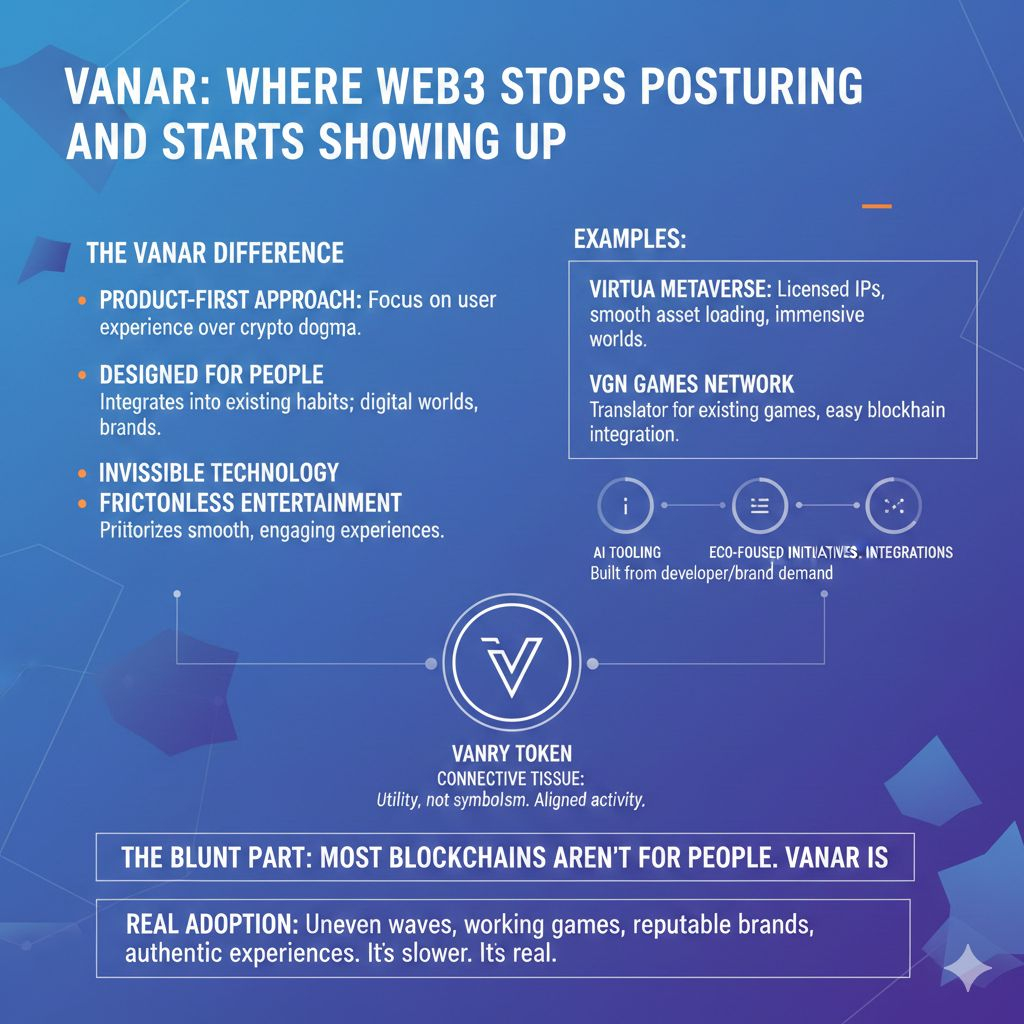 Then there’s the VGN games network, which quietly solves a problem most chains dodge: studios don’t want to rebuild everything just to go on-chain. VGN acts less like a gatekeeper and more like a translator, letting games keep their identity while gaining blockchain rails in the background. No purity tests. Just shipping.
Vanar’s broader ecosystem stretches into AI tooling, eco-focused initiatives, and brand integrations, but it doesn’t bundle them into a grand narrative. They exist because brands and developers asked for them. That’s the tell. Real adoption usually looks messy at first, spread across use cases that don’t fit neatly into one deck.
The VANRY token sits underneath all of this, not as a mascot, but as connective tissue. Utility over symbolism. Incentives aligned with activity, not noise. Tokenomics won’t save a weak product anyway. Anyone who tells you otherwise is selling something.Here’s the blunt part: most blockchains aren’t built for people, they’re built for other blockchains. Vanar clearly isn’t chasing that crowd.
There’s also an honesty in how the platform grows. No rush to declare victory. No pretending that “next billion users” arrive overnight. Adoption comes in uneven waves, through games that work, brands that care about reputation, and experiences that don’t feel like experiments. It’s slower. It’s real.One sentence here won’t be perfect because that’s how thinking actually goes sometimes.
Vanar feels like infrastructure that learned to stay quiet at the right moments. When technology stops demanding attention, people finally start paying attention to what they’re doing instead. That’s usually when things begin to stick.