
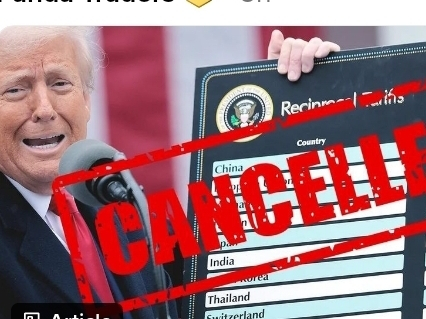
🧠 What the Supreme Court Actually Did
Date: February 20, 2026
The Court struck down the broad tariffs imposed under the 1977 International Emergency Economic Powers Act (IEEPA), ruling that the law does not authorize the president to impose tariffs.
👉 Decision: 6–3
📌 Majority Opinion: Chief Justice John Roberts
📌 Joined the Majority:
Conservatives: Neil Gorsuch, Amy Coney Barrett
Liberals: (remaining five)
📌 Dissenters:
Brett Kavanaugh
Clarence Thomas
Samuel Alito
Key Legal Point:
The Court framed this as a separation-of-powers issue — taxes and tariffs are Congress’s authority. The president needs clear statutory authorization for extraordinary executive powers like imposing tariffs.
🔥 Why This Matters
This is a major constitutional check on executive authority over trade policy. The decision significantly restricts the president’s ability to use broad emergency powers to impose sweeping tariffs.
📉 What Happens Next
💰 Potential Refunds Are Huge
Economists at the Penn-Wharton Budget Model estimate the IEEPA tariff revenue at more than $175 billion (up to ~$179 billion since February 2025).
That’s a massive pool in play for refund claims.
🧾 Refunds Won’t Be Automatic
The Supreme Court did not provide a refund process.
Trade courts and lower courts now will sort out how refunds happen — if at all — and that could take years, not months.
Reuters reports 1,000+ lawsuits already filed seeking refunds, with more expected. This legal battle is just beginning.
⚖️ The Administration Still Has Tools
The White House can pivot to other tariff authorities, but they’re narrower and slower:
National security tariffs (Section 232)
Retaliatory duties after trade investigations (Section 301)
Temporary tariffs under Section 122 (can reach ~15% for 150 days)
These are more constrained than the now-invalid IEEPA approach.
📊 Market & Economic Impact
📈 Markets Reacted
On the ruling day:
U.S. stock indexes jumped
U.S. dollar weakened Markets saw reduced tariff risk — at least in the short term.
📉 Tariff Rates Could Fall
Yale Budget Lab estimates that if replacement tariffs don’t land soon, the effective U.S. tariff rate could fall sharply (example cited: ~17% → ~9.1%).