Introduction Why Fogo Is Starting to Get Attention
I am seeing a shift happening in blockchain right now. For years most networks tried to be everything at once. They promised decentralization, scalability, security, and global infrastructure all in one system. But while they chased those big goals, something important got lost along the way. The experience often felt slow.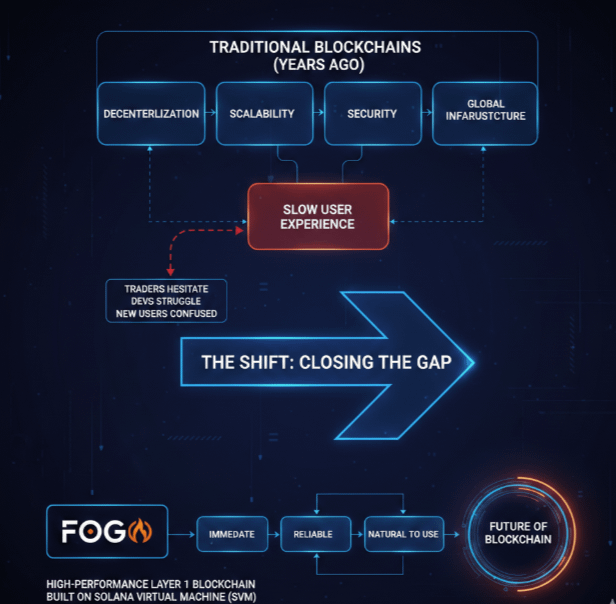
If a blockchain does not feel fast, users notice it immediately. Traders hesitate to execute. Developers struggle to build responsive applications. New users feel confused because the system does not behave like the modern digital world they are used to.
That is where Fogo enters the picture.
Fogo is a high performance Layer one blockchain built on the Solana Virtual Machine. But its story is not just about technology. It is about trying to close the gap between how fast the world moves and how fast blockchain can respond.
The project is built on the idea that the future of blockchain will belong to networks that feel immediate, reliable, and natural to use.
What Fogo Is and What It Wants to Achieve
Fogo is designed as a performance focused blockchain that prioritizes speed, execution stability, and real time activity. Instead of building an entirely new developer environment, it uses the Solana Virtual Machine so that applications can be deployed with familiar tools and logic.
This choice lowers barriers for developers. If they can move into a new network without rewriting everything, adoption becomes easier and faster.
Fogo is especially focused on use cases where speed truly matters. These include decentralized trading, financial infrastructure, payment systems, and applications that require instant response times.
The project is not trying to be a chain for everything. It is trying to be the chain that performs best where timing matters most.
Why Using the Solana Virtual Machine Matters
By building on the Solana Virtual Machine, Fogo inherits a system known for parallel transaction processing and high throughput. This allows the network to handle many operations at the same time instead of forcing them into a slow sequence.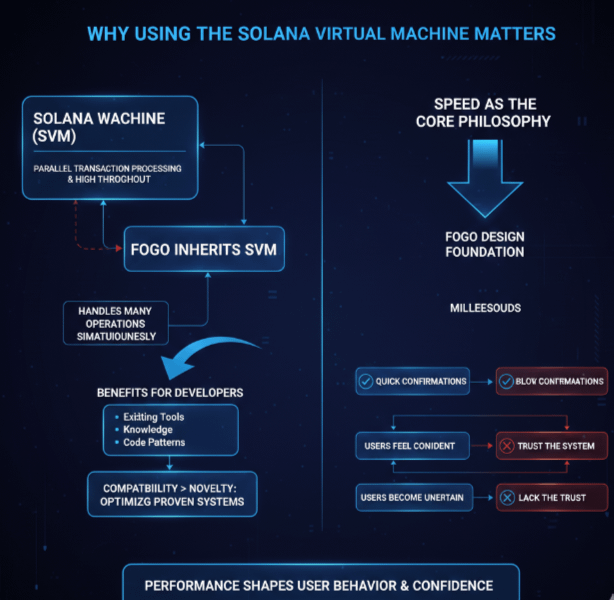
For developers, this means they can bring existing tools, knowledge, and code patterns into the ecosystem without starting from zero.
We are seeing a trend in modern blockchain design where compatibility becomes more valuable than novelty. Instead of creating completely new environments, projects are optimizing proven systems to remove friction.
Fogo fits into that trend by focusing on execution improvements rather than reinvention.
Speed as the Core Philosophy
What makes Fogo stand out is that speed is not treated as just one feature among many. It appears to be the foundation of the entire design.
The network aims to deliver extremely fast block confirmation times, targeting performance measured in milliseconds. That difference may sound technical, but it changes how the network feels to use.
If confirmations happen quickly, users feel confident.
If they take too long, users become uncertain.
That psychological reaction affects whether people trust the system with real value.
Fogo is built with the understanding that performance is not just technical efficiency. It shapes user behavior and confidence.
Built for Real Time Financial Activity
Many blockchains position themselves around gaming, digital collectibles, or experimental social platforms. Fogo seems to place financial infrastructure closer to the center of its vision.
Markets move constantly. Prices shift in seconds. Liquidity can change instantly. If a blockchain wants to support serious financial activity, it must match that pace.
Fogo aims to support environments where execution fairness, reliability, and speed are critical. This includes decentralized trading systems, asset transfers, and applications where timing directly affects outcomes.
If blockchain wants to compete with traditional financial infrastructure, this is exactly the type of performance focus it needs.
Technology Direction and Network Design
Fogo’s architecture combines several performance oriented design choices.
The use of parallel execution allows multiple transactions to be processed at the same time, improving throughput and reducing congestion. The network also emphasizes efficient validator coordination to minimize delays in block production and confirmation.
There is also a focus on high performance client infrastructure, which improves how nodes communicate and process data. This contributes to lower latency and more stable execution under heavy load.
Together these components show that the project is trying to engineer speed directly into the protocol rather than relying on marketing claims.
The Role of the Native Token
Like most Layer one networks, Fogo’s native token plays several roles inside the ecosystem.
It is used to pay transaction fees, support validator staking, and coordinate network security. It also serves as a mechanism for governance and ecosystem incentives.
As more applications deploy on the network, the token becomes increasingly integrated into everyday activity. Its value is connected to how widely the infrastructure is used rather than just speculation alone.
In that sense, the token becomes a reflection of network adoption and participation.
Where Fogo Stands Today
Fogo is still in an early stage of growth, which means its future depends heavily on developer adoption, ecosystem expansion, and consistent performance delivery.
At this stage the focus appears to be on strengthening infrastructure, attracting builders, and proving that the network can handle real world activity reliably.
Every successful blockchain once passed through this phase. Some grew into major ecosystems, while others faded quietly. The difference usually comes down to execution and community adoption.
Fogo is now at that critical moment where the foundation exists and the next step is proving long term relevance.
Final Thoughts Why Fogo Feels Important
I do not see Fogo as just another Layer one network trying to compete for attention. I see it as part of a larger movement in blockchain design.
The first generation of blockchains focused on decentralization.
The second generation focused on programmability.
Now we are entering a phase where execution performance is becoming the main battleground.
If blockchain is going to become everyday infrastructure, it must feel as responsive as the digital world people already live in.
Fogo is built around that idea.
It may not solve everything. No network does. But by focusing on speed, stability, and real time usability, it is aiming at one of the most important problems blockchain still faces.
And sometimes the projects that focus on one real problem instead of many theoretical ones are the ones that quietly shape the future.